Putin’s Iran Peace Channel: Moscow Carries Tehran’s Message to Trump, but the Deal Remains Unclear
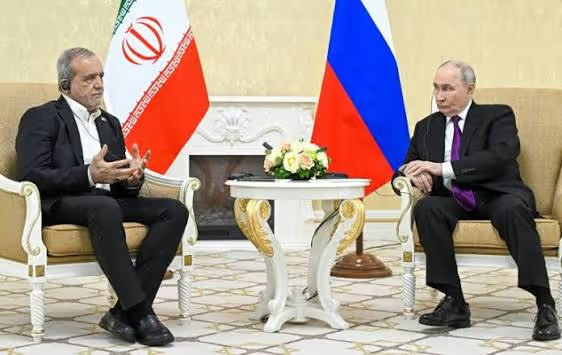
Russia has announced a new diplomatic exchange involving the United States and Iran, with President Vladimir Putin conveying Tehran’s position on a possible resolution to the ongoing US–Iran war to US President Donald Trump. The Kremlin says the communication was made with the backing of Iranian President Masoud Pezeshkian.
The announcement places Moscow in the role of an intermediary at a time when efforts to end the conflict remain stalled. But the message itself has not been made public in detail, and there is no confirmed indication that Washington and Tehran have reached an agreement.
The key distinction: Putin has reportedly communicated Iran’s position to Trump. That is a diplomatic development, not confirmation of a ceasefire, a signed peace agreement or a breakthrough in negotiations.
What the Kremlin Says Happened
On Saturday, October 10, Kremlin spokesman Dmitry Peskov said Putin had conveyed the Iranian side’s views on a possible resolution of the conflict to Trump. The statement was reported by Reuters through coverage published by The Times of Israel and other international news outlets.
According to the Kremlin account, the communication took place in coordination with Pezeshkian. The announcement did not provide a detailed account of Iran’s position, identify the specific terms being discussed or explain how the American president responded.
Those missing details matter. Without the proposal itself or a response from Washington, it is not possible to establish whether the exchange concerned immediate de-escalation, the terms of a broader settlement or preliminary diplomatic messaging.
Why Russia Is Carrying Iran’s Message
Moscow and Tehran have developed closer political, economic and military ties in recent years. Their relationship has included cooperation in areas such as trade, defence and diplomatic coordination, despite sanctions imposed on both countries by Western states.
Putin’s latest communication shows that Russia is seeking a role in discussions over the conflict involving Iran and the United States. By passing Tehran’s position to Washington, Moscow can offer a channel through which the two sides may communicate indirectly even when direct negotiations face difficulties.
However, acting as an intermediary does not automatically mean Russia can secure a settlement. Its influence depends on whether both sides consider the channel useful and whether the issues under discussion can be resolved through negotiation.
The Pezeshkian Meeting Came Before the Trump Message
The diplomatic exchange followed a meeting between Putin and Pezeshkian in Turkmenistan on October 8, held on the sidelines of a summit of the Commonwealth of Independent States. During that meeting, Putin said Russia was prepared to do what it could to help bring the conflict to an end.
The Russian president also spoke positively about the development of relations between the two countries. The meeting provided an opportunity for the leaders to discuss the conflict before the Kremlin announced that Iran’s position had been relayed to Trump.
The sequence is significant because it establishes a clear diplomatic connection: Putin met Pezeshkian, publicly offered Russia’s assistance and subsequently communicated Iran’s position to the US president. It does not, however, establish that the three governments have agreed on a common framework for ending the war.
Why the Peace Process Remains Uncertain
Diplomatic efforts to end the conflict have faced substantial obstacles. Earlier negotiations and attempts to establish a framework for ending hostilities have not produced a durable settlement, while renewed military action has complicated efforts to restore talks.
Reporting by AFP described diplomatic efforts as stalled. The broader dispute involves questions of security, military activity and the conditions under which the parties would agree to end the conflict. The latest Kremlin statement did not explain how Iran’s position addresses those questions.
A message passed between leaders can help clarify positions or open a route for further communication. Turning that exchange into an agreement would require substantive negotiations, decisions by the governments involved and a way to implement any terms they accept.
What We Know—and What We Still Do Not Know
Confirmed in the published reports
- Putin conveyed Iran’s position on a possible resolution of the conflict to Trump.
- The Kremlin said the communication was coordinated with Pezeshkian’s backing.
- Putin and Pezeshkian met in Turkmenistan on October 8.
- Russia has publicly offered to help bring the conflict to an end.
Still unclear
- The full contents of Iran’s position or any specific peace proposal.
- Trump’s response to the message.
- Whether a new round of negotiations will follow.
- Whether the parties are closer to a ceasefire or a comprehensive settlement.
What the Announcement Means for Washington and Tehran
For Washington, the message may provide another opportunity to assess Tehran’s position through a diplomatic channel. For Tehran, using Russia to convey its views may help communicate its position while maintaining a role for a close international partner. These are possible diplomatic implications, not confirmed descriptions of either government’s intentions.
The practical significance will depend on what happens next. If the message leads to substantive exchanges, the announcement could become an early step in a renewed diplomatic effort. If no follow-up emerges, it may remain a limited communication between leaders rather than the beginning of a new peace process.
It is also important to distinguish diplomatic activity from a change on the battlefield. The Kremlin announcement did not establish that military operations had stopped or that either side had accepted new conditions.
What to Watch Next
The next meaningful indicators will be official statements from Washington and Tehran, any confirmation of follow-up talks and details about the terms being discussed. A formal proposal, a public response or an agreed negotiating framework would provide clearer evidence of whether the diplomatic exchange is producing progress.
Until those details emerge, the announcement should be understood as a communication of Iran’s position rather than proof of an imminent agreement. The Kremlin has confirmed that a message was passed, but the substance and consequences of that message remain uncertain.
A Diplomatic Opening, Not Yet a Peace Breakthrough
Putin’s role in relaying Iran’s position gives Moscow a visible place in the latest diplomatic activity surrounding the US–Iran war. It also creates a possible channel for further communication at a time when negotiations have struggled to move forward.
But the most important questions remain unanswered: what exactly does Tehran want, how does Washington respond, and are both sides willing to negotiate terms they can accept? Until those questions are addressed, the message is a development to watch, not evidence that peace is near.
Keywords:
Related Posts