A Third Carrier in the Gulf’s Shadow: Washington Reinforces Its Naval Presence as Iran Tensions Rise
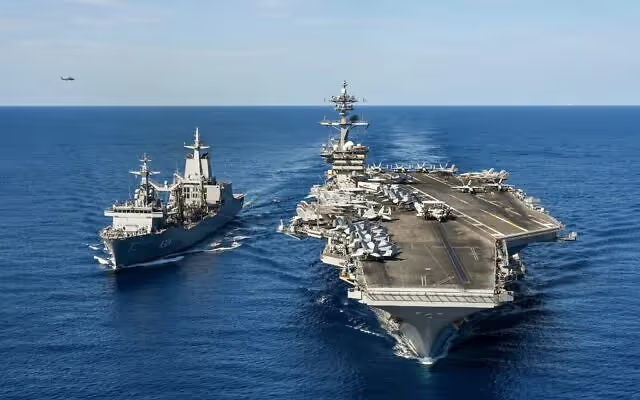
The United States has significantly strengthened its naval presence in the Middle East after a third aircraft carrier, the USS Theodore Roosevelt, arrived in the region. The deployment brings thousands of additional American military personnel and adds another powerful carrier strike group to an already substantial force. The move comes as the conflict with Iran remains unresolved, negotiations have stalled and uncertainty continues around the strategically important Strait of Hormuz. Although Washington has not announced a decision to resume large-scale military strikes, the additional deployment gives the Trump administration greater military options as it maintains pressure on Tehran.
The arrival of another American aircraft carrier is a significant development in an already tense regional environment. Aircraft carriers are among the most powerful instruments of US military projection, allowing American forces to operate aircraft, coordinate naval operations and maintain a presence far from domestic bases.
The latest deployment also sends a message about Washington's willingness to maintain substantial military capabilities in the region while the future of the conflict remains uncertain. However, the presence of another carrier does not automatically mean that a new offensive is imminent.
Key Details at a Glance
- New arrival: USS Theodore Roosevelt has arrived in the Middle East with its accompanying strike force.
- Three US carriers: It joins the USS George H.W. Bush and USS George Washington.
- Additional personnel: The Roosevelt brings thousands of additional American military personnel to the region.
- Naval presence: US forces in the Arabian Sea include destroyers, cruisers and other naval vessels.
- Strategic objective: The expanded presence gives Washington additional military options while pressure on Iran continues.
- Diplomatic situation: Negotiations remain stalled over Iran's nuclear programme and the US naval blockade.
- Major concern: The Strait of Hormuz remains a dangerous shipping route amid reports of attacks, mines and disruptions to commercial traffic.
USS Theodore Roosevelt Joins Two Other American Aircraft Carriers
US Central Command confirmed the arrival of the USS Theodore Roosevelt, a Nimitz-class nuclear-powered aircraft carrier, in the Middle East. The carrier and its accompanying strike force had departed San Diego in September before making the journey towards the region.
The Roosevelt now joins two other American aircraft carriers operating in the region: the USS George H.W. Bush and the USS George Washington. Having three carrier strike groups deployed in the Middle East is unusual and represents a substantial concentration of American naval power.
The USS George H.W. Bush arrived in the region earlier in the year, while the USS George Washington was deployed later. Their continued presence, combined with the Roosevelt's arrival, gives the United States multiple carrier-based forces capable of supporting military operations across a wide geographical area.
According to the Associated Press, the Roosevelt's arrival also adds to a wider naval formation that includes 13 destroyers, two cruisers and a littoral combat ship operating in the Arabian Sea. Two additional destroyers are positioned in the Red Sea.
These vessels serve different roles, including air defence, surveillance, maritime security and support for carrier operations. Together, they form a powerful naval network capable of maintaining a sustained American presence across important maritime routes.
Why Three Aircraft Carriers in One Region Is Significant
Aircraft carriers allow the US Navy to deploy military aircraft without depending entirely on land-based airfields. Each carrier operates as the centre of a larger strike group, supported by destroyers, cruisers, aircraft and thousands of sailors.
Their presence provides Washington with flexibility. Carrier-based aircraft can conduct surveillance, patrol maritime areas, support air operations and, if authorised, carry out strikes against military targets.
Deploying three carrier strike groups in the same region therefore represents more than a symbolic show of force. It provides the United States with additional operational capacity and the ability to sustain a significant naval presence.
The deployment is also notable because the US Navy had previously operated three carrier strike groups in the Middle East in April, the first such concentration since 2003, according to the Associated Press.
Nevertheless, military deployments can serve several purposes. They may support deterrence, protect shipping, strengthen regional security arrangements or prepare for possible military operations. The presence of three carriers alone does not establish which option Washington will ultimately choose.
Trump Keeps Military Options Open as Iran Conflict Continues
The arrival of the Roosevelt comes at a time when President Donald Trump has sent mixed signals about the future of the conflict with Iran.
On one hand, Trump has warned that American forces remain prepared to conduct additional military operations if circumstances require it. He has described the US military as ready to respond and indicated that he would not hesitate to act if negotiations or other developments failed to produce the desired outcome.
On the other hand, the president has also suggested that another major round of strikes may not be necessary. Following discussions with Qatar's prime minister, Trump described the military side of the conflict as effectively over and indicated that he considered further large-scale action unlikely.
These contrasting statements reflect the uncertainty surrounding Washington's next move. The administration appears to be maintaining military pressure while leaving room for diplomacy, although the situation could change if negotiations collapse or attacks escalate.
The additional carrier gives the administration more options, but a decision to use that force would involve political, military and economic consequences extending far beyond the immediate region.
Negotiations Remain Stalled Over Iran's Nuclear Programme
Diplomatic efforts to bring the conflict to a lasting end have faced significant obstacles. One of the central disagreements concerns Iran's nuclear programme and the conditions required for a broader agreement.
Trump has insisted that Iran's nuclear activities must be addressed as part of any deal intended to end the conflict. The US administration has maintained that preventing Iran from developing nuclear weapons is a central objective.
Tehran, meanwhile, has demanded that Washington address several of its conditions, including the lifting of the naval blockade affecting Iranian shipping and oil exports.
The disagreement has made progress difficult. Washington wants an agreement that addresses its security concerns, while Iran is seeking relief from restrictions and pressure imposed by the United States.
With negotiations stalled, the military deployment becomes part of a wider strategy involving economic pressure, naval enforcement and diplomatic bargaining.
The Strait of Hormuz Remains a Major Flashpoint
One of the most serious concerns in the ongoing conflict is the security of the Strait of Hormuz, a narrow maritime passage connecting the Persian Gulf with the Gulf of Oman and the wider Arabian Sea.
The waterway is among the world's most important energy shipping routes. Before the conflict, approximately one-fifth of global oil passed through the strait, making any prolonged disruption a major concern for energy markets and international trade.
Commercial shipping has faced serious risks during the conflict. Reports of attacks, possible naval mines and damage to oil tankers have increased concerns about the safety of vessels attempting to cross the waterway.
Iranian state television, citing the country's Revolutionary Guard naval forces and army, warned shipping companies that a US-supported route through the strait remained dangerous because of mines.
The Revolutionary Guard's navy claimed that six oil tankers had been damaged by mines since Sunday. These claims have not been independently established in full, but they illustrate the level of danger being reported around the waterway.
Separately, the United Kingdom Maritime Trade Operations reported that a projectile struck a tanker attempting to transit the strait, causing a fire in its engine room. No casualties were reported in that incident.
The continuing disruption has affected commercial shipping. Independent maritime assessments cited by the Associated Press indicated that traffic through the strait remained below one-third of its pre-war level.
US Naval Blockade Adds to Pressure on Tehran
The American naval presence in the region is also connected to the blockade of Iranian shipping. US forces have been enforcing restrictions intended to prevent Iranian oil and other shipments from moving freely through the maritime network.
The blockade is an important source of economic pressure on Tehran because oil exports are a major part of Iran's economy. Restricting those exports can affect government revenue and the country's ability to conduct international trade.
US Central Command said American forces had redirected 150 merchant vessels and disabled five since the blockade began in June, according to the Associated Press.
The enforcement effort has also increased the risk of confrontation at sea. Merchant ships, naval vessels and other commercial traffic are operating in an environment where military activity and shipping restrictions overlap.
The presence of additional American warships could strengthen the ability of US forces to monitor maritime activity and support the blockade. At the same time, it increases the number of military assets operating in an area where a single incident could trigger a wider confrontation.
What Is the USS Theodore Roosevelt?
The USS Theodore Roosevelt, also known as CVN-71, is a Nimitz-class nuclear-powered aircraft carrier operated by the United States Navy. It was commissioned in 1986 and named after the 26th president of the United States.
The carrier is designed to support a wide range of naval and aviation operations. It can carry thousands of sailors and operate a large air wing consisting of fighter aircraft, surveillance platforms and helicopters.
Its capabilities allow the US Navy to maintain air operations far from American territory. The carrier can also coordinate with other naval vessels, support maritime security missions and provide a mobile base for military aircraft.
The Roosevelt has a long history of deployments, including operations connected to earlier conflicts and military missions. Its arrival in the Middle East adds another experienced carrier platform to the American naval force operating in the region.
More Marines Are Also Expected in the Region
The Roosevelt's deployment is connected to a larger amphibious force that includes the USS Makin Island amphibious readiness group, along with the amphibious transport ships USS John P. Murtha and USS Anchorage.
The group includes approximately 2,000 Marines. However, the Associated Press reported that these amphibious ships had not yet arrived in the region at the time of its report.
Amphibious readiness groups are designed to transport and support Marine forces during a range of missions. These can include evacuations, humanitarian assistance, maritime security and amphibious operations.
Their deployment does not necessarily indicate that a ground operation is planned. Instead, it provides the United States with additional flexibility should military or emergency requirements arise.
Domestic Political Pressure Complicates Trump's Iran Strategy
The military developments are taking place against a difficult domestic political background for the Trump administration.
The Associated Press reported that the third carrier arrived nearly two weeks after midterm elections in which Republicans suffered major losses. The Iran conflict and its economic consequences were among the issues contributing to public dissatisfaction.
Vice President JD Vance also publicly criticised the war's political consequences, posting that the conflict was the reason for the Republican losses.
Trump has continued to defend the decision to confront Iran, arguing that the military campaign was justified. However, the political cost of a prolonged conflict could make future decisions more difficult.
The administration must balance military objectives with public opinion, economic pressures and the possibility of a wider regional escalation. A decision to resume major strikes could intensify those pressures, while an agreement with Iran could require compromises on issues that Washington considers strategically important.
Could the New Deployment Lead to Another Military Escalation?
The arrival of the USS Theodore Roosevelt has naturally raised questions about whether the United States is preparing to resume large-scale attacks against Iran.
The deployment increases Washington's ability to conduct military operations if the president authorises them. It also strengthens the country's capacity to monitor the region, protect selected maritime routes and respond to threats against American forces.
However, the deployment should not be treated as confirmation that another offensive is imminent. Aircraft carriers can remain in a region for deterrence and security missions without being used to launch a new campaign.
The most important indicators to watch are the progress of diplomatic negotiations, changes in the naval blockade, further attacks on commercial shipping and any new military instructions issued by Washington or Tehran.
The situation remains especially sensitive because the Strait of Hormuz is essential to international energy transportation. Any escalation that significantly disrupts the route could affect oil prices, shipping costs and economies far beyond the Middle East.
What Happens Next?
The immediate focus will be on how the United States uses its expanded naval presence and whether diplomatic efforts can make progress.
The three American carrier strike groups provide Washington with considerable military flexibility. Yet the administration must also consider the risks of a prolonged confrontation, particularly as commercial shipping continues to face threats and the economic consequences of the conflict remain significant.
Iran's response will also be important. Tehran has continued to oppose the American blockade and has warned shipping companies about the dangers of navigating the Strait of Hormuz. Any further attacks or military incidents could increase pressure on both sides.
For regional governments, the priority remains preventing the conflict from spreading and protecting vital trade routes. Countries dependent on energy imports and maritime commerce have a direct interest in restoring stability.
A Powerful Signal, but Not Yet a Decision for War
The arrival of the USS Theodore Roosevelt represents a major reinforcement of American naval power in the Middle East. With three aircraft carriers operating in the region, Washington has established an unusually strong military presence at a moment when the future of its confrontation with Iran remains uncertain.
The deployment gives President Trump additional options, strengthens the naval blockade and increases the United States' ability to respond to developments around the Strait of Hormuz. But it also comes with risks: a larger concentration of military forces can create more opportunities for confrontation, miscalculation and escalation.
For now, the central question is whether the expanded military presence will help pressure Iran towards an agreement or become part of preparations for another phase of the conflict.
Three American aircraft carriers are now in the region, but their presence does not determine what happens next. The outcome will depend on decisions made in Washington and Tehran, the future of negotiations and whether one of the world's most important shipping routes can return to a safer and more predictable state.