Connecting Pattiseema with the Krishna Delta
From Krishna Delta to Pattiseema: How Godavari Water Became a Lifeline for Andhra Pradesh Farmers
Important Points
The Krishna Delta irrigation system supports approximately 13.08 lakh acres across parts of NTR, Krishna and Palnadu districts.
Reduced inflows from upstream Krishna projects have repeatedly created uncertainty for delta farmers.
The division of Andhra Pradesh in 2014 added a new dimension to the Krishna water-sharing dispute between Andhra Pradesh and Telangana.
The Pattiseema Lift Irrigation Scheme transfers surplus Godavari water into the Krishna basin through the Polavaram Right Main Canal.
The project was administratively sanctioned in January 2015 for ₹1,300 crore and commissioned in March 2016.
Pattiseema has 24 pumps with a combined designed lifting capacity of about 8,500 cusecs.
Chief Minister N Chandrababu Naidu has stated that the project can supply around 80 TMC of water annually and stabilise irrigation across nearly 13 lakh acres.
By supplying Godavari water to the Krishna Delta, water stored in the upper Krishna system can potentially be conserved for drought-prone Rayalaseema.
Although Pattiseema has supported agriculture, it has also faced criticism over expenditure, approvals, environmental compliance and its relationship with the Polavaram project.
The project has remained operational under governments led by both the TDP and YSRCP, demonstrating its practical importance to the delta.
Krishna Delta Farmers Face an Uncertain Water Future
The Krishna Delta, one of Andhra Pradesh’s most important agricultural regions, has historically depended on water flowing through the Krishna River and reaching the Prakasam Barrage. Paddy, pulses, sugarcane and several other crops are cultivated through an extensive network of canals connected to the barrage.
However, the availability of Krishna water at the required time has become increasingly uncertain. The construction and operation of reservoirs in the upper reaches of the Krishna, including the Almatti project in Karnataka, affect the timing and volume of water flowing downstream. Interstate disagreements over storage, releases and proposed irrigation projects have consequently become a major concern for Andhra Pradesh.
The bifurcation of the combined Andhra Pradesh state in 2014 further complicated the institutional arrangements governing the river. Andhra Pradesh and Telangana both depend heavily on the Krishna for irrigation, drinking water and power generation. The Krishna River Management Board was constituted under the Andhra Pradesh Reorganisation Act, 2014, to regulate and manage the river system between the successor states. Nevertheless, disagreements over allocations, project control and water releases have continued.
For farmers in the lower reaches, these disputes are not merely political or administrative matters. A delay in releasing water can postpone nursery preparation and paddy transplantation. Crops planted after a delayed water release may also remain in the fields until the cyclone-prone months, exposing farmers to a greater risk of losses from heavy rain, floods or strong winds.
The Krishna Delta command area currently extends across approximately 13.08 lakh acres in NTR, Krishna and Palnadu districts. During periods of poor rainfall and weak reservoir inflows, farmers without access to borewells are forced to wait for canal water, change their crops or abandon cultivation for the season.
Why Nagarjuna Sagar Water Is Not Always Sufficient
Traditionally, the Krishna Delta receives irrigation water through the Krishna system, including supplies released from reservoirs such as Nagarjuna Sagar, Srisailam and Pulichintala before reaching the Prakasam Barrage.
But when rainfall is inadequate in the upper catchment areas, these reservoirs may not receive enough inflow to meet every demand. Water must be divided among drinking-water requirements, power generation, upstream irrigation systems and downstream agricultural regions.
This creates a serious problem for delta farmers. They require water at the beginning of the Kharif season, particularly for paddy cultivation. Even when sufficient water becomes available later, delayed supplies can disturb the agricultural calendar.
The problem was visible again during the 2026 Kharif season. Poor inflows from Nagarjuna Sagar and Pulichintala were reported to be insufficient for the Krishna Delta, prompting the Andhra Pradesh government to resume pumping Godavari water through Pattiseema. Around eight TMC had reportedly been diverted after pumping began on July 8, providing relief to farmers waiting to begin or sustain cultivation.
Farmers’ Protests and the Demand for Irrigation Rights
Repeated water shortages have historically led farmers and agricultural organisations to demand timely releases for the Krishna Delta. Protests, demonstrations and representations before district administrations have reflected the fear that a region with a long-established canal-irrigation system could gradually lose dependable access to Krishna water.
For farming households, the consequences extend beyond the loss of a single crop. Farmers invest in seeds, fertilisers, land preparation, labour and agricultural machinery before receiving any income. When canal water fails to arrive, these investments may be lost.
Tenant farmers face an even higher risk because they must pay land rent in addition to cultivation expenses. Agricultural labourers also lose employment when sowing is delayed or acreage is reduced. Therefore, the irrigation issue affects the entire rural economy, not only landowners.
Against this background, the Pattiseema scheme was presented as an emergency and long-term response to protect the Krishna Delta while the much larger Polavaram project remained under construction.
How the Pattiseema Project Works
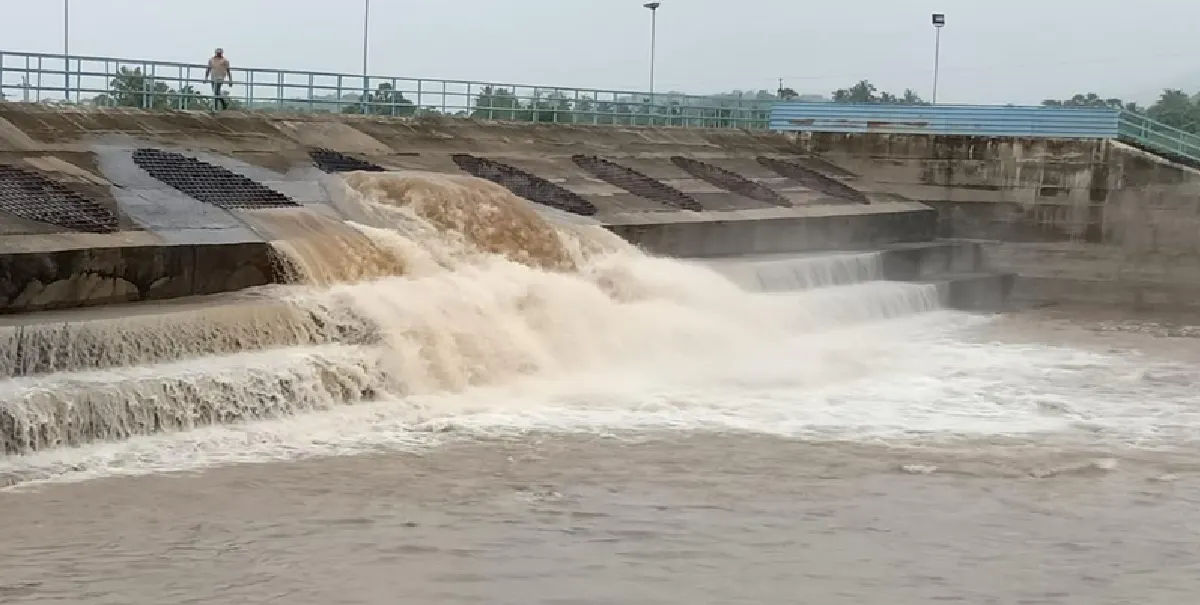
The Pattiseema Lift Irrigation Scheme draws water from the Godavari River and lifts it into the Polavaram Right Main Canal. From there, the water travels towards the Krishna River and reaches the confluence near Ibrahimpatnam, popularly known as Pavitra Sangamam.
Unlike a conventional dam, Pattiseema does not create a major storage reservoir. It is primarily a pumping and transfer system. Its purpose is to use Godavari water when the river has sufficient or surplus flows and redirect part of that water towards the Krishna basin.
The scheme is equipped with 24 pumps with a total designed capacity of approximately 8,500 cusecs. In July 2026, 20 pumps were reported to be operating, lifting approximately 7,080 cusecs. The transferred water travelled through the canal network before reaching the Prakasam Barrage and being released into the Krishna Delta canals.
The scheme was proposed after the government concluded that the Polavaram Right Main Canal could provide early benefits even before the Polavaram headworks were fully completed.
According to the Comptroller and Auditor General of India, Pattiseema received administrative sanction in January 2015 at an estimated cost of ₹1,300 crore. Construction began in March 2015, and the project was commissioned in March 2016. The CAG, however, recorded total expenditure of approximately ₹2,079.94 crore, indicating that the final financial cost was substantially higher than the original administrative sanction.
The Three Main Objectives of Pattiseema
The Pattiseema project was developed around three interconnected objectives.
1. Interlinking the Godavari and Krishna Rivers
The first objective was to transfer water between two major river basins. During periods when the Godavari carries substantial monsoon flows, part of the water can be lifted and conveyed through the Polavaram Right Main Canal into the Krishna system.
At Ibrahimpatnam, Godavari water enters the Krishna River at Pavitra Sangamam. The site has acquired symbolic importance as the meeting point of the two rivers and has also developed as a religious and tourist destination.
2. Protecting Irrigation in the Krishna Delta
The second objective was to provide an alternative source of irrigation when inflows from the upper Krishna system were insufficient or delayed.
Chief Minister N Chandrababu Naidu stated in July 2026 that Pattiseema had transferred approximately 450 TMC of Godavari water since 2015 and had helped stabilise nearly 13 lakh acres in the Krishna Delta. A separate report published a few days earlier placed the cumulative transfer at about 442 TMC, suggesting that the figures may vary according to the reporting date and measurement period.
The practical importance of the project becomes particularly visible during weak monsoon years. When Pulichintala and Nagarjuna Sagar cannot immediately provide the required quantities, Pattiseema water can supplement the Prakasam Barrage and its canal network.
3. Conserving Krishna Water for Rayalaseema
The third objective is linked to Rayalaseema, a region frequently affected by drought and rainfall variability.
The logic is that when Godavari water meets the requirements of the Krishna Delta, an equivalent quantity of Krishna water can potentially be conserved in reservoirs such as Srisailam. That conserved water may then be made available to Rayalaseema through systems including the Pothireddypadu Head Regulator and connected canals.
Therefore, Pattiseema is not a direct canal from the Godavari to every part of Rayalaseema. Its contribution is indirect: Godavari water supports the delta, while saved Krishna water may be used for drought-prone upstream regions.
The broader Polavaram project itself envisages the diversion of 80 TMC of Godavari water to the Krishna basin, along with irrigation, drinking-water and hydroelectric-power benefits.
Political Opposition and the ‘Ottiseema’ Criticism
Pattiseema was politically controversial from the beginning. YSR Congress Party leader YS Jagan Mohan Reddy and other opposition leaders questioned its cost, tendering process and usefulness. Jagan alleged irregularities in the award of project contracts and argued that Pattiseema could become unnecessary once Polavaram was completed.
The opposition mockingly referred to the scheme as “Ottiseema,” suggesting that it was an empty, wasteful or politically motivated project. Critics also pointed out that the system had no independent storage capacity and required significant electricity expenditure to operate its pumps.
The TDP government, in contrast, presented Pattiseema as an urgent intervention that could not wait for the completion of Polavaram. It argued that farmers required immediate relief and that the already constructed sections of the Polavaram Right Main Canal should be put to use.
The subsequent use of Pattiseema during the YSRCP government strengthened the argument that, despite the political criticism surrounding its construction, the scheme had become operationally important. Governments may disagree over credit, expenditure and planning, but stopping the project during a water shortage would directly affect farmers.
Audit and Environmental Concerns Cannot Be Ignored
A balanced assessment of Pattiseema must recognise both its irrigation benefits and the concerns identified by statutory institutions.
The CAG reported that the project’s total expenditure was higher than the original ₹1,300-crore sanction. It also recorded concerns relating to statutory approvals and environmental compliance.
According to the audit report, prior Central Water Commission and environmental approvals required for the new lift schemes had not been obtained before implementation. The National Green Tribunal subsequently examined the environmental issues and directed compensation, while the Andhra Pradesh government challenged related orders before the Supreme Court.
These findings do not erase the water supplied to farmers, but they demonstrate that urgency in project execution must still be accompanied by transparent procurement, financial accountability and compliance with environmental regulations.
Large water-transfer projects also require careful examination of energy costs, ecological impacts, downstream needs and interstate agreements. A scheme may provide immediate agricultural relief while still raising legitimate questions about long-term sustainability.
Relationship Between Pattiseema and Polavaram
Pattiseema was designed partly as an early-benefit arrangement while the Polavaram multipurpose project remained incomplete.
Polavaram is much larger in scale. It envisages irrigation for approximately 2.91 lakh hectares, 960 MW of hydroelectric generation, drinking-water supply to millions of people and diversion of 80 TMC to the Krishna basin. It was declared a national project under the Andhra Pradesh Reorganisation Act, 2014.
Because Polavaram involves a dam, canals, land acquisition, rehabilitation, environmental clearances and interstate submergence issues, its implementation has been significantly more complex.
Pattiseema, by contrast, could be constructed and operated relatively quickly by using the Polavaram Right Main Canal. It therefore functioned like emergency “oxygen” for a Krishna Delta facing uncertain water supplies.
However, the long-term role of Pattiseema after Polavaram becomes fully operational requires a technical and financial assessment. Decisions must consider the availability of gravity-based transfers, Godavari river levels, electricity expenses and seasonal irrigation requirements.
A Lifeline, but Not a Complete Solution
Pattiseema has demonstrated how infrastructure can provide immediate relief when conventional water sources fail to meet agricultural demand. For thousands of Krishna Delta farmers, Godavari water arriving through the project can determine whether fields are cultivated on time or left dry.
Its value lies not only in the quantity of water transferred but also in timing. Water supplied at the beginning of the agricultural season can protect investments, support rural employment and reduce uncertainty.
At the same time, Pattiseema cannot permanently resolve every Krishna water problem. Interstate allocations, upstream dam operations, rainfall variability, reservoir management, canal maintenance and the completion of Polavaram will continue to influence Andhra Pradesh’s water security.
The project should therefore be viewed as part of a larger river-basin management strategy rather than a single answer to every irrigation challenge.
Conclusion
The story of Pattiseema is ultimately the story of a state attempting to manage water scarcity by connecting a relatively water-abundant river with a stressed agricultural region.
For the Krishna Delta, the project offers an additional source of irrigation when traditional Krishna supplies are inadequate. For Rayalaseema, it creates the possibility of preserving more Krishna water in upstream reservoirs. For the government, it represents a model of river interlinking and rapid infrastructure development.
But its legacy also includes political conflict, cost questions and environmental concerns.
The clearest conclusion is that Pattiseema has become practically important to the Krishna Delta, regardless of which political party controls the government. Its future success, however, will depend on transparent management, proper maintenance, environmental compliance and cooperation among the states sharing the Krishna and Godavari rivers.
As Godavari water meets the Krishna at Pavitra Sangamam, the confluence symbolises both the promise and complexity of river interlinking: water can connect regions and protect livelihoods, but it must be managed scientifically, lawfully and equitably.
Tags:
Related Posts