38 Dead in Days: South Africa’s Weekend Shootings Turn a Crime Crisis Into a Test of Gun Control and Policing
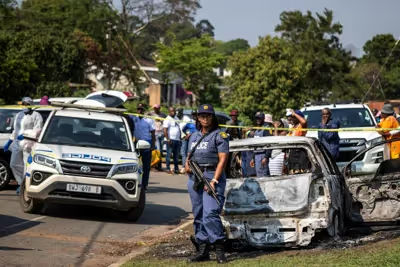
At least 27 people have been killed and 26 others wounded in two separate mass shootings near Johannesburg and Cape Town within hours of each other, extending an exceptionally violent period in South Africa that has now seen at least 38 people killed in three major shooting incidents within days.
The latest attacks struck public gathering places on opposite sides of the country.
In Wedela township, west of Johannesburg, eight armed men attacked a tavern on Saturday night, killing 17 people and wounding 15 others.
Hours later, gunmen opened fire at an entertainment venue in Lwandle township near Cape Town, killing another 10 people and injuring 11.
Police were searching for suspects in both cases on Sunday.
No arrests had been announced, and investigators had not established a motive for either attack in the latest police updates.
The bigger story: The two weekend attacks did not occur in isolation. Just days earlier, 11 people were killed in another mass shooting at a house near Durban. Together, the three incidents have killed at least 38 people in a matter of days, intensifying scrutiny of South Africa's illegal-firearms problem, organised crime and ability to prevent repeated attacks on ordinary gathering places.
Eight Gunmen Stormed a Tavern West of Johannesburg
The deadliest of the two weekend attacks occurred in Wedela township in Gauteng province, around 80 kilometres west of Johannesburg.
According to the South African Police Service, the attack began at approximately 9:30pm on Saturday.
Patrons were drinking both inside and outside the tavern when the attackers arrived.
Police said the suspects first opened fire on people outside the establishment.
They then moved into the tavern and continued shooting.
By the time the attack ended, 17 people were dead.
13 Men and Four Women Were Killed in Wedela
Police identified the victims by gender as 13 men and four women.
Another 15 people sustained gunshot wounds and were taken to medical facilities for treatment.
Emergency services declared the 17 victims dead at the scene.
The scale of the attack triggered a major police operation involving detectives and specialised units.
The Attackers Were Armed With Assault-Style Weapons
Police said the Wedela suspects were reportedly carrying AK-47 rifles and pistols.
Some reporting, citing police, also described the group as carrying other firearms.
Investigators believe eight unidentified armed men participated in the attack.
The use of high-powered firearms is likely to become an important part of the investigation as authorities seek to determine where the weapons came from and whether they can be connected to other criminal activity.
The Gunmen Allegedly Took Phones Before Fleeing
The attack did not end immediately after the shooting.
Police said the suspects allegedly searched some of the patrons and took their mobile phones.
They then fled in two unidentified vehicles.
Two vehicles parked near the tavern were also set on fire.
The combination of the shooting, alleged theft and burning of vehicles is among the details detectives will examine as they investigate the purpose of the attack.
Police Have Not Established a Motive
Despite the organised nature of the Wedela attack, police had not announced a motive as of the latest updates.
There was no confirmed public finding that the attack resulted from gang rivalry, organised crime, robbery or another specific dispute.
South Africa has serious problems involving gangs and organised criminal groups, but those broader conditions should not be treated as proof of the motive in this particular case.
Police are continuing to investigate.
Hours Later, Another Mass Shooting Hit Near Cape Town
South Africa was still dealing with the aftermath of the Wedela attack when another shooting occurred hundreds of kilometres away.
At approximately 1:46am on Sunday, gunmen attacked an entertainment venue in Lwandle township on the outskirts of Cape Town.
Police said the attackers opened fire on people at the venue.
Ten people were killed.
Another 11 people were wounded.
Five Died at the Lwandle Scene and Five Later
Five victims were declared dead at the scene of the Lwandle shooting.
Five others later died from their injuries after being transported for medical treatment.
Eleven injured people were receiving treatment following the attack.
Police established a multidisciplinary investigative team led by detectives specialising in serious and violent crime.
Additional police resources were deployed to the area.
No Arrests Had Been Made in Either Weekend Attack
Police launched searches for the perpetrators following both shootings.
In Gauteng, authorities are specifically searching for the eight men believed to have participated in the Wedela attack.
Police are also searching for multiple suspects in connection with the Lwandle shooting.
As of the latest reports on Sunday, no arrests had been announced in either case.
The motives for both attacks remained unknown.
Important distinction: The Johannesburg-area and Cape Town-area shootings happened within hours of one another, but police have not said that the attacks are connected. They should therefore be treated as separate investigations unless authorities establish evidence linking them.
27 Dead and 26 Injured in a Single Night
Taken together, the two weekend shootings produced an extraordinary casualty count.
- Wedela: 17 killed and 15 wounded.
- Lwandle: 10 killed and 11 wounded.
- Total killed: At least 27.
- Total wounded: At least 26.
The incidents occurred in different provinces and hundreds of kilometres apart, but their timing has intensified national attention on gun violence.
Then There Is the Third Shooting: 11 Dead Near Durban
The weekend attacks came only days after another mass shooting shocked South Africa.
Gunmen attacked a house gathering in KwaMakhutha township, south of Durban in KwaZulu-Natal.
Eleven people were killed in that incident.
Three others were wounded.
A pregnant woman was among those killed, according to reports of the attack.
The KwaMakhutha killings mean South Africa has now experienced three major mass-shooting incidents within days.
Three Attacks Have Left at Least 38 People Dead
Looking at the three incidents together illustrates the scale of the recent violence.
KwaMakhutha, near Durban
Gunmen attacked a house gathering, killing 11 people and wounding three others.
Wedela, west of Johannesburg
Eight armed men attacked a tavern, killing 17 people and wounding 15.
Lwandle, near Cape Town
Gunmen attacked an entertainment venue, killing 10 people and wounding 11.
Combined, the three incidents have killed at least 38 people.
There is no public evidence establishing that all three attacks are connected.
Their significance lies instead in their concentration within such a short period and the broader pattern of firearm violence confronting the country.
South Africa Weekend Shootings: Key Facts
- Date: September 26-27, 2026.
- Wedela deaths: 17.
- Wedela injured: 15.
- Wedela suspects: Eight unidentified armed men.
- Lwandle deaths: 10.
- Lwandle injured: 11.
- Weekend death toll: At least 27.
- Weekend wounded: At least 26.
- Arrests: None announced in the two latest attacks as of the latest reports.
- Motives: Not established by police.
- Earlier KwaMakhutha shooting: 11 people killed.
- Combined deaths across the three recent attacks: At least 38.
Why Taverns and Entertainment Venues Keep Appearing in Shooting Reports
The locations of the latest attacks are notable.
Both weekend shootings targeted places where groups of people were gathered socially late at night.
Similar attacks at taverns and entertainment venues have occurred previously in South Africa.
Crowded venues can present attackers with large numbers of potential victims in confined spaces.
But the fact that both latest attacks occurred at entertainment establishments does not establish that they had the same motive.
South Africa Records Around 60 Murders a Day
The latest shootings are occurring against a broader backdrop of extremely high violent-crime levels.
Recent reporting based on national crime statistics places South Africa's average daily murder count at roughly 58 to 60 people.
With a population of around 62 million, the country has one of the world's highest murder rates.
Not all of those killings involve firearms, gangs or organised crime.
But firearms feature prominently in many serious violent crimes.
Legal and Illegal Firearms Are Part of the Wider Problem
South Africa has a large number of both legally owned and illegally circulating firearms.
Crime experts have repeatedly raised concerns about guns entering criminal networks through theft, trafficking and other channels.
The Wedela attack is particularly significant because police say the attackers possessed AK-47 rifles and pistols.
Investigators will likely seek to trace the weapons if they are recovered.
The Question Is Not Only Who Pulled the Triggers
Arresting the immediate perpetrators is the most urgent task following the attacks.
But crime experts argue that mass shootings can require a wider investigation into the networks that supply firearms and support organised violent crime.
That creates several questions for investigators.
- Where did the firearms used in the attacks come from?
- Were any of the weapons legally registered before entering criminal circulation?
- Were the attackers part of organised groups?
- Were the victims specifically targeted or attacked indiscriminately?
- Was robbery part of the motive in Wedela?
- Why were vehicles burned after the Wedela attack?
- Are any of the suspects linked to previous violent crimes?
Police have not yet publicly answered those questions.
Organised Crime Is Already a National Concern
The shootings also arrive during a wider government effort to combat organised crime.
President Cyril Ramaphosa has previously described organised crime as a major threat to South Africa's society, economy and democratic institutions.
Criminal networks in the country operate across activities that include drug trafficking, illegal mining, extortion and other illicit businesses.
Violence can be used to control territory, intimidate rivals or enforce criminal markets.
However, police have not established that organised crime caused either of the two latest mass shootings.
South Africa Has Already Turned to the Military
The scale of violent crime has already pushed the government toward extraordinary measures.
Earlier in 2026, soldiers were deployed to support police operations in some high-crime areas, including parts of Johannesburg.
The military deployment was intended to reinforce law-enforcement operations in areas experiencing persistent violent crime.
The latest attacks will inevitably intensify scrutiny of whether those interventions are reducing access to illegal firearms and disrupting violent criminal networks.
Mass Shootings Present a Different Policing Challenge
Ordinary crime-prevention strategies often focus on patrols, visible policing and responding to known hotspots.
Coordinated mass shootings can present a more difficult challenge.
Attackers can arrive quickly, inflict large numbers of casualties within minutes and leave before security forces reach the scene.
Prevention therefore depends not only on police presence but also on intelligence, firearm tracing, organised-crime investigations and the disruption of networks before an attack occurs.
The Burned Vehicles Could Become Important Evidence
Investigators in Wedela are also examining the two vehicles that were set alight near the tavern.
It remains unclear why they were burned.
Investigators may examine whether the fires were intended to destroy evidence, create confusion, target particular vehicle owners or serve another purpose.
Until forensic work is completed, those possibilities remain speculative.
Why Police Are Avoiding an Early Motive
The absence of an announced motive is significant.
Mass shootings can result from very different circumstances, including personal disputes, gang conflicts, organised crime, robbery or targeted retaliation.
Similarities between two incidents do not establish a shared cause.
Police therefore need witness testimony, forensic evidence, firearm analysis, surveillance footage and information about the victims and suspects before determining why an attack occurred.
For that reason, describing the latest attacks simply as gang shootings would go beyond what investigators have established.
Communities Are Left With the Immediate Consequences
Behind the national statistics are dozens of families dealing with sudden deaths and serious injuries.
Twenty-seven people were killed in the two weekend incidents alone.
Twenty-six more were wounded.
Hospitals are treating survivors while police investigators work through two major crime scenes hundreds of kilometres apart.
Communities in Wedela and Lwandle are also waiting to learn why their neighbourhood gathering places became scenes of mass violence.
Three Mass Shootings in Days Create a Wider National Question
Each of the three recent shootings has its own investigation.
Police have not established a common perpetrator, organisation or motive connecting them.
But collectively, their scale creates a broader question for South African authorities.
How can groups of heavily armed attackers repeatedly gain access to firearms and strike homes, taverns and entertainment venues with devastating consequences?
Answering that question requires more than solving individual murder cases.
It involves understanding the supply of illegal firearms, criminal networks, intelligence failures and the conditions that allow organised armed violence to persist.
The Immediate Priority Is Finding the Gunmen
For now, both investigations remain active.
Gauteng police are hunting eight suspects in connection with the Wedela attack.
Western Cape investigators are searching for the perpetrators responsible for the Lwandle killings.
Specialised detectives have been deployed, and additional police resources have been sent to affected areas.
Authorities have not announced arrests in either investigation.
South Africa's Gun-Violence Crisis Is Now Under Renewed Scrutiny
The numbers alone make the past several days difficult to dismiss as routine crime.
Eleven people killed near Durban.
Seventeen killed west of Johannesburg.
Ten killed near Cape Town.
At least 38 lives lost across three mass shootings within days.
Investigators still need to determine who carried out the latest attacks and why.
There is currently no basis for claiming that the three shootings were coordinated.
But the rapid succession of attacks is forcing attention onto a problem larger than any single crime scene: the availability of firearms and the persistence of extreme violence despite years of policing initiatives.
The first measure of progress will be whether police identify and arrest those responsible.
The longer-term test will be whether South Africa can disrupt the networks and conditions that allow heavily armed attackers to repeatedly turn ordinary social spaces into scenes of mass killing.
Keywords:
Related Posts