Washington Declares State of Emergency as Region Faces Its Worst-Ever Natural Disaster
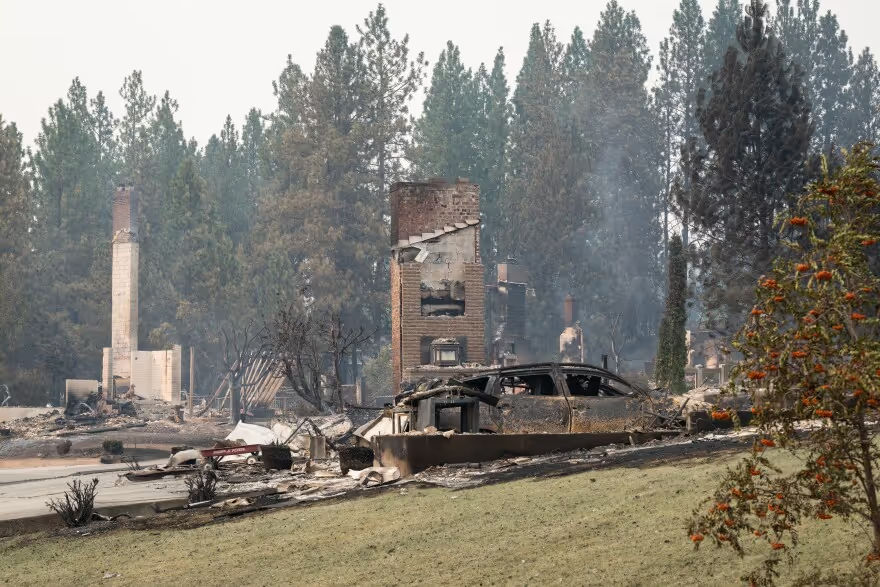
Washington Declares State of Emergency as Devastating Wildfires Force Thousands to Flee
Washington state is confronting one of the most destructive wildfire emergencies in its recent history after multiple fast-moving fires swept through communities around Spokane. Driven by strong winds, extremely dry vegetation, high temperatures and severe drought, the fires have destroyed neighbourhoods, interrupted electricity supplies and forced tens of thousands of residents to leave their homes.
The latest official and media reports indicate that around 67,000 people have been ordered or advised to evacuate, while at least 700 homes, businesses and other buildings have been destroyed. The fires had burned approximately 12.5 square miles, or more than 8,000 acres, by Monday, August 3, with damage assessments continuing in areas that emergency teams could not immediately enter.
Statewide emergency declared in Washington
Washington Governor Bob Ferguson declared a statewide wildfire emergency as the situation deteriorated across the state. The emergency declaration allows state authorities to mobilise personnel, equipment and other resources more rapidly while coordinating the response among local fire departments, law-enforcement agencies, emergency-management teams and state agencies.
The governor also introduced a statewide burn ban, aimed at preventing new fires from starting while firefighting resources are already under severe pressure. The declaration came as numerous major wildfires burned across Washington and as weather officials warned that any new fire could spread quickly because of wind and exceptionally dry vegetation.
Ferguson said he spoke directly with US President Donald Trump and requested federal assistance. Washington’s congressional delegation also called for an expedited federal emergency declaration, arguing that hundreds of residents had lost homes and farms while many others remained unable to return to their communities.
The Federal Emergency Management Agency has authorised federal funds to assist with eligible firefighting expenses connected with the Old Trails Fire. Such Fire Management Assistance Grants generally help state, local and tribal authorities cover qualifying costs of controlling fires that threaten to become major disasters. This firefighting assistance is distinct from a broader presidential major-disaster declaration, which can open additional recovery programmes for affected households and communities.
Three major fires devastate the Spokane area
The crisis centres on three separate fires burning in and around Spokane, Washington’s second-largest city. Spokane is located in eastern Washington near the Idaho border—not “east of Washington,” as some versions of the report incorrectly stated.
The largest blaze, known as the Old Trails Fire, started northwest of central Spokane and rapidly advanced through dry grass, trees and residential areas. It reportedly crossed the Spokane River before entering neighbourhoods where residents had little time to collect belongings and evacuate.
Together, the three fires have been treated as the Spokane Area Fire complex. Fire officials described them as a top national firefighting priority because of their proximity to heavily populated neighbourhoods and the number of structures already destroyed.
At the height of the emergency, huge columns of smoke rose above the area while flames approached homes, roads and electricity infrastructure. Ground crews were supported by helicopters and firefighting aircraft, although strong winds and thick smoke can make aerial operations dangerous or temporarily ineffective.
More than 1,000 firefighters, including crews arriving from outside Washington, had been deployed by Monday, and authorities expected the number to rise substantially. Despite the large response, officials said the Spokane-area fires remained uncontained at that stage.
Evacuations rise from 60,000 to approximately 67,000
Initial reports placed the number of evacuees at approximately 60,000, but updated information suggests that as many as 67,000 people were affected by evacuation orders.
The figure may continue to change because evacuation zones are expanded, reduced or cancelled according to wind direction, fire movement and the safety of roads. It may also include people covered by different levels of evacuation warnings rather than only residents who physically entered public shelters.
Under the evacuation system commonly used in Washington, a Level 1 notice tells residents to prepare, Level 2 means they should be ready to leave immediately and Level 3 means leave now. Residents are expected to follow official county alerts because a neighbourhood’s status may change quickly.
The speed of the fires left some families with only a short period to gather medicines, documents, clothing, pets and valuable possessions. Others returned later to find houses reduced to foundations, with destroyed cars, melted household materials and burnt trees covering previously residential streets.
At least 700 buildings destroyed
Early assessments suggested that around 600 structures had been lost. Updated aerial surveys and local reports later increased the confirmed total to at least 700 buildings, including homes, businesses, agricultural structures and other properties.
Infrared surveys indicated that hundreds of additional buildings may have been damaged or destroyed, meaning the eventual figure could be significantly higher. Damage teams must often wait until flames, falling trees, unstable power lines and smouldering materials no longer make an area unsafe before conducting street-by-street assessments.
The destruction extends beyond houses. Families have lost vehicles, livestock facilities, tools, personal documents and generations of photographs and family possessions. Power interruptions have also affected thousands of residents as utilities shut down or repaired damaged electricity infrastructure.
Even houses that survived may remain inaccessible because of contaminated water, damaged roads, electricity hazards and persistent hot spots. Recovery will therefore require more than simply extinguishing the flames; affected communities will need temporary housing, debris removal, utility restoration, insurance support and long-term rebuilding assistance.
No confirmed deaths, but searches continue
No deaths or major injuries had been officially confirmed in the latest reports available on August 4. However, authorities warned that the position could change as search teams gain access to severely damaged areas.
Spokane County authorities initially received nearly 300 reports concerning people whose whereabouts were unknown. Most were subsequently resolved, leaving 14 outstanding reports by Monday. Officials explained that many of these cases were probably residents who had evacuated but had not yet contacted relatives, rather than people known to be trapped or injured.
The original report incorrectly referred to a “County Police Chief John Knowles.” The official quoted in the latest coverage is Spokane County Sheriff John Nowels. Accurate spelling and designation are important, particularly when reporting statements connected with an active criminal investigation.
Man arrested in connection with Old Trails Fire
In a significant development, the Spokane County Sheriff’s Office arrested a 37-year-old man on suspicion of first-degree arson in connection with the Old Trails Fire, the largest of the three Spokane-area blazes.
Authorities said the investigation began after a member of the public reported suspicious activity near the location where the fire was believed to have started. Investigators later reviewed reports and police body-camera material before identifying and detaining the suspect.
The arrest does not establish guilt. The allegation must be tested through the criminal-justice process, and the accused is entitled to the presumption of innocence unless convicted. Authorities have also said that the causes of the other two fires have not been established publicly.
The arson investigation should therefore not be interpreted as an explanation for the entire Washington wildfire emergency. Even when a fire is started by a person—deliberately or accidentally—its destructive growth depends heavily on environmental conditions such as dry fuels, low humidity, wind and temperature.
“Worst natural disaster” faced by the region
Spokane Mayor Lisa Brown described the event as “the worst natural disaster our region has faced.” The description reflects not only the number of buildings destroyed but also the scale of evacuation, the damage to entire neighbourhoods and the uncertainty facing residents who do not yet know whether their homes survived.
Authorities have opened shelters and organised emergency services for displaced families. Immediate needs include accommodation, food, drinking water, medicines, clothing, pet support and transportation.
In the longer term, residents will require help with insurance claims, government assistance, building permits, mental-health support and reconstruction. Wildfire survivors frequently experience prolonged stress because recovery decisions must be made while they are also dealing with displacement, financial uncertainty and the loss of irreplaceable possessions.
Dangerous weather helped the fires spread
The National Weather Service had issued Red Flag Warnings and particularly dangerous fire-weather alerts for parts of eastern Washington. Forecasts warned that wind gusts could reach approximately 40 to 50 miles per hour in some locations and that new fires could grow rapidly and aggressively.
Strong wind can push flames through dry grass and woodland at high speed while carrying burning embers ahead of the main fire. Those embers can land on roofs, wooden structures or vegetation and create new fires, making containment extremely difficult.
Calmer winds and lower temperatures temporarily helped firefighters, but forecasts indicated that hotter and drier conditions could return by the middle of the week. This meant that apparently quiet areas could remain dangerous because burning roots, tree stumps and concealed embers may reignite when winds strengthen.
Officials also warned members of the public not to fly drones near active fires. An unauthorised drone can force firefighting aircraft to stop operating because of the risk of a mid-air collision, potentially delaying water or retardant drops during a critical stage of the response.
Wildfire smoke creates a wider health emergency
The impact has extended far beyond the immediate fire zones. Smoke from regional wildfires has affected air quality across central and eastern Washington, northern Idaho and parts of western Washington.
The National Weather Service reported that wildfire smoke could persist during the week and that particulate pollution could reach levels considered unhealthy for sensitive groups in affected counties.
Fine particles known as PM2.5 can travel deep into the lungs and may aggravate asthma, heart disease and other respiratory or cardiovascular conditions. Children, older people, pregnant women, outdoor workers and those with existing health problems are generally at greater risk.
During periods of heavy smoke, residents should follow local public-health advice, reduce prolonged outdoor activity, keep indoor air as clean as possible and use properly fitted high-filtration masks when exposure cannot be avoided. Anyone experiencing severe breathing difficulty, chest pain or other serious symptoms should seek medical assistance.
Role of drought and climate change
Washington has faced severe drought conditions and a weak snowpack, leaving forests, grasslands and other vegetation unusually dry. By Monday, fires across the state had burned at least 390 square miles, placing heavy demands on local, state and federal firefighting resources.
Climate change does not necessarily provide the direct ignition source for an individual fire. Fires may begin through lightning, equipment, damaged power lines, accidents or deliberate acts. However, rising temperatures can dry vegetation more quickly, lengthen fire seasons and increase the likelihood that an ignition develops into a large and destructive wildfire.
The current disaster therefore demonstrates how human actions and environmental conditions can combine. A single spark becomes far more dangerous when it occurs during extreme dryness, high heat and powerful winds.
What happens next?
The immediate priorities are protecting life, containing the fire perimeter, reconnecting missing residents with their families and restoring access to damaged communities.
After the flames are controlled, authorities will begin the longer process of confirming losses, clearing hazardous debris, restoring electricity and water services and determining which areas are safe for residents to re-enter.
The final number of destroyed homes may rise, and evacuation figures will continue changing as conditions develop. The absence of confirmed fatalities remains encouraging, but authorities have cautioned that complete searches and damage assessments have not yet been completed.
Important points
Approximately 67,000 people have been affected by evacuation orders around Spokane.
At least 700 buildings have been destroyed, with additional losses still being assessed.
Three major fires have burned more than 8,000 acres around Spokane.
Governor Bob Ferguson declared a statewide wildfire emergency and imposed a burn ban.
Federal firefighting funds have been authorised for the Old Trails Fire.
More than 1,000 firefighters were deployed, but the fires were still uncontained in the latest reports.
No deaths or major injuries had been confirmed as of August 4, although searches were continuing.
A suspect has been arrested in connection with the Old Trails Fire, but the allegation has not yet been proven in court.
Severe drought, dry vegetation, heat and strong winds have intensified the disaster.
Spokane is in eastern Washington, and the official’s correct name is Spokane County Sheriff John Nowels.
Tags:
Related Posts