A Bus Fire, a False Identity and an Unanswered Dispute: What Really Happened at Tripureshwor?
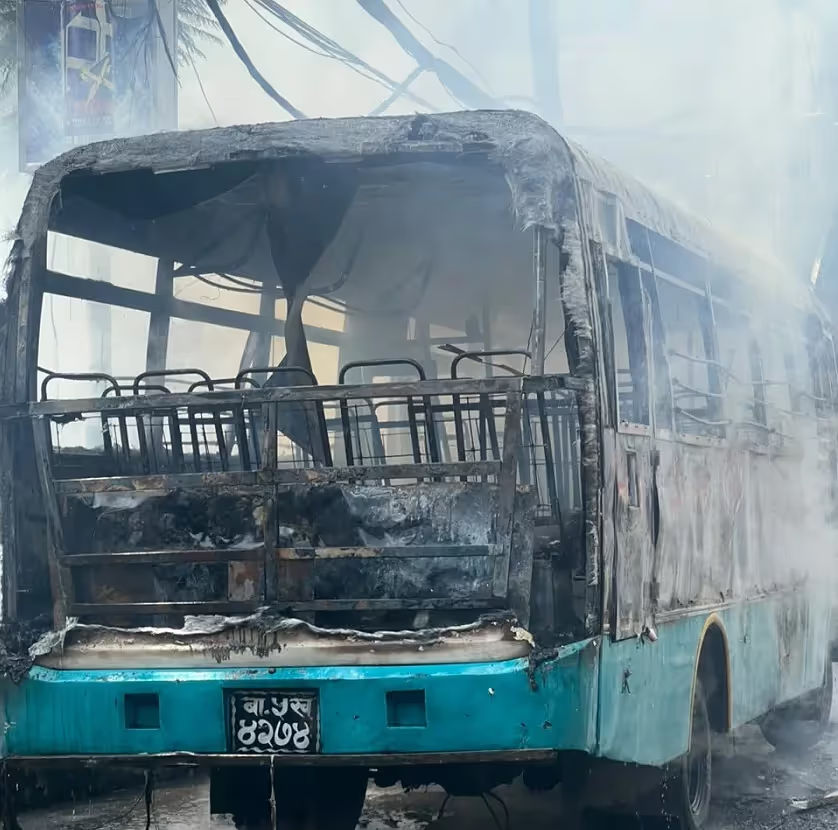
What initially appeared to be a passenger bus fire in Kathmandu's busy Tripureshwor area has developed into a far more complicated case involving a driver's death, a dispute with traffic police, an allegedly false identity and questions about how a man police say was wanted in connection with an earlier road accident remained behind the wheel of a public vehicle.
The incident occurred around noon on Monday, September 21, when a Riddhi Siddhi Yatayat bus caught fire near Tripureshwor Chowk, in front of the Department of Passports.
Early reports identified the badly burned driver as Dawa Lama of Kavrepalanchok because that was the identity shown on documents found with him.
By the following day, however, Kathmandu police said their investigation had established that the deceased was actually Arjun Dong Tamang of Sisneri, Indrasarowar Rural Municipality in Makawanpur.
Police allege that Tamang had been using a driving licence and other documents issued in another person's name.
The bigger story: The Tripureshwor incident is no longer simply a story about a bus catching fire. Investigators are examining what happened during a dispute with traffic police, why the driver allegedly set the vehicle on fire, and how he was reportedly driving under another person's identity despite being wanted in connection with an earlier bus crash.
The Fire Broke Out in the Middle of Tripureshwor
The Riddhi Siddhi Yatayat bus was in the Tripureshwor area of Kathmandu when the incident unfolded on Monday.
Initial reports described the event simply as a bus fire because authorities had not yet established what caused the blaze.
Police and firefighters responded to the scene while the driver was found inside the vehicle with severe burns.
No passengers were reported to have been trapped inside the bus when it burned.
As investigators began speaking with witnesses and reviewing the circumstances, police developed a different preliminary account of how the fire started.
Police Say the Driver Set the Bus on Fire
Kathmandu police later said their preliminary investigation indicated that the driver had deliberately started the fire himself after passengers had left the vehicle.
Senior Superintendent of Police Dilip Ghimire said investigators were continuing to question passengers and others connected with the incident.
Police also noted that the driver did not flee after the fire began.
When security personnel arrived, the bus door was reportedly still locked from the inside.
Officers broke open the door, entered the burning vehicle and rescued the driver.
Firefighters subsequently brought the blaze under control.
A Traffic Fine Dispute Happened Before the Fire
One of the most important aspects of the investigation is an argument that took place between the driver and traffic police shortly before the fire.
Video footage circulating from the scene shows the driver disputing an attempt by traffic officers to take action against him for an alleged traffic violation.
The driver can be heard arguing that he had not committed an offence and objecting to being fined.
Police and other personnel at the scene appear to ask him to move the bus because it was affecting traffic movement in the busy Tripureshwor area.
The disagreement escalated before the fire broke out.
Authorities have not yet issued a final investigative finding establishing the complete sequence of events or the driver's motive.
The Driver Suffered Burns to Around 90 Percent of His Body
Police rescued the driver from the burning vehicle and transported him to the Nepal Cleft and Burn Centre in Kirtipur.
Medical officials said burns covered approximately 90 percent of his body.
His condition was described as critical following admission.
Despite treatment, he died at approximately 7pm on Monday.
His death transformed the incident from an investigation into a vehicle fire into a fatal case requiring authorities to establish both the events leading to the blaze and the driver's true identity.
The First Identity Turned Out to Be Wrong
Initial reports identified the driver as Dawa Lama of Kavrepalanchok.
That identification was based on the driving licence found in his possession.
Further investigation, however, led police to conclude that the deceased was actually Arjun Dong Tamang, a resident of Sisneri in Makawanpur's Indrasarowar Rural Municipality.
Police say the licence in Dawa Lama's name did not belong to Tamang.
This explains why reports published immediately after the incident carried a different name from later police statements.
Police Say He Was Using Another Person's Documents
The identity discrepancy has opened another line of investigation.
According to Kathmandu police, Tamang was allegedly using documents belonging to other people.
Police say preliminary findings indicate he had used documents in Dawa Lama's name, including a driving licence.
Investigators are now examining whether additional identity documents belonging to other people were also used.
The allegations have raised a separate question about how identity and licence verification works for drivers operating public passenger vehicles.
Police Link Him to an Earlier Balaju Bus Crash
The investigation produced another significant development when police connected Tamang to a previous road accident in Kathmandu.
According to police, he was involved in a bus accident in Balaju in 2025 in which three people were injured.
Police say he had been absconding following that incident.
Investigators allege that he was using yet another person's driving licence at the time of the Balaju crash.
Police identified that licence as having been issued in the name of Sunil Tamang.
Police Say This Was Not the First Identity Used
The emerging police account suggests the Tripureshwor case may involve repeated use of licences issued to other people.
- Police identify the deceased as Arjun Dong Tamang.
- At Tripureshwor, police say he possessed a driving licence issued in another person's name.
- During the earlier Balaju bus crash, police say he was using a licence issued in the name of Sunil Tamang.
- Police are investigating whether he used additional documents or identities in other circumstances.
These are preliminary police findings, and the investigation into the use of the documents is continuing.
Another Traffic Police Incident Had Occurred Months Earlier
Kathmandu police also say Tamang had been involved in another confrontation with traffic police approximately three months before the Tripureshwor fire.
That incident occurred in the Mulpani area.
Police allege that he behaved abusively toward traffic officers during the encounter.
Investigators say he was again using a driving licence issued in someone else's name at that time.
This history has become relevant as investigators try to reconstruct the events that preceded Monday's fatal incident.
A Committee Will Investigate the Role of Traffic Police
Authorities have not limited the investigation to the actions of the driver.
The Kathmandu Valley Police Office formed a committee to examine the circumstances surrounding the incident, including the role of traffic police.
The committee is being coordinated by Senior Superintendent of Police Ramesh Basnet.
It has been tasked with investigating the events surrounding the confrontation and determining whether any action should be recommended.
The inquiry is particularly important because video footage of the argument circulated widely after the fire and generated public discussion about what happened immediately before the incident.
Why the Traffic Police Investigation Matters
The existence of an argument before the fire does not by itself establish responsibility for what happened afterward.
Investigators therefore need to separate several different questions.
- Why was the bus stopped?
- What traffic violation was alleged?
- What was said during the interaction between the driver and officers?
- Were proper procedures followed by traffic personnel?
- How did the fire begin?
- What material or method was used to ignite the vehicle?
- Why did the driver remain inside the bus?
- Did anyone else contribute directly to the events that followed?
Those questions remain matters for the formal investigation rather than conclusions that can be drawn from the circulating video alone.
Important distinction: Police preliminarily believe Tamang set the bus on fire himself. However, the investigation into why he did so, the full circumstances of the preceding traffic dispute and the conduct of people involved is continuing.
No Passengers Were Inside When the Bus Burned
One crucial element of the preliminary police account is that passengers had already left the vehicle before the fire.
No passenger fatalities or burn injuries have been reported from inside the bus.
The driver was the person who suffered the severe injuries that later proved fatal.
This distinguishes the incident from an accidental passenger-bus fire in which occupants become trapped after flames unexpectedly break out.
The Bus Was Operated by Riddhi Siddhi Yatayat
The vehicle involved was operated by Riddhi Siddhi Yatayat.
Later reporting identified the bus registration as Ba 5 Kha 4274.
The incident occurred near the bus stop at Tripureshwor Chowk, close to the Department of Passports.
The fire temporarily drew emergency personnel into one of Kathmandu's heavily travelled central-road corridors.
Tripureshwor Bus Fire: Key Facts
- Date: September 21, 2026.
- Location: Tripureshwor, Kathmandu, near the Department of Passports.
- Bus operator: Riddhi Siddhi Yatayat.
- Bus registration: Ba 5 Kha 4274.
- Deceased: Arjun Dong Tamang.
- Permanent address: Sisneri, Indrasarowar Rural Municipality, Makawanpur.
- Burn injuries: Approximately 90 percent of his body.
- Death: Around 7pm on September 21 while undergoing treatment in Kirtipur.
- Initial identification: Dawa Lama, based on documents found with the driver.
- Police assessment: Preliminary investigation indicates the driver deliberately started the fire.
- Investigation: A committee has been formed to examine the incident and the role of traffic police.
The False Identity Raises a Separate Public-Transport Question
Beyond the circumstances of the fire, the driver's alleged use of other people's licences raises questions about verification within public transport operations.
A public-bus driver is responsible not only for a vehicle but potentially for dozens of passengers travelling through crowded roads.
If police findings are confirmed, Tamang was allegedly able to continue driving while using licences that did not belong to him.
Police also say he had remained wanted following the earlier Balaju crash.
That creates questions extending beyond the actions of one individual.
Questions the Case Raises
- How are public-bus drivers' identities verified by transport operators?
- How frequently are driving licences checked against official records?
- Can employers easily verify whether a licence actually belongs to a driver?
- How was a person police describe as absconding able to continue operating a public vehicle?
- Are transport companies notified when drivers become wanted in connection with serious road incidents?
- Could stronger digital verification prevent the use of another person's licence?
The available reporting does not yet establish whether Riddhi Siddhi Yatayat knew of the driver's alleged identity issues or previous police case.
Any assessment of the transport company's responsibility would therefore require additional evidence.
Early Reporting Shows Why Breaking-News Identifications Can Change
The Tripureshwor incident also illustrates how rapidly information can change during a developing story.
When the fire was first reported, authorities had only the documents recovered from the driver and limited information from the scene.
Early reports consequently identified him as Dawa Lama.
Police later said further investigation established that the person carrying those documents was Arjun Dong Tamang.
The updated identity should therefore be used when referring to the deceased in later coverage of the incident.
The Motive Has Not Been Finally Established
The confrontation over the traffic fine provides important context, but authorities are still investigating the driver's motive.
Police have preliminarily concluded that he started the fire himself, while video footage confirms that an argument with traffic personnel occurred shortly beforehand.
Those facts do not by themselves establish every factor that contributed to his actions.
Investigators will need to reconstruct the timeline using witness statements, video recordings, police accounts and other available evidence.
The Five-Member Inquiry Could Answer the Most Important Questions
The investigation committee now has the task of examining the circumstances surrounding the incident.
Its work could clarify both the conduct of the driver and the actions of traffic personnel during the confrontation.
It could also establish whether established procedures were followed and whether any additional action is warranted.
Until that process is completed, assigning responsibility for the entire chain of events would go beyond what investigators have established.
Tripureshwor Has Become More Than a Bus-Fire Investigation
Within roughly 24 hours, the story surrounding the burned bus changed substantially.
What began as reports of a vehicle catching fire developed into a police account of deliberate ignition following a traffic dispute.
The critically injured driver then died.
His original identification was subsequently found to be incorrect.
Police then connected his actual identity to an earlier bus accident and alleged repeated use of driving licences belonging to other people.
At the same time, authorities opened an investigation into the conduct surrounding the traffic-police encounter that preceded the fire.
Those developments have transformed the Tripureshwor incident from a straightforward vehicle-fire report into a wider investigation involving traffic enforcement, identity verification and public-transport oversight.
What Happens Next?
The most important next development will be the findings of the investigation committee.
Police are also continuing to investigate Tamang's alleged use of documents belonging to other individuals and his connection to previous incidents.
Further evidence may clarify exactly what happened during the confrontation at Tripureshwor and why the situation escalated into a fatal fire.
Until then, several parts of the case remain preliminary.
What is established from the latest police account is that the man who died was Arjun Dong Tamang, that he suffered catastrophic burns after a bus caught fire following a dispute with traffic officers, and that police now allege the identity documents initially used to identify him were not his own.
Keywords:
Related Posts