Due to disturbances around Place Mazagran, the State orders the closure of Le Court-Circuit bar.
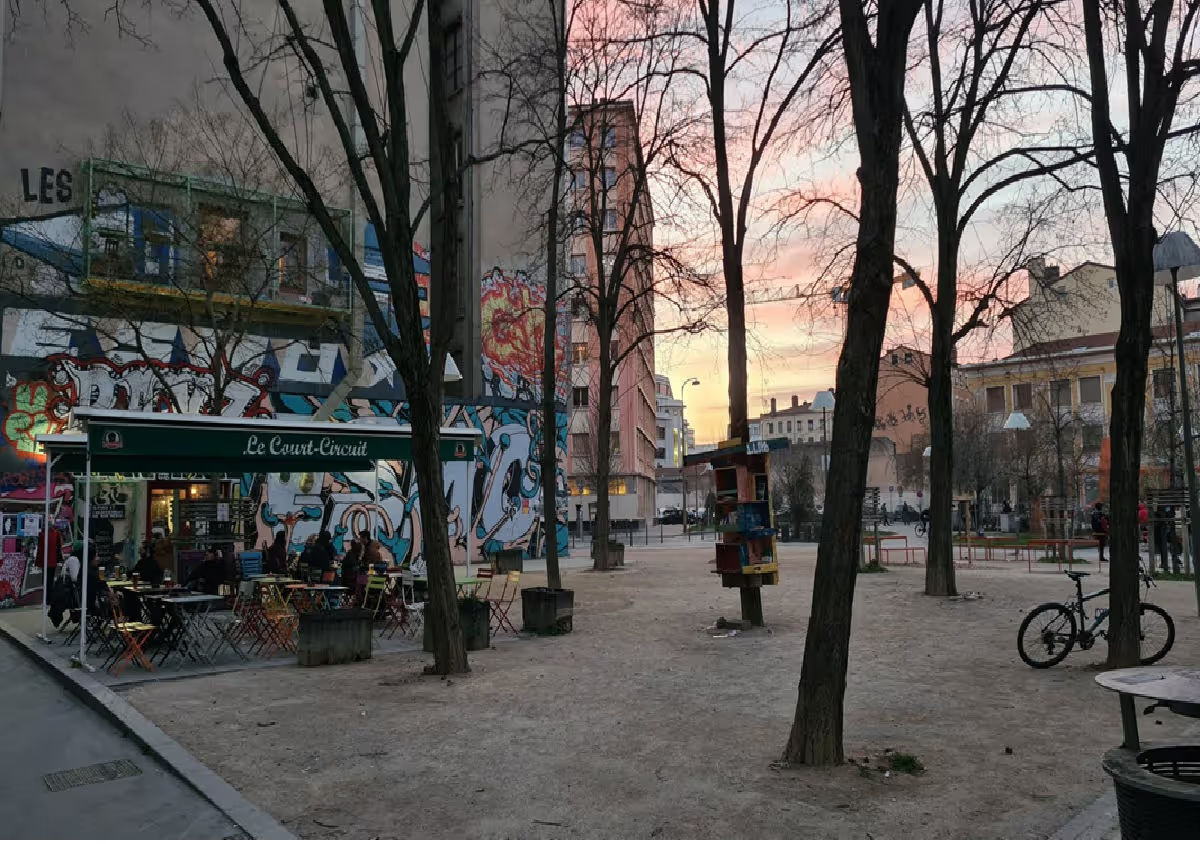
Lyon’s Le Court-Circuit Bar Ordered to Close for Seven Days Amid Place Mazagran Tensions
The well-known bar Le Court-Circuit, located on Place Mazagran in Lyon’s 7th arrondissement, has been ordered to close for seven days following a decision by the Rhône prefecture. The administrative closure began on Friday, April 24, 2026, after a prefectural order dated April 9 accused the establishment of repeated disturbances, including noise complaints and alleged drug-related activity near its terrace.
The decision has sparked anger and frustration among the bar’s managers, local supporters and some political figures, who believe the measure is unfair. According to the bar’s team, the authorities are holding the establishment responsible for wider public order problems on Place Mazagran, even though drug dealing and street disorder have reportedly existed in the area for several years.
Le Court-Circuit is not just a regular bar. It is known locally as a cooperative venue with a strong neighbourhood identity. It often hosts community gatherings, political discussions, activist events and social evenings. For many residents and regular visitors, the closure is being seen not only as a financial blow to the business but also as a symbolic action against a socially engaged local space.
Why was Le Court-Circuit closed?
The Rhône prefecture ordered the temporary closure of the bar after citing several incidents in 2025. According to the closure order, the authorities referred to a case of night-time disturbance on September 13, 2025, and another incident on December 22, 2025, when police reportedly observed street cigarette sales and the movement of drug sellers among customers seated on the terrace.
The order also mentioned that the bar had already received a warning on June 13, 2025, again linked to noise pollution. These elements were later included in a police report dated February 12, 2026, which compiled observations made by police officers during the previous year.
Based on these observations, the prefecture decided to impose an administrative closure lasting one week. Such closures are generally used by authorities when they believe an establishment has contributed to public disorder, security risks or repeated disturbances in the surrounding area.
However, the central dispute in this case is whether Le Court-Circuit itself is responsible for the problems described by the authorities. The bar’s managers argue that the situation on Place Mazagran is much broader than their business and that they should not be punished for problems taking place in the public space around them.
Managers call the decision unfair
The management team of Le Court-Circuit has strongly criticised the prefectural order. Simon, one of the co-managers, described the decision as unfair and disproportionate. He said the bar is struggling to understand why it is being targeted when the public order issues in the area are not new and do not depend solely on the bar’s activity.
Another partner in the company, Diane, said the closure comes at a particularly difficult time. The summer season has started, and the bar was counting on regular revenue to cover its costs. According to her, the business is already facing financial pressure and is short of around 11,000 euros to complete the month.
For a small cooperative bar, losing seven days of business can have serious consequences. Bars and restaurants often depend heavily on weekend and evening activity, especially when warmer weather brings more people outside. A week-long closure during a busy period can mean lost income, difficulty paying staff, and delays in settling supplier bills or rent.
The managers say their frustration is made worse by the feeling that the decision does not properly reflect the reality on the ground. They believe they are being blamed for issues that are linked to wider problems in the square.
Place Mazagran and long-running public order issues
Place Mazagran has reportedly been facing difficulties for several years. The area has been associated with public disturbances, street-level drug dealing and tensions between residents, businesses and authorities. According to the information provided, a drug dealing point has existed near the bar for a long time.
This context is important because it raises a key question: should a local bar be held responsible for illegal activity taking place nearby if that activity is part of a broader public space problem?
The prefecture appears to argue that the incidents observed near the terrace are connected to the operation of the establishment. The bar’s supporters, however, argue that the authorities should focus on addressing the wider situation in Place Mazagran rather than closing a venue that has been part of the neighbourhood for years.
This type of dispute is common in urban nightlife areas. Bars can become focal points for police attention because crowds gather around them, especially at night. But not all problems in the surrounding area are necessarily caused by the venue itself. Distinguishing between bar-related nuisance and broader street disorder can be difficult.
Political and social dimension
The closure has also taken on a political tone. A left-wing elected official from Lyon suggested that Le Court-Circuit may have attracted attention because of its political and activist identity. The bar is known for welcoming a left-leaning audience and hosting events linked to social causes.
This has led some supporters to suspect that the administrative measure may not be purely about noise or public order. They believe the prefecture may have been more willing to act against the bar because of its political profile.
There is no official confirmation of this claim, and the prefecture had not responded to questions at the time the original report was published. Still, the perception of political targeting has added to the controversy.
For supporters of the bar, Le Court-Circuit represents a community space where people can meet, debate and organise. For critics, however, the issue may be more practical: residents and authorities have to deal with noise, late-night activity and safety concerns in the area.
What is an administrative closure?
An administrative closure is a measure that allows public authorities to temporarily shut down an establishment without waiting for a court conviction. In France, prefectures can use this power when they believe a business is linked to disturbances, illegal activity or threats to public order.
The closure can last for a limited period depending on the seriousness of the allegations. In this case, the closure is for seven days.
Such measures are often controversial because they can have immediate financial consequences for businesses. Even a short closure can damage a bar’s reputation, disrupt staff schedules and reduce customer confidence. Business owners may also feel that they are being punished before having a full chance to defend themselves in a judicial process.
On the other hand, authorities argue that administrative closures are necessary tools to respond quickly to repeated disorder or security concerns.
Why this case is controversial
The controversy around Le Court-Circuit is based on several points.
First, the incidents cited by the prefecture appear limited in number. The order refers to two main episodes and one earlier warning. The bar’s supporters argue that this does not justify a closure, especially if the problems were linked to wider street activity.
Second, the timing is difficult for the business. The closure begins at the start of the summer period, when terraces become important sources of revenue. For a cooperative bar already under financial pressure, this creates a serious burden.
Third, there is the issue of responsibility. If drug sellers were seen moving between customers’ chairs, does that mean the bar encouraged or allowed the activity? Or does it mean that the public space around the bar is not being properly managed by authorities? This is the central question behind the dispute.
Fourth, the bar’s political and social identity has made the decision more sensitive. Because Le Court-Circuit is associated with activist circles and a left-wing audience, some believe the closure sends a message beyond public order enforcement.
Impact on the neighbourhood
The temporary shutdown of Le Court-Circuit may also affect the local community. The bar is described as a known and established venue in the area. Regular customers, local associations and residents who use the space for social or political events may lose access to an important meeting point, even if only for a week.
At the same time, some residents of Place Mazagran may view the closure differently. People living near busy nightlife venues often face noise, crowds and late-night disturbances. For them, any action that reduces disorder may be welcomed, even if it is temporary.
This shows the complexity of managing urban public spaces. A square like Place Mazagran can be many things at once: a residential area, a nightlife spot, a community meeting place and a site of public order problems. Balancing these different uses is difficult for local authorities.
The prefecture’s silence
At the time of publication, the Rhône prefecture had not answered questions from journalists. This lack of response leaves several points unclear. It is not known whether the prefecture believes the bar failed to control its terrace, whether police had issued repeated warnings, or whether other establishments in the area are also being monitored.
Without an official explanation beyond the order itself, the bar’s managers and supporters are left with their own interpretation of events. This has contributed to the feeling of injustice expressed by the team.
A fuller response from the prefecture could clarify why the authorities considered the closure necessary and whether other measures had been attempted before the decision was taken.
A wider debate about nightlife and public order
The case of Le Court-Circuit reflects a broader debate in many French cities: how should authorities manage nightlife, terraces, public squares and neighbourhood tensions?
Cities want lively public spaces, especially in central neighbourhoods. Bars and cafés contribute to local culture, economic activity and social life. But when public spaces become associated with noise, drug dealing or insecurity, authorities face pressure to act.
The challenge is ensuring that enforcement measures are fair and targeted. Closing a bar may reduce activity temporarily, but it does not necessarily solve deeper issues such as drug trafficking or long-term public disorder.
If the problems around Place Mazagran have existed for several years, critics may argue that a seven-day closure of one bar is unlikely to solve them. Instead, they may call for a broader strategy involving policing, social services, urban planning and dialogue with residents and businesses.
What happens next?
For now, Le Court-Circuit must remain closed for seven days from April 24. After that period, the bar should be able to reopen unless further administrative action is taken.
However, the dispute may not end with the reopening. The closure has already created tension between the bar, its supporters and the prefecture. It may also lead to further debate in Lyon about the management of Place Mazagran and the treatment of politically engaged community venues.
The managers of Le Court-Circuit are likely to continue defending their position and may seek public support. Local elected officials and activists could also use the case to question how the State handles public order problems in neighbourhood spaces.
Conclusion
The temporary closure of Le Court-Circuit is more than a simple administrative decision against a bar. It has become a symbol of a larger conflict over public space, responsibility, nightlife, policing and political identity in Lyon.
The Rhône prefecture says the closure is linked to noise and drug-related activity observed near the establishment. The bar’s managers say the decision is unfair, financially damaging and disconnected from the wider reality of Place Mazagran, where problems have existed for years.
As the seven-day closure begins, the case raises an important question: should local businesses be punished for disorder around them, or should authorities address the deeper causes of public space insecurity? For Le Court-Circuit and its supporters, the answer is clear — they believe the State has chosen the wrong target.
Related Posts