Putin may be unaware of how severe the situation is”: Intelligence officials warn Russia’s economy is heading toward collapse
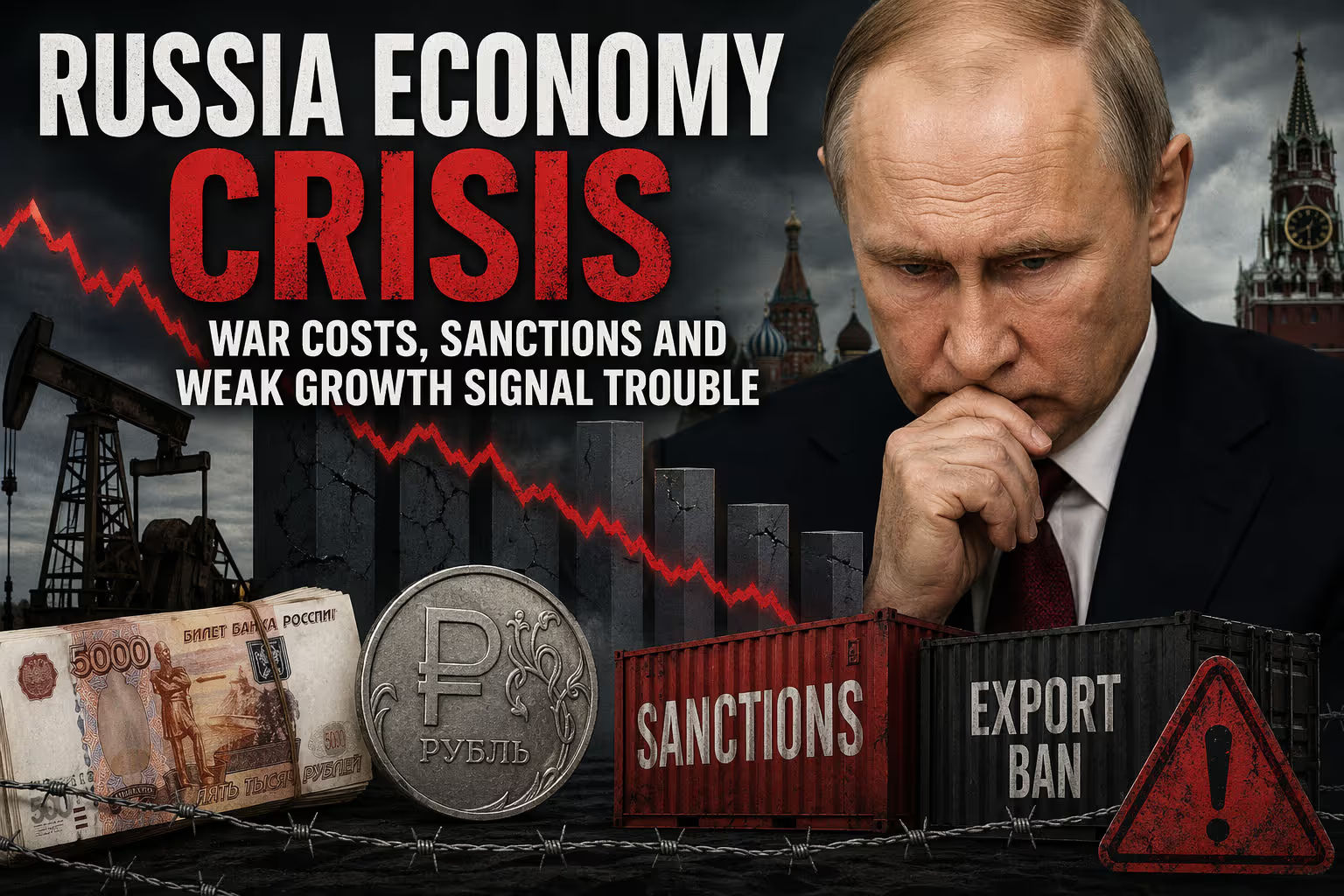
Russia’s Economy Faces Mounting Strain as War Costs, Sanctions, and Data Doubts Deepen
As the war in Ukraine moves through its fifth calendar year, a new argument is gaining ground among Western officials and analysts: Russia’s economy may look stable on the surface, but the underlying model is becoming harder to sustain. The latest warning comes from Thomas Nilsson, head of Sweden’s military intelligence service, who says the Kremlin’s wartime growth is built on an unhealthy foundation. In his view, an economy driven by producing weapons and military supplies that are then consumed and destroyed at the front is not creating durable prosperity. Instead, he argues, it is deepening structural weaknesses that could eventually force Russia into either a prolonged decline or a sudden economic shock.
Nilsson’s remarks matter because they go beyond the usual sanctions debate. For much of the war, Russia has surprised many outside observers by avoiding the dramatic collapse some predicted in 2022. After an initial contraction, the economy returned to growth in 2023 and 2024, helped by high state spending, redirected trade, and resilient energy exports. That record allowed Moscow to argue that Western sanctions had failed. Yet Nilsson says the bigger issue is not whether Russia can keep funding the war this month or this quarter, but whether its entire economic system is becoming distorted by military demand, heavy state borrowing, and manipulated statistics. His message is that the outward picture of resilience may be hiding a more fragile reality underneath.
There is evidence that even the Kremlin has begun to acknowledge a slowdown. On April 15, 2026, President Vladimir Putin publicly criticized top economic officials after Russia’s economy contracted by 1.8% in the first two months of the year. Reuters reported that Putin demanded detailed explanations and new proposals to revive growth, signaling unusual dissatisfaction with the current trajectory. This frustration followed a steep deceleration over the previous year: Russia’s economy grew 4.1% in 2023 and 4.9% in 2024, but growth slowed to about 1% in 2025. For a government that has spent years presenting the wartime economy as proof of national endurance, the shift is politically significant as well as economically troubling.
Putin had already sounded the alarm in late March. At a government meeting, he said Russia’s gross domestic product in January was 2.1% lower than a year earlier and called for steps to return the country to “a path of sustainable economic growth.” That phrase is telling. It suggests the Russian leadership understands that growth fuelled mainly by wartime spending, emergency borrowing, and commodity revenues is not the same as broad-based, long-term expansion. A state can boost output by pouring money into arms factories and military logistics, but that does not automatically raise productivity across the civilian economy, improve living standards, or create a healthier investment climate. The issue, in other words, is not just slower growth, but the quality of that growth.
That is the heart of Nilsson’s critique. In his telling, Russia’s defense sector may be one of the fastest-growing parts of the economy, but even there the picture is more complicated than official narratives suggest. He argues that corruption, hidden costs, and dependence on credit from state-owned banks weaken the industry’s true performance. Remove highly visible sectors such as drone production, and the broader defense build-up may not be delivering the durable returns Moscow wants others to believe. Sweden’s assessment is that Russia has a systemic problem, not just a temporary dip. That systemic problem includes distorted incentives, unreliable data, and a state structure that rewards officials for telling superiors what they want to hear rather than what they need to know.
The Russian wartime model has also created strains that are visible even in official reporting. Reuters noted that double-digit interest rates and labor shortages are now weighing heavily on growth. Central Bank Governor Elvira Nabiullina has warned of an acute shortage of workers, a predictable consequence of military mobilization, war-industry recruitment, demographic decline, and emigration. When too many workers are pulled into defense, construction, or uniformed service, the civilian economy loses capacity. At the same time, high interest rates make it more expensive for businesses to borrow and invest. Russia’s central bank cut its key rate to 15% in March 2026, but that is still extremely high by normal standards and reflects persistent concern over inflation and instability.
Oil remains the biggest variable in this story. Russia is still deeply dependent on fossil fuel revenues, and recent turmoil in the Middle East has offered Moscow a short-term lifeline. Reuters reported that after oil prices rose because of the Iran-related crisis, the International Monetary Fund lifted its 2026 growth forecast for Russia to 1.1% from 0.8%. That revision shows why predictions of immediate collapse can be misleading. Commodity exporters often receive breathing space when global energy prices jump, even if their deeper economic model remains weak. For Russia, higher oil prices can refill the budget, stabilize the ruble, and buy time for the state. But windfalls of this kind do not solve structural problems; they only delay the moment when those problems become impossible to ignore.
At the same time, sanctions and market pressure are still biting. AP reported that Russia’s state revenues from taxing the oil and gas sector fell sharply in January 2026 to 393 billion rubles, the lowest level since the COVID-era slump. The decline reflects multiple pressures: broader Western sanctions, tighter scrutiny of the so-called shadow fleet used to ship Russian oil, and a drop in purchases by India compared with previous months. Buyers have also demanded much steeper discounts on Russian crude to compensate for sanctions risk and payment complications. That matters because Russia can still sell oil, but often at less favorable terms and with higher logistical costs. Reduced margins mean less money flowing into the budget just as war expenditures remain enormous.
To compensate, the Kremlin has been using a familiar set of tools: higher taxes, heavier borrowing, and reserve spending. AP says the government has increased taxes and relied more on domestic banks to help finance its budget, while the National Wealth Fund still provides some cushion. These measures show that Russia is not out of options. But they also show why warnings about future instability are being taken more seriously. Borrowing from compliant banks may stabilize state finances today, yet it can deepen financial-system risks tomorrow. Higher taxes can preserve revenue in the short term, but they may further slow private-sector activity. Reserve funds can fill gaps, though they are finite. This is why some analysts say the current model is sustainable for now, but progressively more expensive and brittle over time.
Nilsson’s most striking claim is that Moscow may be disguising the depth of the problem. According to reporting on his interview, Swedish intelligence believes Russia is understating its budget deficit by roughly $30 billion and that real inflation may be much closer to levels implied by a 15% policy rate than the officially reported annual inflation rate of 5.86%. Sweden also estimates that Russia would need Urals crude to remain above $100 a barrel through the year to cover its budget gap, with even more needed to offset broader weaknesses. These are serious allegations, and they have not been independently verified in full. But they point to a larger concern shared by many Russia watchers: that the Kremlin’s official numbers may reveal only part of the picture.
This is where the political dimension becomes important. Nilsson suggested that Putin himself may not fully understand how bad the economy really is because authoritarian systems often filter information on its way upward. Leaders hear what subordinates believe is safe to say, not always what is most accurate. Whether or not that is true in every detail, the possibility is plausible enough to attract attention. Reuters reported that Putin held a closed-door session with top economic officials after his public criticism, and the Kremlin later described it as a lengthy and open exchange of views. Even that description indicates concern at the top. Governments confident in the strength of their economy do not usually summon their key economic bloc for urgent explanations after a measurable contraction.
Still, it would be an oversimplification to say Russia is on the verge of immediate collapse. Reuters explicitly noted that Russia has outperformed many external expectations and avoided the crash that Western governments once hoped sanctions might trigger. AP likewise reported that while finances are under strain, the Kremlin still has resources and policy tools to keep the system going for now. That distinction matters. A slow deterioration is not the same thing as a sudden breakdown. Russia retains large state capacity, control over key sectors, and the ability to redirect economic pain onto households, regional budgets, and private firms. In practical terms, this means the Russian economy may continue to function and fund the war even while becoming weaker, less efficient, and more vulnerable to shocks.
The Institute for the Study of War has echoed that broader interpretation. In its April 20 assessment, ISW said Swedish intelligence’s conclusions are consistent with its own long-standing view that the Russian economy faces significant challenges. The think tank’s position is not that Moscow will run out of money overnight, but that the costs of war, sanctions, labor shortages, and financial distortion are compounding. Such assessments also highlight the Kremlin’s continuing effort to project endurance, both to its domestic audience and to Ukraine’s partners abroad. The strategic objective is clear: if Russia can convince outsiders that it can fight indefinitely, it may weaken support for long-term pressure or aid to Ukraine.
The real question, then, is not whether Russia’s economy is collapsing today. The more important question is whether the system that has kept it afloat since 2022 can remain viable without causing deeper damage. The evidence so far suggests a mixed answer. Russia has not fallen into the kind of immediate crisis once forecast by some Western observers. Rising oil prices can still offer relief, and the state still has room to tax, borrow, and spend. But the same evidence also shows slower growth, weak fossil revenues under sanctions, labor shortages, stubborn inflation concerns, and rising official anxiety at the Kremlin. That is why the debate has shifted from “Will Russia crash tomorrow?” to “How long can this increasingly warped model last?”
In that sense, Nilsson’s warning may be less about predicting an imminent implosion and more about describing a dangerous trajectory. If Russia continues to finance war through shrinking civilian dynamism, opaque statistics, commodity dependence, and mounting financial pressure, it may not need a dramatic market panic to suffer real economic damage. A drawn-out decline could itself become strategically decisive. A shock remains possible, but even without one, the longer the war economy distorts the broader system, the harder it may become for Moscow to return to normal growth. For now, Russia is not yet at the end of the road. But the signs increasingly suggest that the road ahead is narrowing.
Related Posts