Iran signals Europe is within striking distance with longest-range ballistic missile test.
Iran’s Long-Range Missile Attempt Signals Strategic Shift and Raises Global Security Concerns
Iran’s recent attempt to strike a remote military installation in the Indian Ocean has triggered widespread concern among global powers, with analysts warning that the move could signal a major تحول in Tehran’s military capabilities. The attempted missile strike on Diego Garcia, a strategically vital island hosting a joint United States–United Kingdom military base, is being described as a potential turning point in understanding the true reach of Iran’s ballistic missile program.
A Historic Attempt at Extended Range
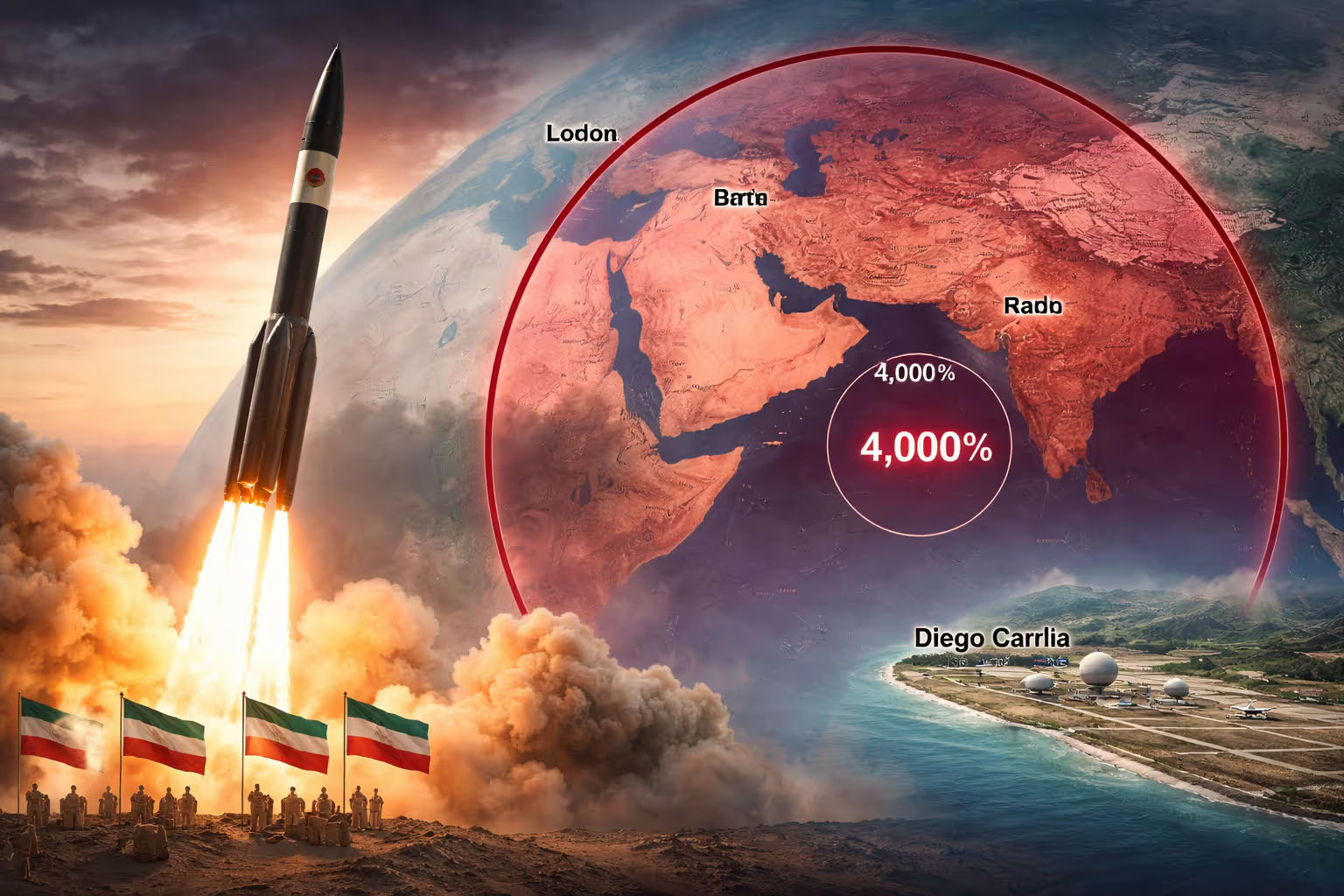
The incident involved the reported launch of two long-range missiles toward Diego Garcia, located approximately 4,000 kilometres from Iran. While one missile was intercepted by United States defense systems and the other reportedly failed mid-flight, the significance of the attempt lies less in its outcome and more in what it reveals about Iran’s technological advancements.
Analysts from the Institute for the Study of War (ISW) have described the launch as the “furthest ever attempted Iranian missile strike,” challenging long-held assumptions about the operational limits of Tehran’s missile arsenal. Until now, Iran was widely believed to lack the capability to strike targets at such distances.
Diego Garcia, situated in the Indian Ocean, plays a crucial role in US military operations across multiple regions, including the Middle East, South Asia, and East Africa. It serves as a launchpad for long-range bombers, surveillance missions, and logistical support, making it a high-value strategic target.
Breaking the Self-Imposed Limit
For years, Iran has maintained that it had voluntarily imposed a limit of approximately 2,000 kilometres on the range of its ballistic missiles. This policy was often presented as a measure of restraint, aimed at reducing tensions with Western nations while maintaining regional deterrence.
However, the attempted strike on Diego Garcia—nearly double that range—has cast serious doubt on these claims. If confirmed, the development would indicate that Iran has either quietly advanced its missile technology or found ways to extend the range of existing systems beyond previously known limits.
This revelation could have far-reaching implications, particularly for countries outside the Middle East that were previously considered beyond Iran’s reach.
Conflicting Narratives and Denials
Iranian officials have denied targeting the Diego Garcia base. Foreign Ministry spokesperson Esmaeil Baghaei rejected the claims, while NATO Secretary-General Mark Rutte stated that the alliance could not independently verify the missile launches.
Despite these denials, multiple defense analysts and intelligence sources suggest that the attempted strike did occur. The lack of definitive confirmation reflects the сложности of verifying military activities in a highly contested and rapidly evolving conflict environment.
Meanwhile, the Israel Defense Forces (IDF) issued a warning that Iran’s missile developments could pose a broader threat beyond the Middle East. Israeli officials claimed that European capitals such as Berlin, Paris, and Rome could fall within range if Iran’s capabilities extend to 4,000 kilometres.
The United Kingdom government, however, downplayed the threat, stating that there was no specific intelligence indicating that Britain was at immediate risk.
Inside Iran’s Missile Program
Iran has spent decades developing one of the largest and most diverse ballistic missile arsenals in the Middle East. According to US intelligence estimates, the country possesses at least 14 different types of ballistic missiles, ranging from short-range systems to medium-range weapons.
Among the most notable are the Khorramshahr and Sejjil missiles, both of which are believed to have ranges of approximately 2,000 kilometres. These systems have formed the backbone of Iran’s long-range strike capability.
The recent developments suggest that Iran may not have introduced entirely new missile systems but instead modified existing ones to achieve greater distances.
How Could Iran Extend Missile Range?
Experts have proposed several possible explanations for how Iran managed to reach—or attempt to reach—a target nearly 4,000 kilometres away.
One key factor is payload reduction. By decreasing the weight of the warhead, a missile can travel significantly farther. This principle is well understood in missile engineering: the lighter the payload, the greater the achievable range.
French defense researcher Etienne Marcuz suggested that a Khorramshahr-4 missile equipped with a lighter warhead could potentially reach distances far beyond its standard range. Similarly, analysts from the James Martin Center for Nonproliferation Studies noted that reducing payload weight could extend the range of existing missile systems.
However, such modifications come with trade-offs. A lighter payload may limit the missile’s destructive power, raising questions about its practical military effectiveness.
The Role of Space Technology
Another theory involves the use of Iran’s space-launch capabilities. The Simorgh rocket, designed to place satellites into low Earth orbit, could potentially be adapted for military purposes.
The Simorgh is a two-stage, liquid-fuelled rocket capable of achieving significant velocities and altitudes. While its primary purpose is civilian, the underlying technology shares similarities with long-range ballistic missiles.
US intelligence agencies have long warned that such dual-use technologies could be repurposed to develop intercontinental missile systems. If Iran has indeed leveraged its space program for military applications, it would represent a significant шаг forward in its capabilities.
Challenges of Accuracy and Reliability
While the ability to launch a missile over long distances is a notable achievement, it does not necessarily translate into an effective weapon.
Long-range missiles face several technical challenges, particularly in terms of accuracy and survivability. As a missile travels further, it must endure extreme speeds and temperatures during re-entry into the Earth’s atmosphere.
Ensuring that a warhead remains intact and reaches its intended target requires advanced engineering, including heat shielding and precise guidance systems. Experts have noted that Iran has limited experience testing warheads over such distances, raising doubts about the reliability of its extended-range capabilities.
Professor Stephan Fruehling from the Australian National University emphasized that while Iran may be able to “throw something” over long distances, this does not guarantee that it can accurately strike targets or deliver meaningful payloads.
Strategic Messaging and Deterrence
Beyond the technical aspects, the attempted strike appears to carry significant political and strategic implications.
Analysts believe that Iran’s actions were intended to send a clear message to its adversaries, particularly the United States and its allies. By demonstrating a potential ability to strike distant targets, Tehran may be seeking to deter further military action against its interests.
The move also comes amid heightened tensions in the Middle East, including attacks on Iranian infrastructure, ongoing conflicts involving allied groups, and disruptions in critical shipping routes such as the Strait of Hormuz.
In this context, the missile launch can be seen as part of a broader strategy aimed at asserting Iran’s resilience and способность to respond to external threats.
Shifting Dynamics Within Iran
The missile launch may also reflect changes in Iran’s internal power structure. Following the reported killing of Supreme Leader Ayatollah Ali Khamenei, analysts suggest that decision-making processes within Tehran may be evolving.
Israeli analyst Danny Citrinowicz argued that the launch represents a departure from the осторожный approach traditionally associated with Khamenei’s leadership. He suggested that new power centers within Iran may be more willing to take risks and adopt a more aggressive stance.
Such shifts could lead to increased unpredictability in Iran’s military actions, complicating efforts to manage regional tensions.
The Strategic Importance of Diego Garcia
The choice of Diego Garcia as a target underscores its importance in global military strategy. The island serves as a ключевой hub for US operations, enabling rapid deployment across multiple regions.
Its remote location has long been considered a strategic advantage, placing it beyond the reach of most regional угроз. However, Iran’s attempted strike challenges this assumption, suggesting that even distant bases may no longer be immune.
The base has also been at the center of diplomatic tensions. While the United Kingdom initially hesitated to allow its use for offensive operations against Iran, it later permitted limited use for defensive purposes.
Implications for Global Security
If Iran’s extended-range capabilities are confirmed, the implications could be profound.
First, it would alter threat perceptions across multiple regions. Countries in Europe, Asia, and Africa may need to reassess their security strategies and invest in advanced missile defense systems.
Second, it could accelerate a global arms race, with nations seeking to enhance both offensive and defensive capabilities in response to evolving threats.
Third, it raises concerns about the proliferation of missile technology. If Iran can successfully adapt existing systems to achieve greater ranges, other countries may attempt similar approaches.
Conclusion
Iran’s attempted missile strike on Diego Garcia represents a significant development in the evolving landscape of global security. While the operation did not succeed in hitting its target, it has raised critical questions about the true capabilities of Iran’s missile program and its strategic intentions.
Whether this event marks a genuine breakthrough or a one-time demonstration remains uncertain. However, it has already reshaped discussions about regional and global угрозы, highlighting the need for continued vigilance and diplomatic engagement.
As tensions continue to rise, the international community will be closely watching Iran’s next moves, seeking to understand whether this attempted strike signals a new era in long-range missile capabilities or simply a попытка продемонстрировать силу in an increasingly complex geopolitical environment.
Related Posts