Fuel Price Hike and Cricket Fever Grab Attention Today
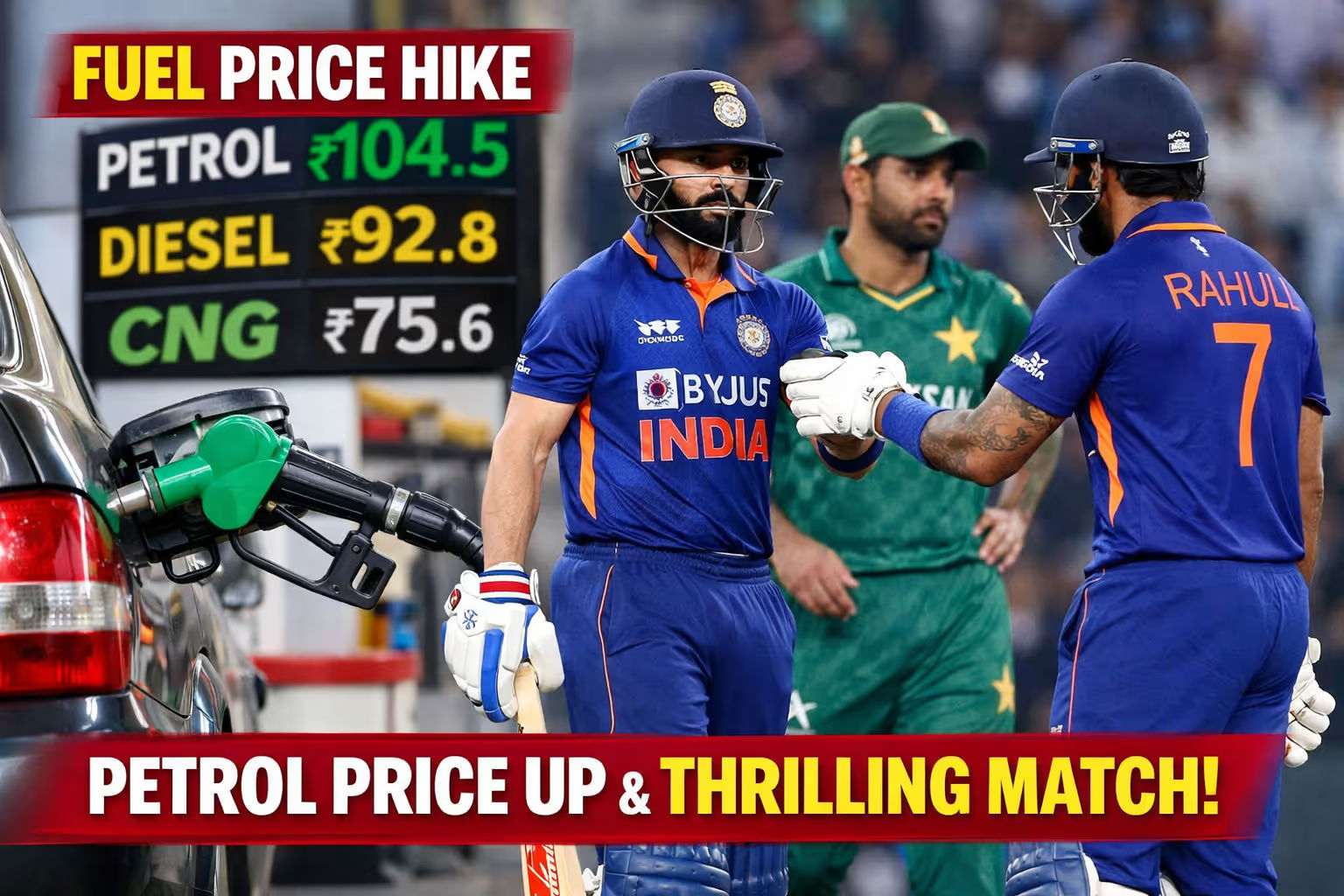
Fuel Prices Stay Firm as IPL Drama Grips Fans: Two Big Stories Defining India’s Sunday
India’s news cycle on Sunday was shaped by two subjects that instantly connect with everyday life: the cost of fuel and the emotion of cricket. On one side, petrol and diesel prices remained under close public watch as global oil markets stayed volatile amid disruption fears in West Asia. On the other, the Indian Premier League delivered another dramatic contest, with Kolkata Knight Riders pulling off a tense win over Rajasthan Royals in a match that reminded fans why T20 cricket can dominate the national conversation in a matter of hours.
For millions of households, fuel prices are not just a number on a board outside a petrol pump. They affect commuting, transport costs, deliveries, food prices and business expenses. That is why the latest update drew attention even though there was no broad nationwide retail shock at the pump on April 19. According to the latest city-wise updates, petrol and diesel prices at state-run outlets remained largely stable across major Indian cities despite continued turbulence in the global oil environment. The stability came even as broader concerns persisted over maritime energy routes and supply-chain risks.
The city-level fuel picture showed how closely consumers track even the smallest shifts. Petrol in New Delhi was listed at ₹94.77 per litre, while Mumbai stood at ₹103.54 and Kolkata at ₹105.41. Chennai was at ₹100.84, showing a marginal decline, while Bengaluru stood at ₹102.92. Diesel prices also reflected relative stability: New Delhi was at ₹87.67 per litre, Mumbai at ₹90.03, Kolkata at ₹92.02, Chennai at ₹92.39 and Bengaluru at ₹90.99. For many consumers, the key takeaway was not just the absolute price but the fact that there was no sweeping revision across the major metros on Sunday.
That stability matters because India’s fuel pricing remains deeply tied to international developments. IndianOil notes that petrol and diesel prices are revised daily at 6 a.m., which means even if consumers see no visible change on a given day, the domestic market remains highly responsive in structure. The latest reporting also linked the current caution in the fuel market to disruption risks around the Strait of Hormuz, one of the world’s most sensitive oil transit chokepoints. In that backdrop, stable retail prices become a political and economic signal: authorities are trying to keep inflationary spillover under control even when the global backdrop is unsettled.
The pressure is not only about petrol and diesel for vehicles. Cooking gas has also become part of the broader affordability discussion. Official Bharat Petroleum data for April 1 showed domestic LPG prices in the metros at ₹913 in Delhi, ₹912.50 in Mumbai, ₹928.50 in Chennai and ₹939 in Kolkata. At the same time, commercial LPG prices rose sharply in early April, with reports noting a ₹195 increase in the 19 kg commercial cylinder and metro commercial rates such as ₹2,078.50 in Delhi, ₹2,031 in Mumbai, ₹2,246.50 in Chennai and ₹2,208 in Kolkata. That gap between household and commercial gas pricing matters because restaurants, food vendors and small service businesses often pass part of that burden onward to customers.
The wider macroeconomic concern is clear. Reuters reported this week that India’s retail inflation rose to 3.4% in March, up from 3.21% in February, with worries mounting over how prolonged tension in West Asia could raise energy-linked costs in an economy that imports most of its oil. Even when pump prices do not jump immediately, volatility in crude, freight, insurance and supply chains can slowly work through transport, logistics and household budgets. That is why stable fuel prices on a single day may reassure consumers in the short run, while still leaving policymakers alert to the risks ahead.
There was also another important reassurance in the Sunday coverage: the claim that India currently holds significant fuel inventories. The latest report said stocks of crude oil, petrol, diesel and aviation turbine fuel were sufficient for more than 60 days of consumption, with LNG stocks for up to 50 days and LPG stocks for around 40 days. That kind of reserve position is meant to calm fears of immediate shortages and discourage panic reactions in the market. In a news environment where global conflict often creates sudden anxiety, the message was clear: volatility may continue, but supply continuity remains a priority.
If fuel prices represented the anxiety of everyday economics, cricket supplied the day’s emotional release. The IPL once again delivered a match packed with momentum swings, collapses, recoveries and late drama. In Kolkata, the Knight Riders defeated Rajasthan Royals by four wickets after chasing 156 with two balls to spare. Official match reporting said KKR restricted RR to 155/9 and then reached 161/6 in 19.4 overs, with Rinku Singh finishing unbeaten on 53 and playing the decisive role in the closing stages.
The story of the match was especially compelling because Rajasthan had begun with authority. Vaibhav Sooryavanshi made 46 off 28 balls and Yashasvi Jaiswal contributed 39 off 29 as RR surged to 81 without loss in 8.3 overs. At that point, Rajasthan looked on course for a much bigger score. But KKR’s spinners changed the rhythm of the contest. Varun Chakaravarthy produced figures of 3/14, while Sunil Narine added 2/26, helping trigger a collapse that dragged Rajasthan from control into a far more modest total.
KKR’s chase then swung violently in the other direction. Nandre Burger and Jofra Archer reduced the home side to an early crisis, removing Tim Seifert and Ajinkya Rahane for ducks within the first eight balls. Archer’s strike was especially notable because the official report said it marked the third straight match in which he had taken a wicket with the first ball of the innings. Later, when Cameron Green and Angkrish Raghuvanshi fell, KKR were in deep trouble at 70/5 in the 11th over. At that stage, another defeat appeared more likely than a comeback.
What followed is exactly why Rinku Singh has built such a reputation as a finisher. Joined by Anukul Roy, he steadied the innings before accelerating at the right time. The official match report said the pair transformed the equation, including a 19-run over off Ravi Bishnoi that changed the pressure pattern. Anukul remained unbeaten on 29 from 16 deliveries, while Rinku sealed the contest in style, bringing up his half-century and KKR’s first win of the season. The result also lifted Kolkata off the bottom portion of the table, while Rajasthan missed the chance to move to the top.
The official IPL schedule showed that April 19 was always going to be a high-attention day, with two matches listed for the Sunday slate. The sports feed also showed Punjab Kings versus Lucknow Super Giants in progress later in the day, underlining how nonstop the league’s news rhythm has become. In practical terms, this means cricket now functions not merely as sport but as a rolling national event, producing match reports, social media conversation, fantasy reactions, brand buzz and emotional headlines all within a few hours.
What makes today’s pairing of stories so striking is how different they are and yet how naturally they sit together in the Indian public mood. Fuel news speaks to responsibility, budgets and the practical cost of living. Cricket news speaks to identity, excitement and shared emotional release. One is read with concern, the other with anticipation. Yet both are immediate. A litre price on the fuel board and a six in the final over can each dominate public attention in their own way because both affect routine conversation across homes, offices, markets and mobile screens.
There is also a deeper connection between the two stories. Stable fuel prices, even amid global uncertainty, create a sense of temporary relief in an economy where transport costs ripple widely. At the same time, a gripping IPL finish offers a cultural counterweight to that tension, giving people something to celebrate, debate and replay. Sunday, therefore, did not produce one single headline that defined the nation. Instead, it produced a familiar Indian duality: concern over prices and joy in sport.
For now, the fuel market remains watchful rather than panicked. Petrol and diesel prices across major cities are largely steady, domestic LPG rates in the metros remain at their April 1 levels, and official messaging stresses adequate inventories. But the global context remains fragile, and that means energy costs will continue to be monitored closely in the coming days. On the cricket front, KKR’s thrilling win has injected fresh life into their campaign, while Rajasthan will reflect on a game they once seemed to control.
In the end, this Sunday’s biggest stories were about movement in two very different forms: the movement of fuel through a nervous global supply chain, and the movement of momentum in a T20 contest that turned on a few overs and a few nerves. One story asked whether India could stay insulated from global oil shocks. The other asked which side could hold its nerve in a chase. Together, they created the kind of news day that feels instantly familiar: practical, emotional, uncertain and impossible to ignore.
Related Posts