Connections: Sports Edition for April 5, 2026 — clues and solutions for Puzzle #559
Connections: Sports Edition Puzzle No. 559 Gives Players a Clever Mix of NFL Knowledge and Wordplay
Daily puzzle fans had another reason to test their sports knowledge on April 5, 2026, as Connections: Sports Edition returned with Puzzle No. 559, offering a board that blended football familiarity, current player recognition, and one especially tricky dose of wordplay. With a difficulty rating of 3.5 out of 5, the latest edition struck a balance between approachable and challenging, giving players a game that was not too easy to finish at first glance but still satisfying once the patterns began to emerge.
Published as part of The Athletic’s growing lineup of interactive sports content, Connections: Sports Edition continues to attract readers who enjoy games that combine logic, vocabulary, and sports awareness. Unlike a traditional trivia quiz, the puzzle does not simply ask players to recall facts. Instead, it presents a board of 16 words and challenges them to arrange the words into four groups of four, with each group connected by a shared theme. The twist, of course, is that many words can appear to fit more than one category, making the process more difficult than it first seems.
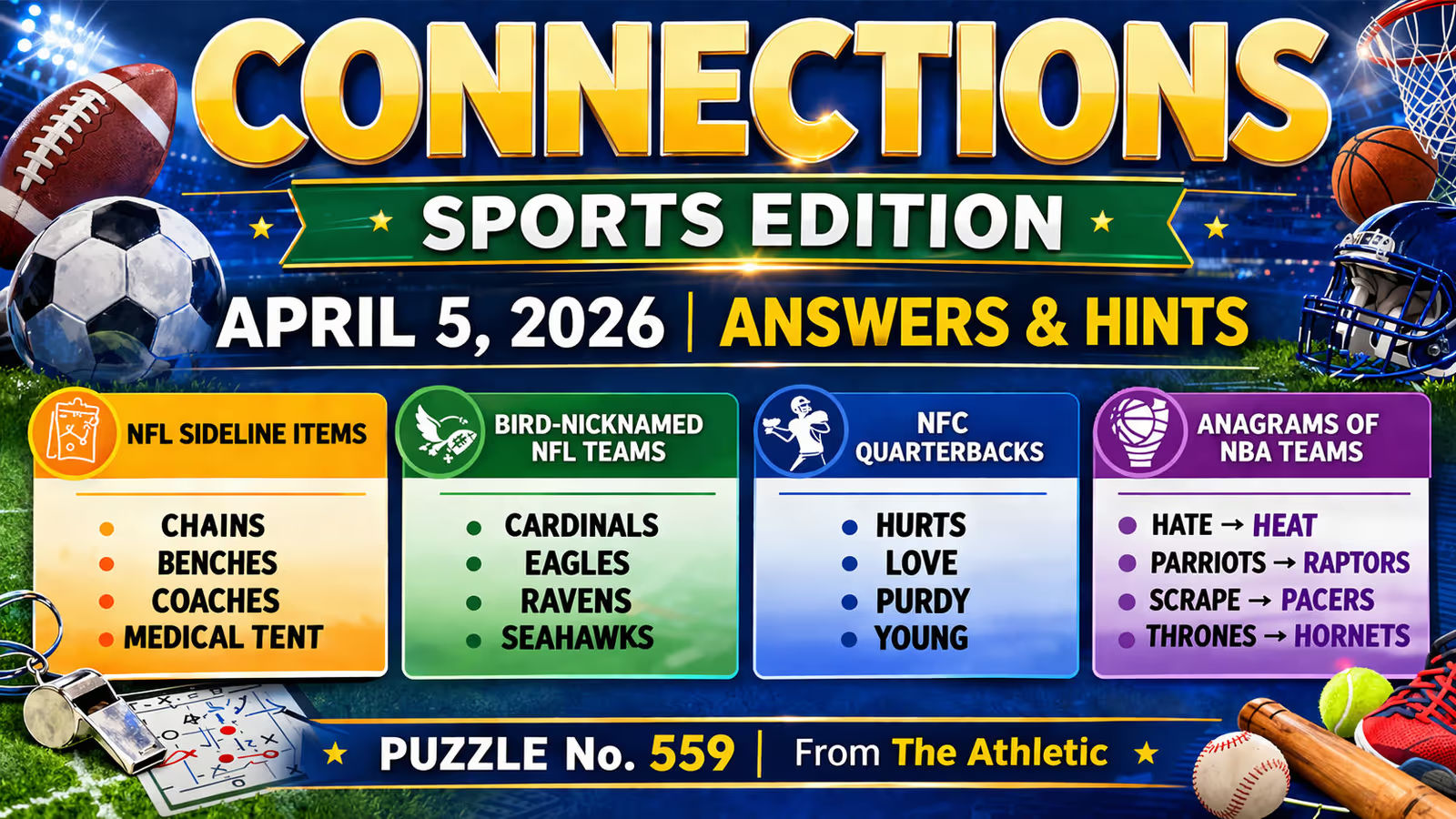
That formula was fully on display in Puzzle No. 559. Today’s board featured categories built around NFL sideline items, NFL teams with bird nicknames, NFC quarterbacks, and anagrams of NBA teams. Together, those themes created a puzzle that leaned heavily into football but still left room for language-based trickery. For sports fans, it was a reminder that the appeal of Connections lies not only in what you know, but in how you think.
Before revealing the full answers, the puzzle’s companion article offered a familiar warning to readers: scroll carefully if you want to avoid spoilers. Like other daily puzzle communities, Connections: Sports Edition thrives on the tension between discovery and assistance. Some readers want a gentle nudge, while others prefer to struggle through the board unaided. To meet both kinds of players, the article first provided one clue from each category and only later revealed the complete solutions.
Those early hint words were COACHES, CARDINALS, YOUNG, and HATE. On the surface, they may not have looked especially connected. In fact, that was part of the puzzle’s design. Each hint served as a doorway into a broader category, but none made the full answer immediately obvious. For players trying to solve the board without spoiling it entirely, those clues offered just enough direction to keep the challenge alive.
The easiest category on the board, marked in yellow, was Things on an NFL sideline. The four answers were CHAINS, BENCHES, COACHES, and MEDICAL TENT. This group likely gave many players their first foothold. Football fans are used to seeing all of these items during live games and television broadcasts. The chains, used to measure first downs, are iconic symbols of American football itself. Benches line the team area, coaches move constantly along the sideline calling plays and managing personnel, and the medical tent has become an increasingly common presence in the modern NFL era due to the league’s greater focus on player safety and injury evaluation.
What made this category effective was that it felt obvious only after it was solved. “Coaches” and “benches” might have stood out right away, but “chains” and “medical tent” required players to picture the sideline more carefully. That is often how Connections works best: a category seems simple in hindsight, but only after the player has mentally organized the scene or concept in the correct way. The yellow group was therefore straightforward, but not lazy. It asked for recognition, not just reaction.
The green category moved to NFL teams with bird nicknames, and the answers were CARDINALS, EAGLES, RAVENS, and SEAHAWKS. This was another category that likely felt accessible to sports fans, especially anyone with even a basic familiarity with the NFL. The Arizona Cardinals, Philadelphia Eagles, Baltimore Ravens, and Seattle Seahawks are all long-established franchises with strong fan bases and recognizable identities. Once a player identified two of them, the rest of the pattern likely became easier to see.
Still, the category worked because it demanded precision. Sports puzzles often rely on names that can belong to multiple leagues or themes, and bird nicknames are specific enough to force the player to narrow the possibilities. The green group also fit nicely with the yellow one, since both were rooted in the NFL but approached the sport from different angles. One focused on the physical environment of the game, while the other focused on team branding. That thematic overlap may have made the puzzle feel coherent, but it also risked misleading players into assuming the entire board was about teams or football objects.
The blue category raised the difficulty by requiring awareness of current player names. This group was NFC quarterbacks, with the correct answers being HURTS, LOVE, PURDY, and YOUNG. This was the point in the puzzle where sports knowledge became more specialized. These are surnames of prominent quarterbacks in the National Football Conference, and recognizing them required more than casual exposure to headlines. Jalen Hurts, Jordan Love, Brock Purdy, and Bryce Young are all names tied to ongoing NFL storylines, roster discussions, and team ambitions.
This category also showed how Connections uses ordinary words to create ambiguity. “Love” and “Young” are words that exist comfortably outside sports language. A player who did not immediately recognize them as quarterback surnames might have tried to connect them through emotions, age, or other abstract concepts. That is exactly the kind of trap that makes the puzzle engaging. The word is familiar, but its meaning inside the puzzle is narrower and more context-specific than it seems at first glance.
The choice of quarterbacks as a category also reflected the puzzle’s connection to current sports culture. Quarterbacks remain the most visible figures in American football, and fans regularly discuss their performances, injuries, contracts, and playoff chances. By using a category built around NFC passers, the puzzle tapped into that visibility while still making the task challenging enough to reward careful thinking. For some players, this group may have been the breakthrough that separated a casual solve from a satisfying one.
Then came the purple category, which was the board’s most difficult group and arguably its most clever. The theme was Anagrams of NBA teams, and the answers were HATE, PARRIOTS, SCRAPE, and THRONES. This was the category that likely stopped many players in their tracks. At first glance, these words do not point clearly to basketball or even sports at all. They look random, or perhaps like they belong in a general vocabulary puzzle rather than a sports one. But once players started rearranging the letters, the pattern emerged.
Anagram-based categories are especially effective in Connections because they force players to switch modes. Instead of looking for meaning, they have to look for structure. Instead of asking what the words represent, they have to ask what the letters can become. That shift is often what makes the purple category feel tricky, even for people who are strong on sports knowledge. It is not enough to know the teams; the player must also spot the hidden transformation behind the clue.
This category added variety to a board that otherwise leaned heavily on football. By ending with NBA-related wordplay, Puzzle No. 559 avoided becoming too predictable. It also demonstrated one of the core strengths of the format: the categories can test different mental skills within the same board. The yellow group rewarded visual familiarity with game-day settings, the green group rewarded knowledge of franchises, the blue group rewarded player recognition, and the purple group rewarded word manipulation. That range is a large part of what keeps the game fresh.
The reported difficulty of 3.5 out of 5 seems fitting when looked at in that context. This was not an impossible puzzle, but it was certainly not one that most players would finish instantly. The yellow and green groups were manageable entry points. The blue category required stronger awareness of the NFL’s current quarterback landscape. The purple category introduced the kind of twist that can either delight or frustrate, depending on how quickly the solver sees it. Altogether, the board delivered a moderate challenge, one that likely produced a mix of quick victories and narrow escapes.
Another key feature of the puzzle is its rule that players must find all four groups without making four mistakes. That limit adds genuine tension to the experience. In a puzzle where many words seem like they could fit together, every guess matters. A player might think “Love” and “Young” belong in a group about personal qualities, or assume “Cardinals” belongs with a religious or bird-related category unrelated to the NFL. The fear of using up mistakes creates suspense, which is part of why players often want hints without full spoilers.
The article surrounding today’s puzzle served both as a guide and a celebration of the game’s community. It invited players to gather, discuss, and even share their scores. That social aspect has become a major part of modern puzzle culture. People no longer just solve games privately; they compare results, swap frustrations, laugh at missed patterns, and measure how quickly they spotted the trickiest category. In that sense, Connections: Sports Edition is not only a daily brain teaser but also a small communal event for sports-minded readers.
The game itself is described as The Athletic’s first-ever game, a fact that highlights how sports media outlets are increasingly expanding beyond reporting and commentary. Interactive products now sit alongside match analysis, transfer news, opinion columns, and fantasy advice. Sports audiences no longer want to only read; they also want to participate. Daily puzzles offer a way to keep readers engaged beyond the news cycle, especially during quieter hours of the day when there may be no live events underway.
The presence of a named puzzle creator also adds personality to the feature. Mark Cooper, identified as the person behind Connections: Sports Edition, brings a human voice to the game. That matters because puzzle fans often develop a relationship with a constructor’s style. Over time, regular players begin to recognize certain habits, tricks, and levels of difficulty. Knowing who creates the game helps turn the puzzle into a continuing dialogue between editor and audience.
The article also noted that the next puzzle would become available at midnight in the player’s time zone. That release pattern helps make the game part of a daily routine. Just as some fans check scores every morning or read sports headlines with breakfast, others now begin the day with a puzzle. The simplicity of that habit is part of the game’s strength. It is short enough to fit into a busy schedule, yet layered enough to feel meaningful when solved.
Puzzle No. 559 shows why this format has found an audience. It did not rely on obscure statistics or highly technical knowledge. Instead, it used recognizable elements of sports culture and arranged them in a way that demanded attention, pattern recognition, and patience. A sideline scene, a set of bird mascots, a group of quarterbacks, and a hidden set of NBA anagrams may sound like disconnected ideas, but inside the puzzle they formed a tightly designed challenge.
For players, the satisfaction of solving such a board comes from the moment when confusion gives way to clarity. A random set of words suddenly becomes structured. A misleading clue turns out to be part of something elegant. A category that felt impossible reveals itself as obvious. That emotional swing is what makes daily puzzles compelling, and it is what today’s Connections: Sports Edition puzzle delivered.
In the broader picture, the success of features like this reflects a shift in how audiences consume sports content. Fans still want breaking news, live updates, and expert analysis, but they also want interactive experiences that allow them to test themselves. Games like Connections: Sports Edition meet that demand by turning sports knowledge into play. They give fans a new way to engage with the teams, players, and language they already follow closely.
April 5’s puzzle may have been rated only moderately difficult, but its appeal went beyond the number. It captured the charm of a good sports puzzle: familiar enough to invite people in, tricky enough to hold their attention, and clever enough to leave an impression after the board was complete. For regular players, Puzzle No. 559 was another enjoyable daily challenge. For newcomers, it was a strong example of why the game continues to grow in popularity.
In the end, Connections: Sports Edition Puzzle No. 559 delivered exactly what fans of the format hope for — a blend of sports awareness, logic, surprise, and fun. Whether players solved it quickly or needed a few hints along the way, the board offered a rewarding mental workout and another reminder that sports entertainment now includes much more than scores and standings.
Related Posts