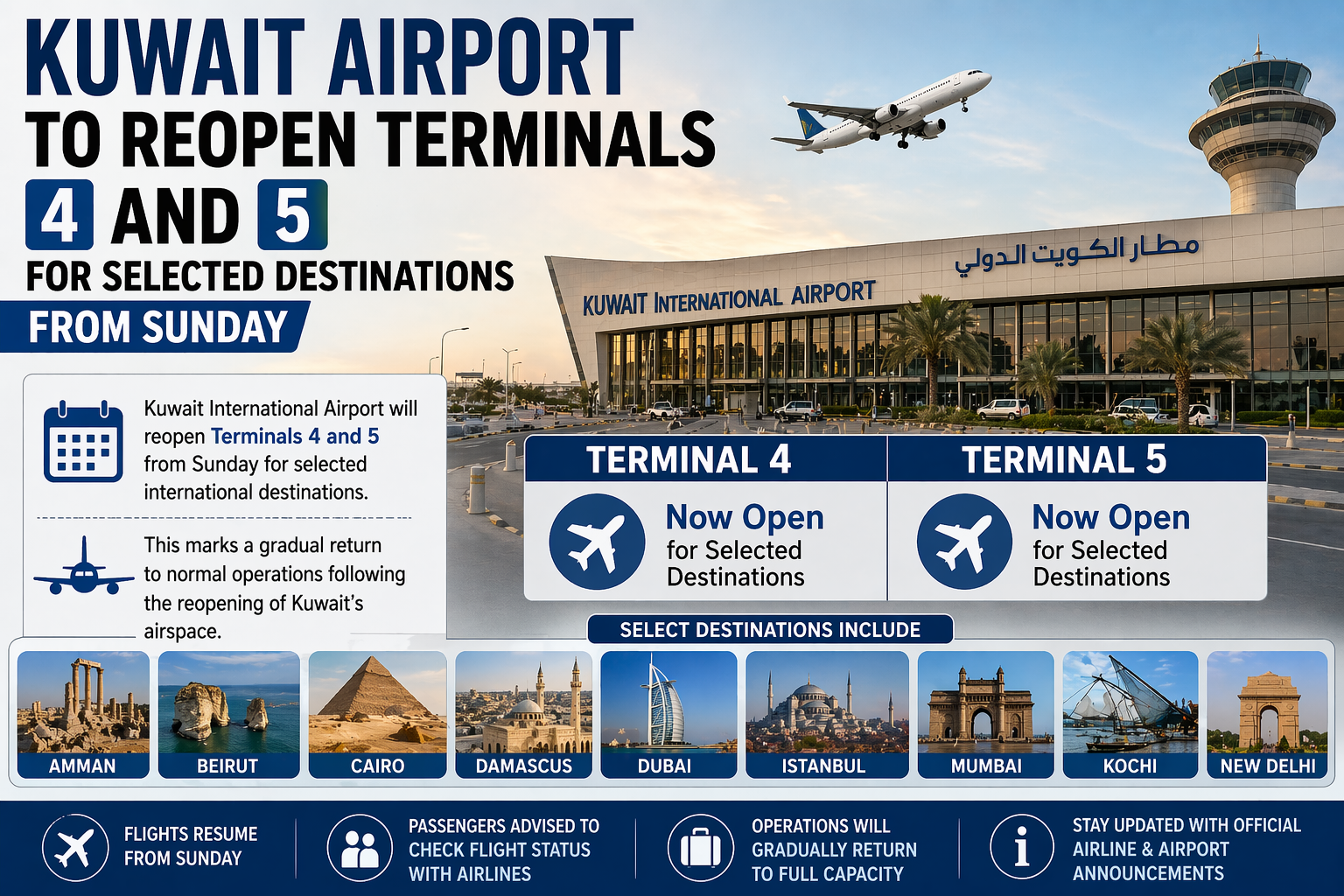
Kuwait Airport to Reopen Terminals 4 and 5 for Selected Destinations from Sunday
Jazeera Airways to Resume Flights to Nine Destinations as Kuwait International Airport Reopens Operations
In a significant boost for regional aviation and passenger connectivity, Jazeera Airways has announced the resumption of flights to nine international destinations from Kuwait International Airport Terminal 5 beginning Sunday. The move follows the reopening of Kuwait’s airspace by the Directorate General of Civil Aviation after months of precautionary restrictions linked to regional developments.
The announcement marks an important turning point for Kuwait’s aviation sector, which has been operating under temporary limitations since late February 2026. With airspace now reopened, airlines are gradually restoring schedules, reconnecting passengers, businesses, and families with key destinations across the Middle East, South Asia, and beyond.
Nine Key Routes to Restart
According to the airline, the first phase of resumed services will cover nine major cities:
Amman
Beirut
Cairo
Damascus
Dubai
Istanbul
Mumbai
Kochi
New Delhi
These destinations represent some of the busiest travel corridors for Kuwait, serving a mix of leisure travelers, expatriate communities, business passengers, and transit flyers.
The airline said additional services would be restored gradually as operations stabilize and demand strengthens.
Why the Announcement Matters
The resumption of flights is highly significant because Kuwait serves as a strategic travel hub in the Gulf region. Any disruption to airport operations affects thousands of travelers daily, along with trade flows, tourism, and workforce mobility.
For months, Kuwait had imposed a temporary suspension of certain flight operations beginning February 28, 2026, citing regional security developments. While the suspension was described as precautionary, it required airlines to rapidly adapt operations, reroute passengers, and temporarily shift assets outside the country.
Now, with normal aviation activity beginning to return, travelers and the broader business community are expected to benefit immediately.
Jazeera Airways’ Role During the Disruption
During the suspension period, Jazeera Airways continued operating limited services by shifting flights to alternative airports in neighboring Saudi Arabia.
The airline said it maintained Kuwait’s connectivity through operations from:
Al-Qaisumah Airport
King Fahd International Airport
This contingency plan demonstrated the carrier’s operational flexibility and its effort to keep passengers connected despite difficult circumstances.
According to company officials, more than 500 employees were temporarily relocated from Kuwait to support those operations. In addition, 14 aircraft from the airline’s fleet of 23 were moved outside Kuwait during the disruption.
Such a large-scale temporary relocation reflects the seriousness of the earlier restrictions, as well as the airline’s commitment to continuity.
CEO Highlights Commitment to Reliability
Chief Executive Officer Barathan Pasupathi stated that the airline remains focused on delivering value, reliability, and strong air connectivity.
His remarks emphasized that aviation is more than transportation—it is a critical economic enabler that links communities, supports tourism, enables employment mobility, and strengthens commercial relationships between countries.
By restoring flights quickly after the reopening of airspace, Jazeera Airways appears keen to reassure passengers that schedules are returning and services remain dependable.
Why These Nine Destinations Were Chosen First
The first batch of resumed routes is notable because it includes a balanced mix of high-demand markets.
Gulf and Middle East Routes
Flights to Dubai, Amman, Beirut, and Damascus are important regional links used by business travelers and families.
Major International Cities
Cairo and Istanbul are two of the most popular regional travel hubs, offering onward connections and strong tourism demand.
Indian Market Importance
The inclusion of Mumbai, Kochi, and New Delhi reflects the importance of the Indian market to Kuwait’s economy and society.
India has a large expatriate community in Kuwait, and these routes are frequently used for employment travel, family visits, trade, and tourism.
Reopening of Kuwait Airspace
Earlier the same day, Kuwait’s civil aviation authorities formally announced the reopening of the country’s airspace.
The decision came after a temporary suspension introduced on February 28 due to evolving regional developments. Officials had previously described the restrictions as precautionary, aimed at ensuring public safety and operational readiness.
The reopening signals greater confidence in the current security environment and paves the way for a phased normalization of aviation services.
Terminal 5 Returns to Action
The resumed services will operate from Terminal 5, the dedicated terminal associated with Jazeera Airways at Kuwait International Airport.
Terminal 5 has played a major role in the airline’s growth, offering a streamlined passenger experience with faster processing, dedicated facilities, and improved convenience.
For regular travelers, the reopening of Terminal 5 operations means a return to more familiar schedules and airport procedures.
Impact on Passengers
For many passengers, the announcement will bring immediate relief.
Travelers who had delayed family visits, vacations, medical trips, or business travel may now begin making plans again. Some had previously relied on rerouted journeys through Saudi airports or alternative Gulf hubs.
Direct flights from Kuwait save time, reduce travel complexity, and often lower total costs.
Passengers are still expected to monitor airline notifications closely, as schedules may continue to evolve during the gradual restoration period.
Economic Importance for Kuwait
The return of normal airline operations has broader economic implications.
Aviation supports:
Tourism revenue
Cargo movement
Hospitality demand
Retail spending
Conference and business travel
Job creation
As flights increase, hotels, transport services, travel agencies, restaurants, and airport-linked businesses are also likely to benefit.
For Kuwait, a well-functioning aviation sector is essential to maintaining competitiveness in the Gulf region.
Appreciation to Saudi Authorities
Jazeera Airways publicly thanked the Saudi General Authority of Civil Aviation for its cooperation during the disruption period.
That acknowledgment highlights the importance of regional coordination in aviation. During times of operational stress, neighboring countries can provide vital support through airport access, regulatory coordination, and logistical assistance.
The airline also expressed gratitude to Kuwait’s civil aviation authorities for their trust and support.
What Happens Next?
Industry observers expect the following developments over coming weeks:
More destinations added to schedules
Increased flight frequencies on busy routes
Gradual return of aircraft to Kuwait bases
Full staff normalization
Improved passenger confidence and bookings
Much will depend on regional stability and travel demand, but the latest move clearly signals progress toward full recovery.
Competitive Landscape
The Gulf aviation market remains highly competitive, with carriers from Kuwait, the UAE, Saudi Arabia, Qatar, Bahrain, and Oman competing for passengers.
By restarting quickly, Jazeera Airways can defend market share and restore loyalty among travelers who value direct Kuwait departures.
Budget-conscious passengers may also see the airline as an attractive option once regular pricing and schedules normalize.
Final Outlook
The decision by Jazeera Airways to resume flights to nine destinations from Sunday is more than a routine scheduling update—it is a strong sign that Kuwait’s aviation system is returning to normal after a challenging period.
With flights restarting to major cities such as Dubai, Mumbai, New Delhi, and Istanbul, passengers once again gain access to key business and family routes.
For Kuwait, the reopening of airspace and airport terminals represents renewed confidence, restored connectivity, and a positive step for the economy. For travelers, it means simpler journeys ahead.
Tags:
Related Posts

BMW F 450 GS debuts with a starting price of ₹4.70 lakh.

HK Accounting Watchdog Penalises PwC HK$300 Million, Enforces Six-Month Practice Ban Over Evergrande Audit