What is the purpose of the pattern attribute in an <input> tag?
What Is the Purpose of the pattern Attribute in an <input> Tag?
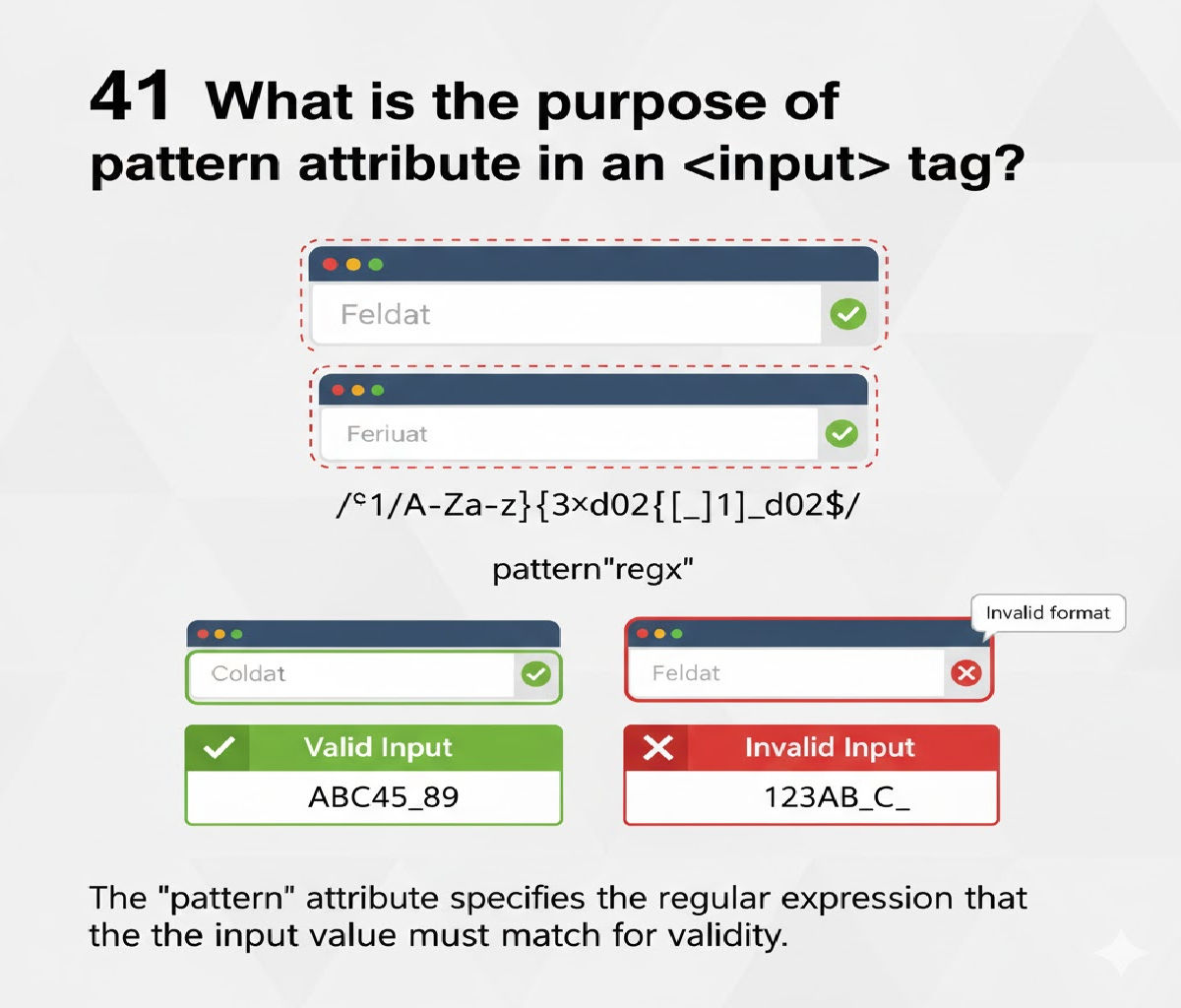
The pattern attribute in an HTML <input> element is used to define a regular expression (regex) that the input’s value must match in order to be considered valid. It is a powerful client-side validation tool that helps ensure users enter data in the correct format before submitting a form.
In simple terms, the pattern attribute acts like a format checker. If the user enters data that does not match the specified pattern, the browser automatically prevents form submission and displays a validation message.
1. Why the pattern Attribute Is Important
Modern web forms collect various types of user input such as:
- Phone numbers
- Email addresses
- Postal codes
- Passwords
- Username formats
- IDs
If users enter incorrect data, it can cause errors in:
- Database storage
- Payment processing
- Account creation
- API communication
The pattern attribute ensures that the input follows a specific format before the data even reaches the server.
This improves:
- Data accuracy
- User experience
- Security
- Form reliability
2. Basic Syntax of the pattern Attribute
<input type="text" pattern="regular_expression">It works with:
type="text"type="password"type="search"type="tel"type="url"type="email"(in combination with built-in validation)
3. Simple Example: Numbers Only
Let’s create a field that only allows 4 digits.
<!DOCTYPE html><br><html><br><head><br> <title>Pattern Example</title><br></head><br><body><form><br> <label>Enter 4 Digit PIN:</label><br> <input type="text" pattern="[0-9]{4}" required><br> <button type="submit">Submit</button><br></form></body><br></html>Explanation:
[0-9]→ Allows digits 0 to 9{4}→ Exactly 4 digitsrequired→ Field cannot be empty
If the user enters:
- ✅ 1234 → Valid
- ❌ 12 → Invalid
- ❌ 12345 → Invalid
- ❌ abcd → Invalid
4. Example: Only Alphabets Allowed
<form><br> <label>Enter Name (letters only):</label><br> <input type="text" pattern="[A-Za-z]+" required><br> <button type="submit">Submit</button><br></form>Explanation:
[A-Za-z]→ Uppercase and lowercase letters+→ One or more characters
Valid:
- John
- Ritika
Invalid:
- John123
- @Ritika
5. Example: Phone Number Validation
Let’s validate a 10-digit phone number.
<form><br> <label>Enter 10 Digit Phone Number:</label><br> <input type="tel" pattern="[0-9]{10}" required><br> <button type="submit">Submit</button><br></form>Valid:
- 9876543210
Invalid:
- 98765
- 98765432101
- 98-7654-3210
6. Example: Custom Password Validation
Let’s create a password rule:
- Minimum 8 characters
- At least 1 uppercase
- At least 1 lowercase
- At least 1 number
<form><br> <label>Create Password:</label><br> <input type="password"<br> pattern="(?=.*[a-z])(?=.*[A-Z])(?=.*[0-9]).{8,}"<br> title="Must contain at least 8 characters, including uppercase, lowercase and number"<br> required><br> <button type="submit">Submit</button><br></form>Explanation:
(?=.*[a-z])→ At least one lowercase(?=.*[A-Z])→ At least one uppercase(?=.*[0-9])→ At least one digit.{8,}→ Minimum 8 characters
The title attribute shows a helpful message when validation fails.
7. Example: Username Format
Rules:
- 5–12 characters
- Letters and numbers only
<form><br> <label>Username:</label><br> <input type="text" <br> pattern="[A-Za-z0-9]{5,12}" <br> title="5 to 12 letters or numbers only"<br> required><br> <button type="submit">Submit</button><br></form>Valid:
- Ritika123
- User2026
Invalid:
- @Ritika
- ab
8. Example: Indian Postal Code Validation
Indian PIN code = 6 digits.
<form><br> <label>Enter PIN Code:</label><br> <input type="text" pattern="[0-9]{6}" required><br> <button type="submit">Submit</button><br></form>Valid:
- 110001
Invalid:
- 11001
- 1100012
9. Combining pattern with required
If you do not use required, the field can be empty and still pass validation.
<input type="text" pattern="[0-9]{4}">Empty input = valid
But:
<input type="text" pattern="[0-9]{4}" required>Empty input = invalid
10. Custom Validation Message with JavaScript
<form><br> <label>Enter 4 Digit Code:</label><br> <input id="code" type="text" pattern="[0-9]{4}" required><br> <button type="submit">Submit</button><br></form><script><br>document.getElementById("code").addEventListener("invalid", function() {<br> this.setCustomValidity("Please enter exactly 4 digits.");<br>});<br></script>This overrides the browser’s default message.
11. Real-World Example: Complete Registration Form
<!DOCTYPE html><br><html><br><head><br> <title>Registration Form</title><br></head><br><body><h2>User Registration</h2><form> <!-- Name --><br> <label>Full Name:</label><br> <input type="text" pattern="[A-Za-z ]+" required><br> <br><br> <!-- Email --><br> <label>Email:</label><br> <input type="email" required><br> <br><br> <!-- Phone --><br> <label>Phone Number:</label><br> <input type="tel" pattern="[0-9]{10}" required><br> <br><br> <!-- Password --><br> <label>Password:</label><br> <input type="password"<br> pattern="(?=.*[a-z])(?=.*[A-Z])(?=.*[0-9]).{8,}"<br> title="Minimum 8 characters, 1 uppercase, 1 lowercase, 1 number"<br> required><br> <br><br> <button type="submit">Register</button></form></body><br></html>12. How Browser Validation Works
When a user clicks Submit:
- Browser checks required fields
- Browser checks pattern match
- If mismatch → Form is blocked
- Error message displayed
No JavaScript required.
13. Advantages of Using pattern
✅ Built-in browser validation
✅ No extra JavaScript required
✅ Improves user experience
✅ Reduces invalid server requests
✅ Easy to implement
14. Limitations of pattern
❌ Only works on certain input types
❌ Client-side validation can be bypassed
❌ Complex regex can be hard to maintain
❌ Different browsers may show different messages
Important: Always validate again on the server side.
15. Difference Between pattern and type="email"
type="email" automatically validates email format.
But you can restrict it further:
<input type="email" pattern=".+@gmail\.com" required>This allows only Gmail addresses.
16. Practical Interview Answer (Short Version)
If asked in an interview:
The
patternattribute in HTML is used to specify a regular expression that the input field’s value must match. It provides client-side validation to ensure users enter data in the correct format before submitting a form.
17. When Should You Use pattern?
Use it when you need:
- Fixed digit numbers
- Password rules
- Specific ID format
- Username restrictions
- Country-specific formats
18. Best Practices
✔ Always use title for user guidance
✔ Keep regex simple
✔ Test across browsers
✔ Combine with required
✔ Always validate on server side
Conclusion
The pattern attribute in an <input> tag is a powerful and efficient tool for client-side validation using regular expressions. It ensures that users enter properly formatted data before submission, improving data quality and user experience.
By using pattern correctly, developers can:
- Prevent incorrect input
- Reduce server load
- Enhance security
- Build professional forms
Whether you're building a simple login form or a complex registration system, the pattern attribute is an essential part of modern HTML form validation.
Related Posts