CUET Exam Centre Allocation Issue: NTA Clarifies 3.4% Discrepancy, Begins Reassignment Process
CUET Centre Allotment Issue: NTA Explains 3.4% Gap, Opens Reallocation Window for Candidates
Thousands of CUET Aspirants Face Centre Allocation Concerns
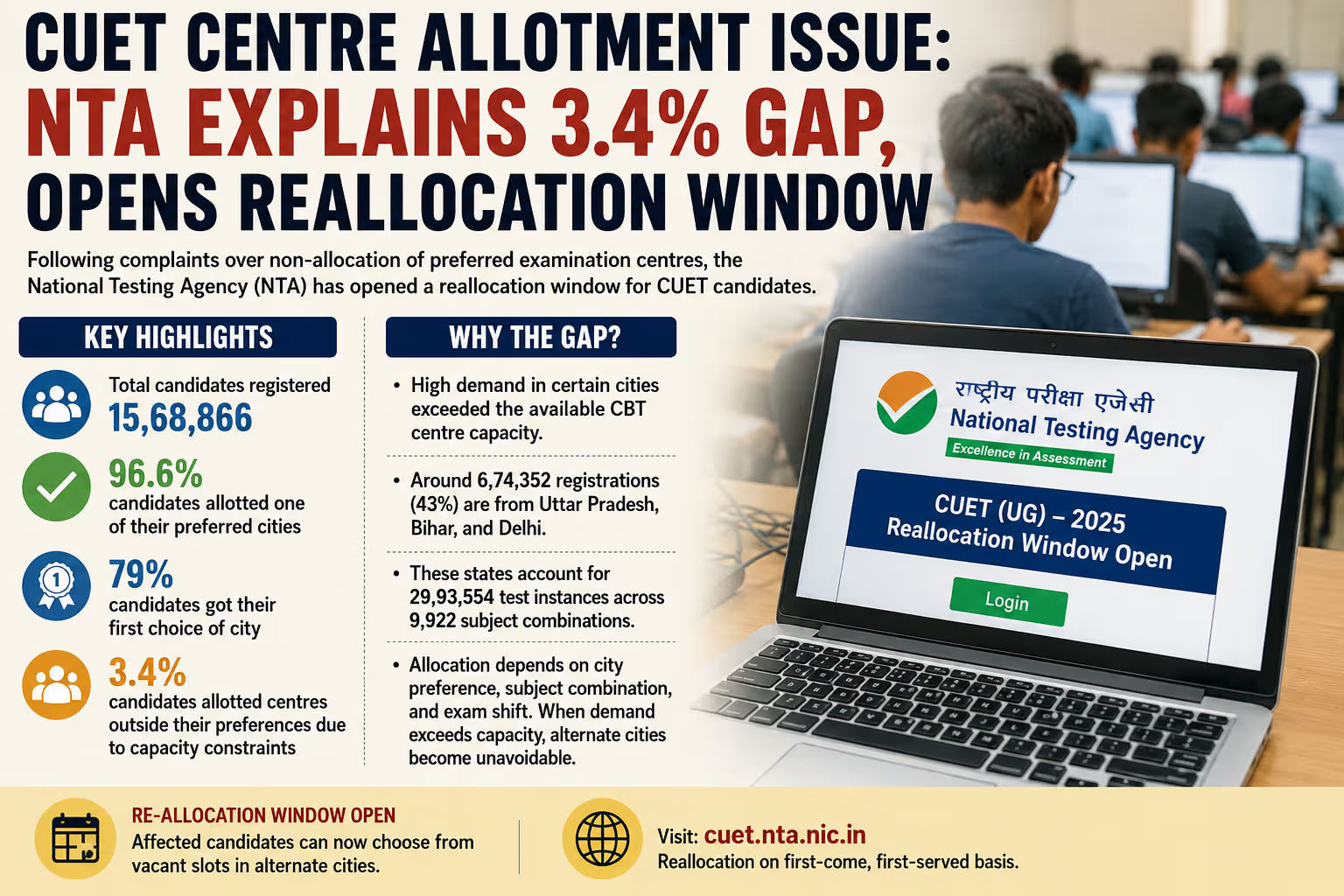
The National Testing Agency (NTA) has opened a reallocation window for candidates appearing in the Common University Entrance Test (CUET) after receiving complaints from students who were not allotted their preferred examination centres. The agency clarified that while the majority of candidates received centres in their chosen cities, a small percentage had to be assigned locations outside their preferences due to capacity limitations in high-demand regions.
The issue has sparked concern among students and parents across the country, especially in states where competition for examination centres is extremely high. Many candidates reported being allotted centres far away from their hometowns despite selecting nearby locations during the application process.
In response to growing criticism, the NTA released detailed statistics explaining the scale of the examination and the logistical challenges involved in managing one of India’s largest entrance tests.
According to official data, 96.6 percent of the total registered candidates were allotted one of their preferred cities, while 79 percent received their first-choice city. However, approximately 3.4 percent of candidates were assigned centres outside their selected preferences because available Computer-Based Testing (CBT) infrastructure in certain locations could not accommodate the overwhelming demand.
To address the issue, the agency has now opened a special reallocation facility through its official website, allowing affected candidates to choose from vacant examination slots available in alternate cities.
Over 15 Lakh Students Registered for CUET
The CUET examination has rapidly become one of the largest entrance examinations in India. This year alone, a total of 15,68,866 candidates registered for the exam, highlighting the growing importance of CUET in the higher education admission process.
Introduced as a common entrance platform for undergraduate admissions in central and participating universities, CUET has transformed the admission landscape by creating a unified system for students seeking entry into top institutions.
However, the massive scale of the examination has also created unprecedented logistical challenges for authorities.
NTA explained that the complexity of centre allocation increased significantly because candidates were allowed to choose up to five subjects. As a result, the total number of test instances rose to nearly 67,56,321.
On average, each candidate selected approximately 4.31 subjects, leading to highly varied examination schedules and combinations.
The agency further stated that students registered across 12,906 unique subject combinations, making the coordination of examination shifts, centres, and subject arrangements extremely difficult.
Why Some Candidates Did Not Get Preferred Centres
The NTA clarified that examination centre allocation depends on multiple factors rather than just city preference.
According to the agency, three major elements are considered while assigning centres:
The city selected by the candidate
The specific combination of subjects chosen
The examination shift assigned for those subjects
Because CUET is conducted in Computer-Based Test mode, every subject combination must be carefully mapped to available computer infrastructure and scheduling slots.
The agency explained that when the number of candidates choosing a particular city, subject combination, and shift exceeds the available capacity, authorities are forced to allocate nearby or alternate cities.
This situation became particularly severe in states such as Uttar Pradesh, Bihar, and Delhi, which together accounted for around 6,74,352 registrations — nearly 43 percent of the total candidates appearing for the examination.
These three regions alone generated approximately 29,93,554 effective test instances spread across 9,922 subject combinations.
NTA stated that although these states possess substantial CBT infrastructure, the concentrated demand in certain cities placed enormous pressure on the available examination centres.
As a result, some candidates could not be accommodated within their preferred city choices.
Reallocation Window Opened for Affected Candidates
To reduce inconvenience for affected students, the NTA has launched a reallocation facility on its official website cuet.nta.nic.in. Candidates who were unable to receive their preferred examination locations can now log in and select from vacant slots available in alternate cities. The process is being conducted on a first-come, first-served basis.
The agency urged students to complete the process quickly because available seats in nearby cities may fill rapidly.
The reallocation system is intended to provide flexibility to candidates who may otherwise face long-distance travel or accommodation challenges during the examination period.
Students and parents welcomed the decision, although many argued that the issue should have been anticipated earlier given the increasing number of registrations each year.
Several aspirants expressed frustration over receiving centres located hundreds of kilometres away from their homes, creating additional financial and emotional stress before the examination.
For many students from economically weaker backgrounds, travelling to distant cities for examinations can involve considerable expenses related to transport, food, and accommodation.
The Growing Pressure on India’s Entrance Examination System
The CUET centre allocation controversy has once again highlighted the mounting pressure on India’s examination infrastructure.
Over the past decade, competitive entrance examinations have witnessed record-breaking participation due to the expanding number of students seeking higher education opportunities.
Centralized entrance systems such as CUET, NEET, and JEE have streamlined admissions but have simultaneously increased pressure on testing infrastructure, particularly in densely populated states.
The transition toward Computer-Based Testing has further intensified these challenges because CBT exams require specialized infrastructure, including computer labs, internet connectivity, backup power systems, and technical supervision.
Unlike traditional pen-and-paper examinations, CBT systems limit the number of candidates that can be accommodated at a single centre during one shift.
As a result, authorities must divide examinations into multiple shifts across several days.
For CUET, the NTA is conducting the examination across 35 shifts nationwide to manage the enormous volume of candidates and subject combinations.
Complexity of Subject Combinations Adds to Challenges
One of the biggest difficulties in organizing CUET lies in the enormous variation in subject selections.
Unlike many entrance examinations that focus on a fixed set of subjects, CUET allows students from different academic streams to choose combinations according to university admission requirements.
This flexibility benefits students but significantly complicates examination planning.
According to the NTA, more than 12,900 unique subject combinations were recorded this year. Each combination requires separate scheduling, technical arrangements, and seat allocation planning.
For example, two students appearing in the same city may still require different shifts or centres because their chosen subjects differ.
Authorities must ensure that computer systems are configured properly for each subject while preventing scheduling overlaps and maintaining examination security.
These logistical requirements make centre allocation far more complicated than simply assigning candidates to the nearest city.
Students Demand Better Planning
Despite the NTA’s explanation, many students and parents believe authorities should improve planning to prevent such issues in future examinations.
Social media platforms were flooded with complaints from candidates who claimed they received centres located far from their selected preferences.
Some students argued that examination authorities should increase the number of centres in high-demand areas or improve regional distribution to reduce travel burdens.
Education experts also noted that India’s rapidly growing student population requires significant investment in examination infrastructure.
As more universities adopt centralized entrance systems, the demand for CBT centres is expected to rise further in the coming years.
Experts suggest that authorities may need to collaborate with educational institutions, private testing agencies, and technology providers to expand available infrastructure.
Impact on Students and Families
For many candidates, examination centre allocation is not a minor administrative issue but a matter that directly affects their preparation and mental well-being.
Students already face intense academic pressure while preparing for competitive examinations. Being assigned distant centres can add anxiety related to travel, accommodation, safety, and time management.
Parents also worry about additional financial burdens, especially when examinations require overnight travel or hotel stays.
In states with limited transportation connectivity, travelling to another city for an examination may involve long journeys and significant logistical difficulties.
Many families believe that examination authorities should prioritize student convenience while planning centre distribution.
At the same time, experts acknowledge that managing nearly 16 lakh candidates with thousands of subject combinations represents an extremely challenging task for any examination body.
NTA Defends Its Allocation Process
The National Testing Agency has maintained that the majority of candidates successfully received centres within their preferred locations.
According to official figures, nearly 97 percent of candidates obtained one of their selected cities, while almost four out of every five students received their first preference.
The agency emphasized that only a relatively small percentage faced allocation issues, primarily due to extraordinary demand concentration in specific cities.
NTA also highlighted that examination integrity and technical feasibility must remain top priorities during the allocation process.
The agency stated that balancing city preference, subject combination, shift scheduling, and infrastructure capacity simultaneously is a highly complex operation.
Officials further explained that unavoidable reallocations become necessary whenever the number of applicants exceeds the available seating capacity for a specific city-subject-shift combination.
Calls for Expansion of CBT Infrastructure
The controversy has renewed discussions about the need to strengthen India’s digital examination infrastructure.
Education analysts argue that the growing popularity of Computer-Based Testing requires substantial investment in modern testing centres across both urban and rural areas.
Currently, high-demand states such as Uttar Pradesh, Bihar, and Delhi face enormous pressure because of their large student populations.
Experts believe expanding CBT infrastructure in tier-2 and tier-3 cities could help reduce congestion in major examination hubs.
Additional centres would also minimize travel requirements for students and create a more balanced examination ecosystem.
Some specialists have proposed the creation of permanent government-supported testing centres that could be used year-round for multiple national examinations.
Such facilities could improve efficiency, reduce scheduling conflicts, and provide better accessibility for students from remote regions.
A Reminder of the Challenges in Large-Scale Testing
The CUET centre allotment issue serves as a reminder of the immense complexity involved in conducting nationwide entrance examinations in India.
With millions of students competing for university admissions, authorities must manage enormous logistical operations involving technology, scheduling, security, and infrastructure.
While the NTA’s reallocation window may provide relief to many affected candidates, the controversy has highlighted the urgent need for long-term improvements in examination planning and testing capacity.
As CUET continues expanding in scale and importance, ensuring fair and convenient access to examination centres will remain a major challenge for education authorities.
For now, affected students are being advised to utilize the reallocation facility as quickly as possible while preparing for one of the country’s most significant university entrance examinations.
Related Posts