Panic Buying Fears Rise in Japan Amid Surging Food and Power Costs
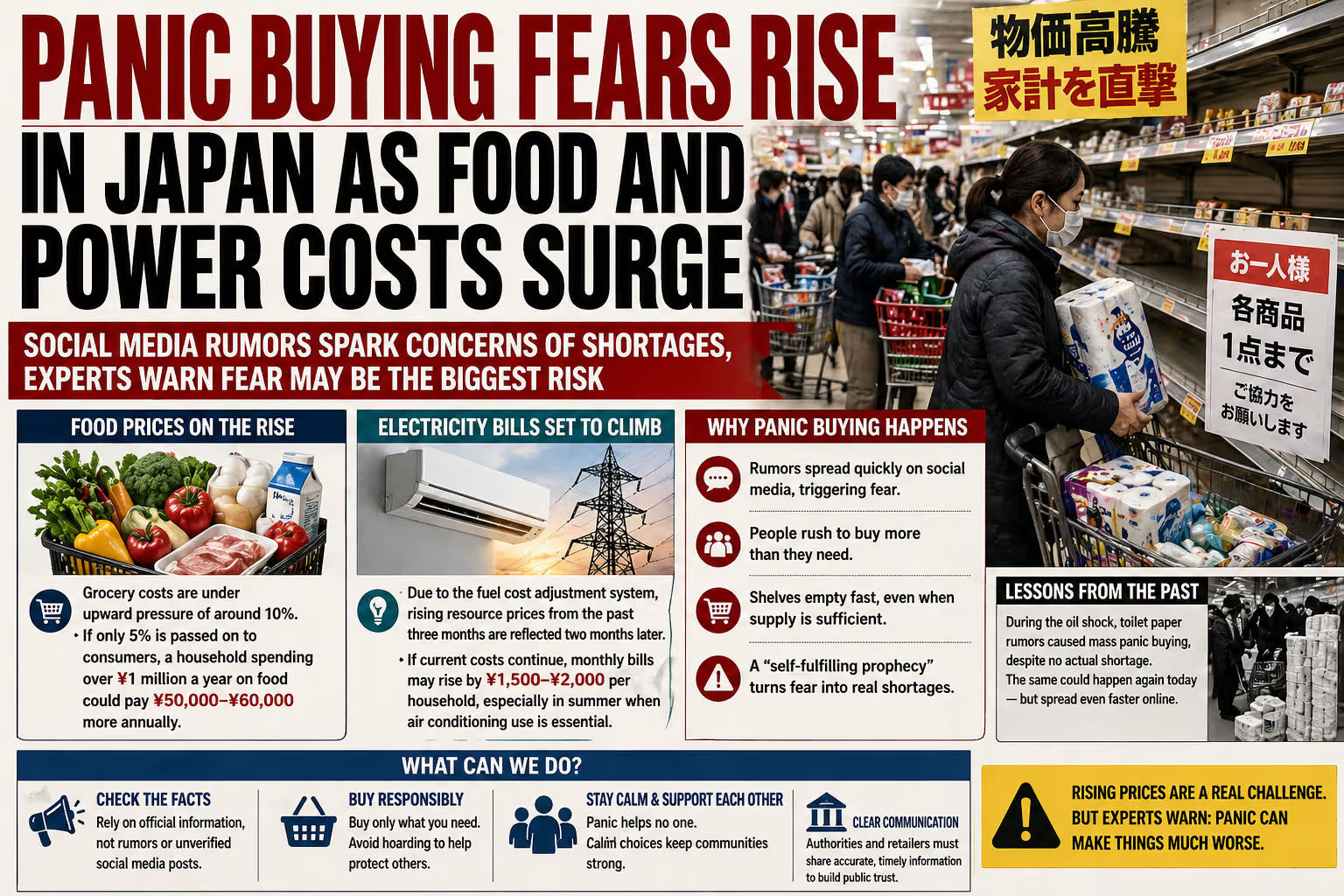
Panic Buying Fears Rise in Japan as Food and Power Costs Surge Through Social Media Rumors
As living costs continue to rise in Japan, economists and market observers are warning that the country may face not only inflationary pressure but also a dangerous wave of consumer panic accelerated by social media. With food prices climbing, electricity bills expected to rise sharply in the coming months, and household savings already under pressure, experts say fear itself could become a major economic problem.
The concern is simple but serious: when people believe products will soon become scarce or more expensive, they often rush to stores and buy more than they need. If enough people act in the same way, shortages can appear almost overnight, even if supply chains remain stable. In this way, panic buying can create the very crisis people are trying to avoid.
Food Prices Add Pressure on Household Budgets
One of the biggest concerns for consumers is the rising cost of groceries. Food remains one of the largest regular expenses for households, and any sustained increase is felt immediately across society. According to analysts, grocery items are already facing around 10% upward cost pressure. Even if only half of that increase reaches store shelves, families could still face a meaningful rise in annual spending.
For a household spending more than 1 million yen each year on groceries, that could mean an additional 50,000 to 60,000 yen in yearly costs. While this may appear manageable for wealthier households, for many middle-income and lower-income families it represents a serious financial burden.
Unlike optional spending such as travel or entertainment, food purchases cannot be delayed indefinitely. Families may cut back on restaurant meals, switch to cheaper brands, or reduce non-essential shopping, but they must continue buying rice, vegetables, dairy products, and other essentials. As a result, food inflation affects nearly every consumer in the country.
Economists note that prolonged increases in food costs often change consumer behavior. Households become more price-sensitive, compare products more carefully, and reduce spending elsewhere. Over time, this can weaken broader retail demand and slow economic activity.
Electricity Bills Expected to Climb in Summer
The second major source of concern is electricity pricing. In Japan, many utility bills are linked to fuel costs through an adjustment mechanism. This means higher global prices for imported energy resources are not always reflected immediately. Instead, they appear in consumer bills after a delay.
As a result, analysts believe the real financial impact may be felt during the summer months, when air-conditioning demand rises sharply. If current resource prices remain elevated, average household electricity bills could rise by around 1,500 to 2,000 yen per month.
That increase comes at a difficult time. During hot weather, cooling systems are not simply a matter of comfort. For elderly residents, young children, and those with health conditions, air-conditioning can be essential for safety. Higher power bills may force some families to reduce usage despite rising temperatures, increasing the risk of heat-related illness.
For businesses, especially restaurants, retailers, and small offices, higher electricity costs may also mean further price increases for consumers. This creates a cycle in which energy inflation feeds into wider inflation across the economy.
Savings Buffers Already Under Strain
The broader problem is that households have already been dealing with rising prices for several years. Many families have used savings to absorb higher daily expenses, but those financial buffers may now be reaching their limits.
If wages fail to keep pace with inflation, purchasing power declines. Even employed households can feel poorer when salaries remain stable but grocery, transport, and utility costs continue to rise. In such an environment, people become more sensitive to rumors of future shortages or further price increases.
Consumer confidence is a critical factor in economic stability. When households feel financially secure, they are more likely to spend normally and make rational decisions. But when uncertainty rises, even small rumors can trigger outsized reactions.
Experts Warn Panic May Be More Dangerous Than Shortages
Kazuhiko Fuji has warned that the greatest risk may not be actual supply shortages, but public panic. According to him, fear-driven behavior can rapidly disrupt markets even when production and logistics remain sufficient.
His warning draws attention to a well-known historical example: the toilet paper panic during the oil shock era. At the time, many consumers believed toilet paper would soon become unavailable. Although there was no genuine nationwide shortage in production, large numbers of people rushed to buy excessive quantities. Store shelves emptied quickly, reinforcing the belief that the rumors were true.
The result was a self-fulfilling prophecy. Panic buying created visible scarcity, which then triggered even more panic buying.
This phenomenon is common in economics. If enough people expect a problem and act as though it already exists, they can bring that problem into reality. Markets are shaped not only by actual supply and demand, but by expectations.
Social Media Can Spread Fear Instantly
What makes the current situation more serious, experts say, is the speed of modern communication. In previous decades, rumors spread through newspapers, television, or word of mouth. Today, social media platforms can distribute fear across the country within minutes.
A single viral post showing empty supermarket shelves can create the impression of a national shortage, even if the image reflects only one store or temporary restocking delays. Messages claiming “buy now before it’s gone” or “prices rise tomorrow” often travel faster than calm explanations from officials or retailers.
Social media algorithms frequently reward emotional, urgent, or dramatic content. This means alarming messages can receive more attention than balanced information. Once people see others stockpiling, they may feel pressure to do the same, fearing they will be left without essential goods.
This herd behavior can overwhelm supply chains that are designed for steady, predictable demand rather than sudden spikes. Even products with healthy inventories may disappear temporarily if millions of consumers buy at once.
Lessons From the COVID-19 Mask Shortages
The warning also recalls shortages seen during the COVID-19 pandemic, when masks and sanitizers became difficult to obtain in many markets. In some cases, manufacturing eventually caught up, but temporary shortages were worsened by panic buying, hoarding, and reselling.
The same pattern could now spread to a wider range of everyday goods. Food staples, batteries, tissues, bottled water, household supplies, and over-the-counter medicines are all vulnerable if fear spreads faster than facts.
Once panic starts, retailers often respond with purchase limits. While helpful, such measures usually come after shelves have already been cleared. Rebuilding confidence can take longer than restocking products.
Impact on Society and Inequality
Panic buying does not affect all households equally. Families with higher incomes can afford to purchase large quantities immediately. Those with cars or storage space can buy in bulk more easily.
Meanwhile, lower-income households, elderly shoppers, and people paid weekly may only be able to purchase essentials when needed. If they arrive after panic buying begins, they may find shelves empty or prices higher.
This means fear-driven consumer behavior can widen inequality during already stressful times. Essential goods may become hardest to access for those who need affordability the most.
What Authorities and Businesses Can Do
Experts say clear communication is one of the most effective tools against panic. Governments, retailers, and manufacturers can reduce anxiety by sharing accurate information about stock levels, delivery schedules, and pricing conditions.
Retailers may also use early purchase limits, digital inventory updates, and customer notices to discourage hoarding. Responsible media coverage is equally important, as sensational headlines about shortages can unintentionally fuel demand spikes.
At the same time, long-term economic stability depends on improving wage growth, managing energy costs, and protecting vulnerable households from sustained inflation.
A Test of Public Confidence
The situation in Japan highlights a wider challenge facing modern economies: markets are influenced not only by physical supply chains but also by psychology. When trust is strong, consumers act calmly and systems function smoothly. When fear spreads, even small disruptions can become major crises.
Rising food and electricity bills are real problems. But as experts warn, panic itself may prove even more damaging. If consumers remain measured and institutions communicate effectively, shortages can be avoided. If rumors dominate, temporary concerns could quickly become nationwide disruptions.
For now, the key question is not only whether prices will continue rising, but whether confidence can hold.
Related Posts