USC men collapse in heavy defeat against Illinois
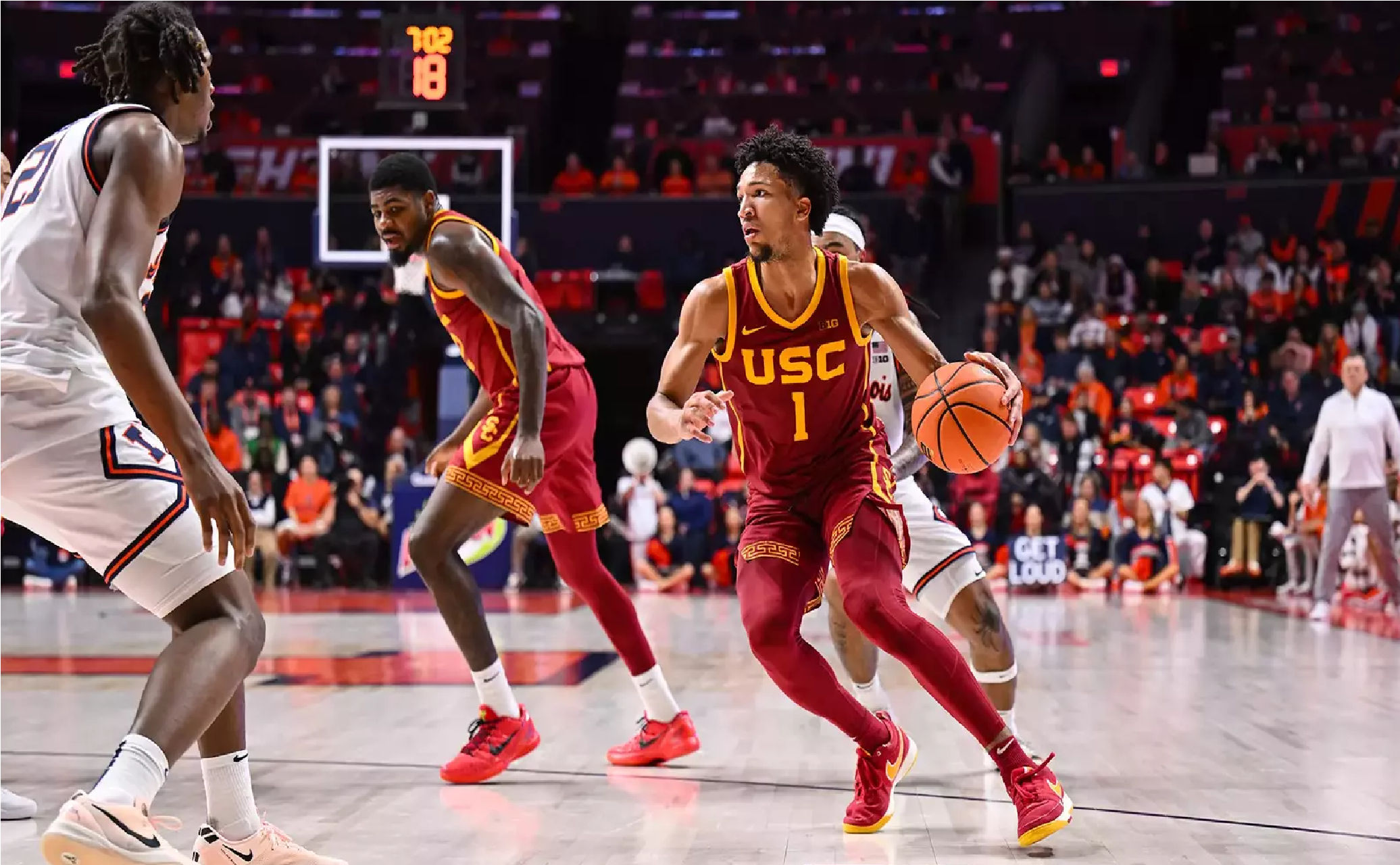
USC Trojans men's basketball Come Unraveled in Blowout Loss to Illinois Fighting Illini men's basketball
Alijah Arenas sat motionless, a towel draped over his head, shoulders heaving as he tried to steady his breathing. It was a quiet, painful image — one that captured the mood of a night that spiraled quickly out of control for USC.
For days leading up to the matchup with No. 10 Illinois, Arenas had been battling illness. The Trojans’ electrifying freshman guard — in the midst of what many considered his long-awaited breakout stretch — was physically depleted. He had missed practice earlier in the week and entered Wednesday’s game as a question mark. His status wasn’t confirmed until just hours before tipoff.
But sitting out was never a serious consideration in his mind. USC needed him. The Trojans were clinging to NCAA tournament hopes, and a signature win over a top-10 opponent could have shifted their postseason outlook dramatically. Even at less than full strength, Arenas decided to suit up.
“That takes real courage,” forward Jacob Cofie said afterward.
Courage, however, can only carry a team so far.
By the midpoint of the first half, Arenas was already struggling to catch his breath. Illinois had seized control early, exploiting every weakness USC displayed. What began as a competitive opportunity quickly turned into a one-sided showcase of dominance. When the final buzzer sounded, Illinois had dismantled USC 101-65 — a result that left the Trojans stunned and searching for answers.
A Defining Collapse Under Eric Musselman
Head coach Eric Musselman did not sugarcoat the outcome.
“It’s pretty simple,” Musselman said. “We were not good enough tonight. We’ve got to get better in all aspects.”
The loss was historic for all the wrong reasons. It marked the largest margin of defeat in Musselman’s two seasons at USC. Even more concerning, it was the first time since 2019 that USC allowed an opponent to score more than 100 points in regulation.
For a program attempting to establish consistency in its first season navigating the rigorous Big Ten schedule, the blowout exposed glaring shortcomings.
Musselman called for introspection, saying the performance should make “every player, person, coaches in the program look in the mirror.” It was not simply a bad night; it was a systemic breakdown — defensively, offensively, and mentally.
Tournament Hopes Hanging by a Thread
The timing could not have been worse.
USC entered the game with an 18-8 overall record and a 7-8 mark in conference play. The Trojans were precariously positioned on the NCAA tournament bubble. A victory over Illinois — a 22-5 team firmly planted in the national rankings — would have bolstered their résumé. Instead, the lopsided defeat weakened their standing and intensified the pressure surrounding the final five games of the regular season.
The remaining stretch is relatively favorable on paper. Only one opponent ranks inside the top 25, and two games loom against crosstown rival UCLA, a team that has struggled with inconsistency this season. But Wednesday’s performance raised a troubling question: Can USC generate the intensity and cohesion necessary to capitalize on that opportunity?
At no point against Illinois did the Trojans resemble a team poised to make March noise.
Arenas’ Grit, Limited Impact
Much of USC’s recent surge had coincided with Arenas’ offensive explosion. Over the previous three games, he had scored at least 24 points each night, energizing the offense and providing a dynamic scoring threat from all levels.
Against Illinois, that spark was absent.
The illness clearly affected him. Arenas finished with just eight points in 18 minutes — a dramatic departure from his recent output. Early foul trouble compounded his struggles, and at one point he appeared to aggravate his already-injured right knee. He spent extended stretches on the bench, unable to provide the rhythm USC desperately needed.
Yet placing the blame solely on Arenas’ health would oversimplify the problem.
USC was outplayed in virtually every statistical category. The Trojans were outrebounded 41-30, surrendered easy transition opportunities, and mustered only one fast-break point. Inside the arc, they shot a dismal 36%, unable to convert even high-percentage looks.
The offense stagnated. The defense broke down. The energy waned.
Illinois’ Ruthless Execution
If USC faltered, Illinois thrived.
The Fighting Illini entered the game riding momentum, boasting a 13-3 conference record. They wasted no time asserting dominance, racing to a 15-3 lead as USC stumbled through turnovers and missed shots. In the opening six minutes alone, the Trojans committed four turnovers and missed seven of their first eight attempts.
Illinois capitalized on every mistake.
Their shooters found space on the perimeter, knocking down three-pointers with confidence. Guards sliced through the lane without resistance. On the defensive end, they swarmed passing lanes and forced USC into uncomfortable possessions.
By halftime, Illinois had built a commanding 22-point lead. The atmosphere inside USC’s home arena felt oddly neutral — perhaps even tilted in Illinois’ favor — as a sea of blue and orange celebrated each highlight play.
Freshman standout Keaton Wagler, Illinois’ own heralded newcomer, was relatively quiet by his standards. He finished with 10 points and four assists — solid but not spectacular. Yet Illinois didn’t require a heroic performance from him. The team’s balance and depth overwhelmed USC.
Big man Zvonimir Ivisic punctuated the night with a thunderous alley-oop dunk in the closing minute, pushing Illinois into triple digits. The roar from the crowd underscored the humiliation for the Trojans.
Offensive Breakdown
USC’s offensive issues began immediately and never subsided.
Only one of the Trojans’ five starters — Jacob Cofie — made more than one field goal in the first half. Arenas opened 0-for-4 before picking up his second foul and retreating to the bench. Without consistent shot-making, USC struggled to establish tempo or confidence.
Chad Baker-Mazara’s continued absence due to injury further limited the team’s scoring versatility. With two primary contributors compromised — one by illness, one by injury — USC lacked a reliable offensive engine.
Ezra Ausar led the team with 15 points, and Cofie added 14. No other Trojan reached double digits. In modern college basketball, where offensive explosions are common, such limited production spells disaster — especially against a disciplined, high-powered opponent.
The Trojans also failed to generate transition opportunities. Illinois dictated pace, forcing USC into half-court sets where execution faltered. Ball movement stagnated, spacing collapsed, and contested shots became the norm.
Defensive Lapses and Physicality Gap
Perhaps even more alarming than USC’s offensive woes was the defensive collapse.
Illinois exploited mismatches, attacked the rim aggressively, and dominated the boards. The 41-30 rebounding margin illustrated a clear physicality gap. Second-chance opportunities fueled Illinois’ scoring runs, while USC struggled to secure defensive stops.
Interior defense was particularly porous. Illinois guards penetrated at will, and help defense arrived a step too late. Rotations were slow, communication inconsistent.
In high-stakes games, defensive intensity often reflects mental sharpness. On this night, USC lacked both.
Jacob Cofie candidly assessed the situation: “I feel like we made them look good today.”
The statement captured the essence of the defeat. Illinois played well — but USC’s inability to compete amplified the disparity.
A Reality Check in the Big Ten
Transitioning into the Big Ten has presented new challenges for USC. The conference’s physical style, depth, and consistency demand relentless focus. Wednesday’s loss served as a harsh reminder of that reality.
Illinois, a seasoned contender, demonstrated the level USC must reach to compete at the top tier. Precision ball movement, defensive commitment, rebounding discipline — these are non-negotiables against elite competition.
For USC, the defeat exposed how thin the margin for error remains. Illness, injuries, and off nights cannot derail effort and structure. Championship-caliber teams adapt. The Trojans did not.
Looking Ahead: Urgency Required
With five regular-season games remaining, USC’s path forward is clear but unforgiving.
Each matchup now carries heightened importance. Selection committees scrutinize not only wins and losses but also competitiveness. Blowout defeats can linger in evaluators’ minds. USC must demonstrate resilience — not only by winning but by rediscovering defensive identity and offensive cohesion.
Arenas’ health will be central to that effort. If he returns to form, his scoring ability could reignite the offense. But the broader lesson from the Illinois loss is that USC cannot rely on one player, no matter how talented.
Depth must emerge. Rebounding must improve. Defensive accountability must tighten.
A Night to Forget — or Remember
As players filed out of the arena, frustration was visible. Musselman sat with his head in his hands, absorbing the magnitude of the defeat. The scoreboard read 101-65, but the implications stretched far beyond a single number.
For USC, the loss can serve one of two purposes: a demoralizing setback that derails postseason hopes, or a wake-up call that sparks urgency.
The image of Arenas, slumped and breathless on the bench, may linger. It symbolizes both individual courage and collective vulnerability. He chose to fight through illness. But basketball, ultimately, is a team endeavor.
Illinois proved deeper, stronger, and sharper. USC must now decide how it responds.
March looms.
And whether this night becomes a footnote or a turning point depends entirely on what the Trojans do next.
Related Posts