Sunday’s Divisional Round: Rams and Bears brace for freezing conditions
NFL Divisional Sunday
The second weekend of the NFL postseason will come to a dramatic close on Sunday as four teams battle in a pair of high-stakes divisional contests that promise to reshape the road to Super Bowl LX. With only two slots remaining in next week’s conference championship round, the margins have shrunk, the strategies have tightened, and the sense of urgency has never been clearer.
After a chaotic Wild Card weekend that delivered unexpected results and breakout performances, the Divisional Round now shifts its focus to Houston, Foxborough, Los Angeles, and Chicago—markets with storied football histories and fan bases hungry for a return to the NFL’s biggest stage. The winners of Sunday’s slate will move one step closer to Allegiant Stadium in Las Vegas, where the league’s crown jewel awaits.
This Sunday’s games offer contrasting storylines: one matchup features a rookie quarterback carrying the hopes of a rebuilding franchise into hostile playoff territory, while the other places two explosive offences into the heart of a Midwest winter storm. Both games bring compelling questions, tactical wrinkles, and pressure-heavy scenarios that will define how the rest of January unfolds in the NFL.
Texans and Patriots: A Chance to Rewrite Post-Season History
For the Houston Texans and New England Patriots, Sunday’s early contest offers an opportunity to advance to the AFC Championship Game. The stakes may feel routine for New England, but for Houston, reaching the conference title would be a franchise first. For years, the Texans have fielded competitive rosters only to stall in the Divisional Round, often undone by offensive inconsistencies or lack of depth at key positions. Now, after a season of defensive dominance and emerging young talent, Houston appears closer than ever to breaking through that barrier.
Yet to do so, they’ll have to dispatch a Patriots team that has quietly reinvented itself behind rookie quarterback Drake Maye. New England spent the first half of the season sorting through offensive growing pains, inconsistent line play, and a lack of explosive plays. But Maye’s composure, arm talent, and movement have fueled a late-season resurgence that turned the Patriots from an afterthought into a post-season contender.
The central drama going into Sunday surrounds Houston’s ability to pressure Maye. The Texans boast one of the league’s most disruptive pass rushes—one built on collapsing pockets, forcing uncomfortable reads, and attacking offensive breakdowns with relentless energy. Houston’s front has feasted on quarterbacks who hesitate or struggle to identify pass protections pre-snap, and Maye’s youth only magnifies the intrigue.
Even in New England’s Wild Card win over the Chargers, the rookie absorbed plenty of punishment. Los Angeles consistently compressed the pocket, forced Maye to escape into space, and sped up his internal clock. He was sacked five times and stripped once—errors that could have proven fatal had the Patriots’ defence not delivered timely stops. The most encouraging sign for New England was Maye’s improvisation. When the passing attack stalled, he leaned on his legs and mobility, picking up crucial scramble yardage including 37 yards on third-down situations alone.
Maye finished the regular season ranked second in the league in scramble yards, according to PFF—an unexpected but valuable facet of his game. Against Houston, that ability may function less as a luxury and more as a lifeline. The Texans excel at squeezing offensive structures until they crack; if plays extend beyond two or three seconds, Houston often turns them into drive-killing losses.
Beyond protection concerns, New England will need stability from its offensive line, a unit that has oscillated between encouraging and concerning performances throughout the year. If Maye is consistently pressured from the opening drive, the Patriots risk losing tempo, rhythm, and balance—three elements critical for playoff success.
Houston’s Offensive Puzzle: Who Carries the Load?
While Houston’s defence headlines the matchup, their offence enters Sunday under heavier scrutiny. The Texans have spent the season operating as a defence-first team capable of winning ugly, clock-draining affairs. Yet playoff football often demands multi-dimensionality, and Houston has spent much of the year searching for a consistent supporting act for quarterback C.J. Stroud.
Against Pittsburgh in the Wild Card round, Stroud led an offence that sputtered for long stretches, surviving largely on defensive stops and favourable field position. What ultimately steadied the unit was an effective ground attack powered by Woody Marks, who delivered a critical 112-yard performance and sealed the game with a fourth-quarter touchdown. The offensive line played some of its cleanest football of the season in that matchup, allowing just one negative play and creating consistent lanes inside and off-tackle.
Replicating that approach against the Patriots will be decidedly more difficult. New England’s defence has tightened considerably since the mid-season return of interior disruptor Milton Williams and linebacker Jack Gibbens. The duo has fortified the middle of the formation and restored the Patriots’ ability to shut down early-down runs—an essential element when hunting for predictable passing situations.
Houston’s receiver group remains talented but depleted. Nico Collins, one of Stroud’s most reliable perimeter threats, will not suit up, while New England enjoys the return of star corner Christian Gonzalez after passing concussion protocol. That matchup alone has the potential to shift Stroud’s passing map, forcing the Texans to rely on secondary and tertiary receiving options or on schemed touches underneath.
If Houston is to finally cross the threshold into the AFC Championship Game, it will need someone beyond Stroud to provide stability—whether via the run game, yards after catch, or explosive misdirection. Defence may remain the Texans’ backbone, but post-season success usually hinges on balanced production, not singular brilliance.
Rams and Bears: An Offensive Showcase Meets Chicago’s Winter Chill
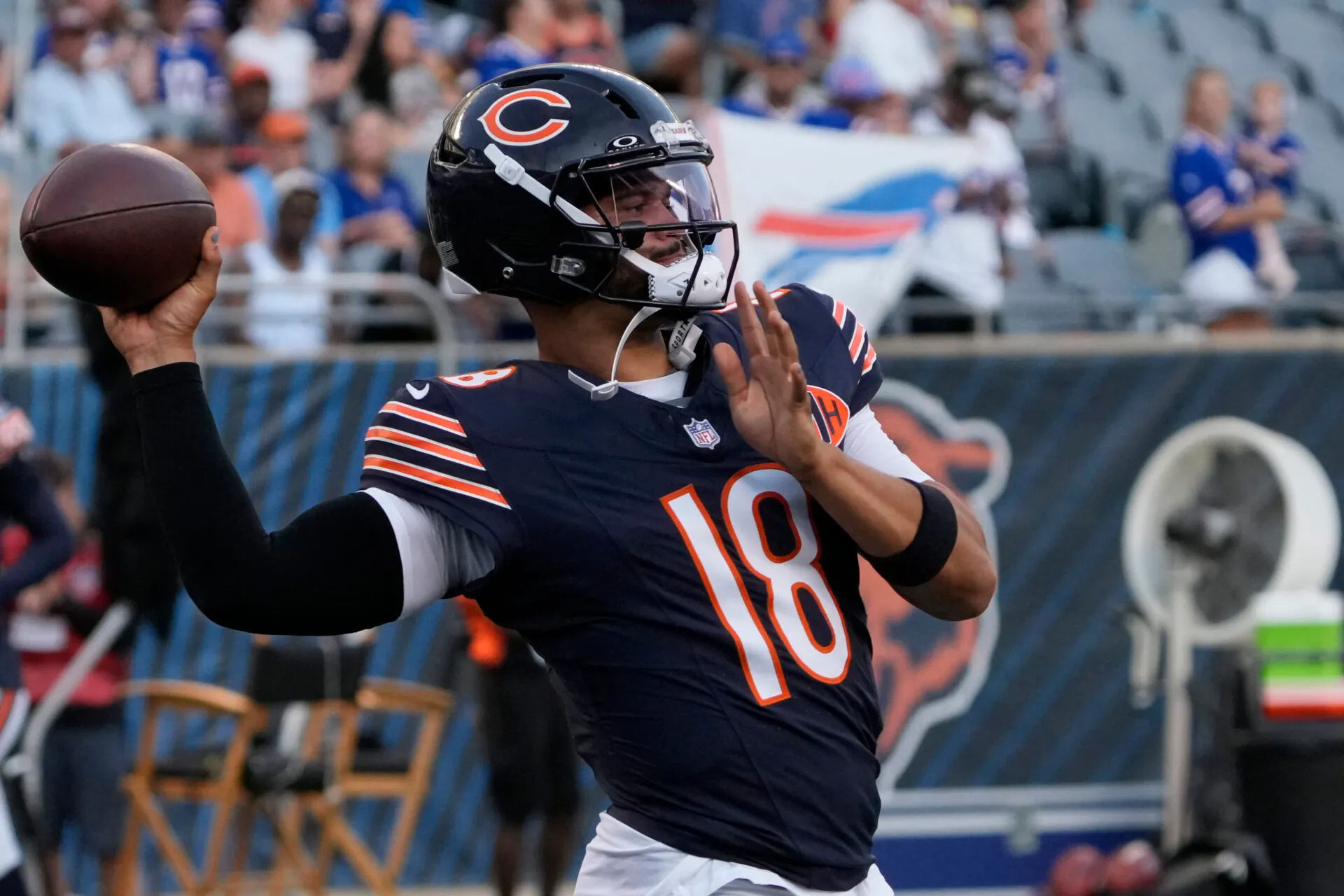
If the AFC game centres on grit, disruption, and tactical strain, the late NFC contest offers something closer to controlled chaos. When the Los Angeles Rams meet the Chicago Bears at Soldier Field, it will pit two of the league’s most dynamic offences against a weather system determined to reduce football to a test of elements.
While Bears–Rams matchups of the past conjure images of defensive slugfests and low-scoring exchanges, this year’s iteration features two top-10 offences that ranked among the league’s most explosive units throughout the regular season. The Rams led the NFL in both scoring (30.5 points per game) and total yardage (394.7 yards), while Chicago finished close behind at 25.9 points and 369.5 yards. Both teams thrive on tempo, misdirection, and intermediate-to-deep passing attacks capable of flipping field position within a single snap.
On paper, such a pairing promises fireworks. In reality, Sunday night’s forecast threatens to reduce that spectacle to a survival exercise. Temperatures in Chicago are expected to settle somewhere between 10 and 15 degrees Fahrenheit, accompanied by 20-30 mph wind gusts and wind chills dipping below zero. The cold alone would challenge timing-based passing offences, but the wind introduces a second—and possibly more disruptive—variable, altering ball trajectory and reducing kicker reliability.
Much of the discourse entering the game has focused on Matthew Stafford’s history in cold-weather environments. Since arriving in Los Angeles, Stafford holds a 1–9 record in games played in cold, rain, or snow—a statistic frequently used as shorthand criticism regarding his winter performance. However, the metric lacks nuance; Stafford has played only three sub-40-degree games with the Rams, losing two despite throwing for over 300 yards in both. The broader point is not that Stafford is ineffective in cold weather, but that cold-weather games shrink the margin for error—turning slight inaccuracies, tipped passes, or protection breakdowns into turnovers.
The Rams’ offence is engineered for controlled aggression—pre-snap motion, layered route concepts, and play-action sequencing that pull defences into manufactured conflict. But all three components require reliable footing, steady winds, and clean ball handling. Soldier Field’s winter environment seldom provides such luxuries.
Chicago’s Counter: Weather as an Equalizer
The Bears’ offensive profile mirrors Los Angeles in many ways, but Chicago holds one advantage unique to this matchup: familiarity with the conditions. While no team fully “masters” bitter cold or swirling wind, the Bears have spent the season fine-tuning their approach to home climates that favour physicality over finesse. Chicago’s run game has been particularly lethal at home, aided by an offensive line that specializes in gap schemes and zone variations that punish overaggressive fronts.
If weather suppresses downfield passing, Chicago’s ground attack and play-action rhythm could gain efficiency. That in turn would extend drives, shorten the game, and keep Stafford off the field—an approach that has historically worked against explosive NFC foes.
Weather also benefits Chicago’s defence, a unit designed to bend-and-limit rather than gamble-and-blitz. In poor conditions, tackling and positioning become premium traits, while intricate coverage designs begin to erode as footing worsens. The Bears’ defensive structure forces opponents to build drives brick by brick—precisely the formula cold-weather games often demand.
Defining Sunday’s Narrative
Taken together, the day’s two contests encapsulate the layered drama of January football. In the AFC, Houston and New England will duel for a seat at a table neither occupies with consistency in the modern era. In the NFC, Chicago and Los Angeles will stage a collision between elite offences in an environment determined to drag them back toward old-school football values.
Sunday will not decide the Super Bowl champion, but it will define the makeup of the final four—and perhaps carry the imprint of defining performances for years to come. Whether through rookie resilience, defensive ferocity, or weather-induced chaos, the final hours of Divisional Sunday will chart a meaningful portion of the NFL’s remaining playoff path.
Related Posts