Kishan’s explosive powerplay innings powers India to joint-highest successful run chase
Ishan Kishan’s Powerplay Blitz, Suryakumar’s Comeback, and India’s Historic 209 Chase Against New Zealand — Full Match Analysis
India produced one of their most breathtaking performances in men’s T20I cricket by chasing down a massive 209-run target against New Zealand in Raipur, achieving the feat in just 15.2 overs. This extraordinary chase wasn’t just another victory — it rewrote several records, showcased individual brilliance, and underlined India’s evolving dominance in high-pressure run chases.
At the heart of this historic night were Ishan Kishan’s explosive powerplay innings and Suryakumar Yadav’s long-awaited return to form, supported by a fearless team approach that dismantled New Zealand’s bowling attack. Let’s break down every major milestone, statistic, and its deeper significance in world cricket.
🚀 Ishan Kishan’s 21-Ball Fifty: The Fastest by an Indian Against New Zealand
One of the biggest highlights of the match was Ishan Kishan’s blistering half-century, which came off just 21 balls. This made it the fastest fifty by an Indian batter against New Zealand in men’s T20Is, surpassing Abhishek Sharma’s 22-ball effort in the previous match at Nagpur.
Why This Matters
In modern T20 cricket, powerplay overs (first six overs) often determine the momentum of the innings. Kishan didn’t just use the powerplay effectively — he obliterated it. His innings was packed with fearless strokeplay, clean hitting over the infield, and a calculated assault on both pace and spin.
The fact that Kishan achieved this milestone while batting not as an opener but at No. 3 makes the feat even more impressive. Middle-order batters usually face a few balls to settle in, but Kishan entered with the intent to dominate from ball one — and succeeded spectacularly.
💥 56 Runs in the Powerplay: Among India’s Best Ever
Kishan scored 56 runs inside the powerplay, the second-most by any Indian batter in men’s T20Is, behind only Abhishek Sharma’s 58 against England in Mumbai last year.
Elite Company in Global T20 Cricket
Globally, only three batters batting at No. 3 or lower have ever scored more than Kishan in a powerplay where ball-by-ball data is available. Even more remarkable, Josh Inglis’ 51 off 29 balls against West Indies in 2025 is the only other instance of a non-opener scoring a fifty inside the powerplay against a Full-Member team.
This puts Kishan’s innings in rare historical company, reinforcing his credentials as one of India’s most destructive left-handed batters in the shortest format.
🌟 Suryakumar Yadav Ends Long Dry Spell With Match-Winning 82*
Another emotional and statistical milestone came from Suryakumar Yadav, who smashed an unbeaten 82 runs, ending a prolonged drought of scores over fifty in T20 internationals.
23 Consecutive Innings Without a Fifty — Finally Broken
Before this match, Suryakumar had endured 23 consecutive T20I innings without reaching fifty, his last half-century coming against Bangladesh in October 2024. During this stretch, he consistently batted in the top four, making the slump particularly concerning given his role as India’s premier middle-order aggressor.
This streak was the second-longest for an Indian batter batting in the top four, behind only Rishabh Pant’s run of 34 innings without a fifty-plus score.
By scoring 82* under pressure in a massive chase, Suryakumar didn’t just end a statistical drought — he reaffirmed his importance as India’s most dangerous T20 batter when set.
🎯 Suryakumar’s Record in Big Chases: A Proven Finisher
The Raipur innings added another impressive achievement to Suryakumar’s resume.
- He now has 10 fifty-plus scores across all T20s while chasing 200-plus targets, which is the joint-most by any batter, alongside Jos Buttler, David Warner, and Reeza Hendricks.
- In T20 internationals alone, he has four fifty-plus scores in six 200-plus chases, bettered only by Hendricks (six) and Babar Azam (five).
What This Tells Us
Big chases demand composure, timing, and tactical awareness — skills that Suryakumar Yadav has mastered. His ability to maintain a high strike rate without losing control has made him one of the most reliable batters in run chases globally.
In Raipur, after early wickets left India wobbling, he calmly rebuilt the innings with Kishan before accelerating brutally, showing once again why he’s nicknamed “SKY” — because the shots go straight into orbit.
🏏 India Chase 209: Joint-Highest Successful Chase in T20Is
India successfully chased down 209 runs, equalling their highest successful chase in men’s T20Is, previously achieved against Australia in Visakhapatnam in 2023.
Why a 200+ Chase Is Special
Chasing over 200 in T20 cricket is a daunting task, even for elite batting lineups. The margin for error is slim, and losing early wickets often spells disaster. That’s why this chase becomes even more astonishing when you factor in India’s disastrous start.
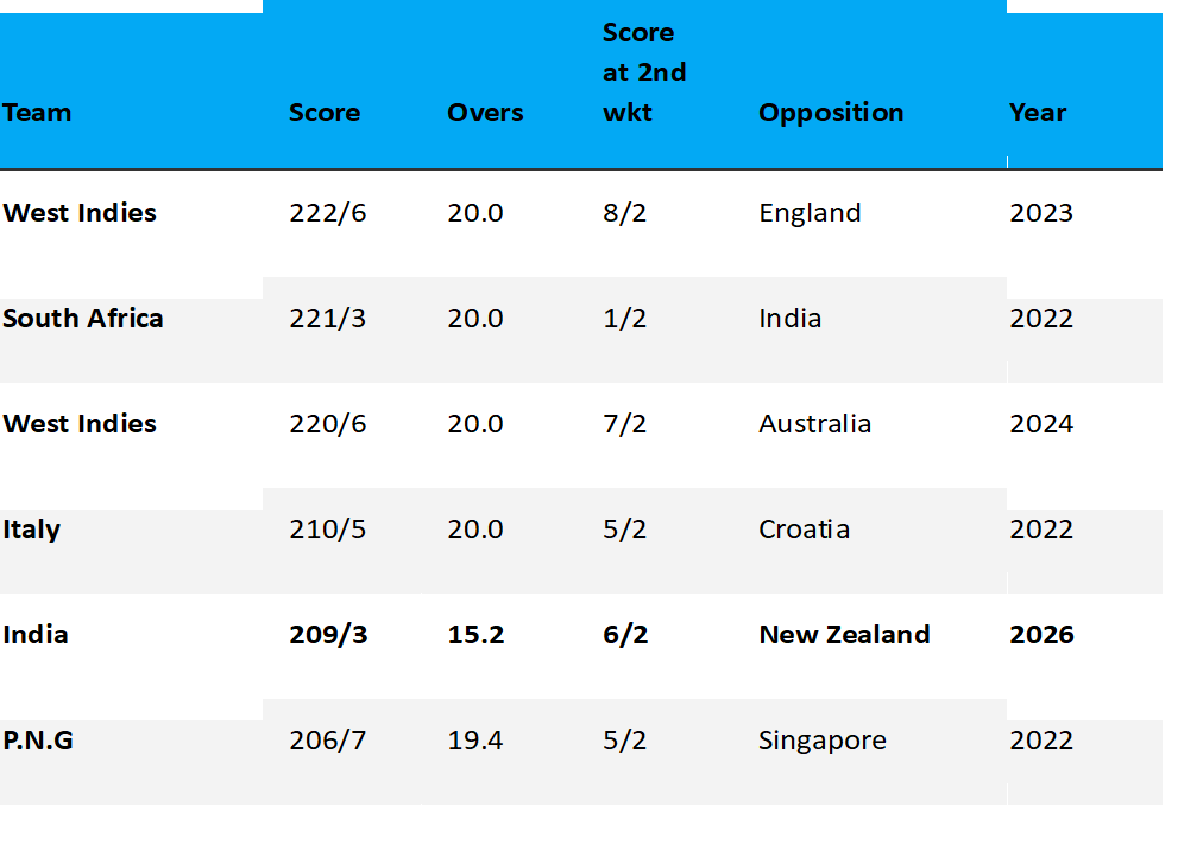
😱 India Were 2 Down for Less Than 10 Runs — And Still Won
One of the most jaw-dropping statistics from the match is this:
India became only the second team in men’s T20I history to successfully chase a 200-plus target after being two wickets down for fewer than 10 runs.
The only other team to achieve this feat was Papua New Guinea, who chased 204 against Singapore in 2022 after being 2 for 5.
A Rare and Historic Recovery
Even more incredibly, India and PNG are the only teams ever to chase 200+ in T20Is after their openers combined for fewer than 10 runs.
This highlights not just individual brilliance, but also the depth and resilience of India’s batting lineup. Losing both openers early usually places enormous pressure on the middle order, but Kishan and Suryakumar absorbed that pressure and turned the game completely around.
⚡ Fastest 200+ Chase by a Full-Member Team
India completed the chase in just 15.2 overs, making it the third-fastest 200+ chase in men’s T20I history.
More importantly, it became the fastest such chase by a Full-Member team, surpassing Pakistan’s 205-run chase in 16 overs against New Zealand in Auckland last year.
Why Overs Taken Matter
In T20 cricket, the speed of a chase reflects dominance. Not only did India reach the target, but they did so with over 28 balls to spare, sending a clear message about their aggressive batting philosophy.
Such rapid chases demoralize opposition bowling attacks and reshape tactical thinking around defending big totals.
🔁 India’s New Trend: Massive Recoveries After Early Setbacks
Another fascinating statistic from this series:
Before the New Zealand series, India had never scored 200-plus runs in a T20I after losing their second wicket.
But in this series alone:
- In the first T20I, India scored 211 from 27/2
- In Raipur, they added 203 runs from 6/2
This shows a clear tactical shift — India are no longer playing conservatively after early wickets. Instead, they’re trusting their batting depth and attacking instincts, redefining what recovery looks like in T20 cricket.
🇳🇿 New Zealand: On the Wrong Side of History Again
Unfortunately for New Zealand, this match added to an unwanted record.
They have now been on the receiving end of five successful 200-plus chases in men’s T20Is, tied with South Africa and behind only West Indies (seven).
While New Zealand are traditionally known for disciplined bowling and strong fielding, this trend suggests growing challenges in defending large totals, particularly on batting-friendly surfaces in subcontinental conditions.
💣 Zak Foulkes’ Nightmare Spell: One of the Costliest in T20I History
A major contributor to India’s dominant chase was New Zealand bowler Zak Foulkes, who endured one of the toughest spells ever recorded in men’s T20 internationals.
- Figures: 3 overs, 67 runs conceded
- Economy rate: 22.33 runs per over
- Second-worst economy rate ever for any bowler delivering three or more overs in men’s T20Is
- Most runs conceded by a New Zealand bowler in a men’s T20I, surpassing Ben Wheeler’s 64 runs in 2018
The only worse economy rate belongs to Musa Jobarteh of Gambia, who conceded 93 runs in four overs (23.25 economy) against Zimbabwe in 2024.
What Went Wrong?
Foulkes struggled with his length and pace, offering slot balls that were punished mercilessly by Kishan and Suryakumar. On a pitch offering little assistance to bowlers, any marginal error was enough to send the ball into the stands.
This spell alone shifted momentum decisively in India’s favor, making the chase not just achievable — but comfortable.
📊 Powerplay Domination: Setting the Tone for Victory
India’s approach in the powerplay overs was fearless, despite losing early wickets. Kishan’s aggressive intent neutralized the psychological advantage New Zealand gained from early breakthroughs.
By scoring 56 runs in the powerplay, Kishan ensured that India stayed ahead of the required run rate, forcing New Zealand’s bowlers into defensive lines that were repeatedly punished.
In modern T20 cricket, the powerplay is often described as the most crucial phase of the innings — and Kishan turned it into a personal highlight reel.
🧠 Tactical Evolution of India’s T20 Strategy
This match was more than just a thrilling victory — it reflected India’s strategic evolution in T20 cricket.
1️⃣ Fearless Batting Philosophy
India no longer rebuilds cautiously after early wickets. Instead, they encourage batters to maintain high strike rates, trusting the batting depth that follows.
2️⃣ Role Clarity
Kishan played the aggressor’s role while Suryakumar anchored with controlled explosiveness — a perfect blend that kept the chase on track without sacrificing momentum.
3️⃣ Match Awareness
Rather than blindly attacking every ball, Suryakumar smartly targeted specific bowlers, especially during the middle overs, ensuring that pressure never swung back toward New Zealand.
🌍 What This Match Means for Global T20 Cricket
Matches like these redefine what teams believe is possible in T20 cricket.
Earlier, a 200-plus target, especially after losing early wickets, was almost considered game over. But performances like India’s in Raipur prove that:
- No total is safe
- Middle-order depth can outweigh opening stability
- Strike rate matters more than preserving wickets
These trends are influencing how teams build squads, select batting orders, and plan powerplay strategies.
👏 Individual Milestones Summary
Let’s recap the key personal achievements from this match:
🔥 Ishan Kishan
- Fastest fifty by an Indian vs New Zealand in T20Is (21 balls)
- Second-most powerplay runs by an Indian in men’s T20Is (56)
- Among the very few non-openers globally to score a powerplay fifty
🌟 Suryakumar Yadav
- Ended 23-innings drought without a fifty in T20Is
- Scored unbeaten 82 in a massive chase
- Joint-most fifty-plus scores in 200+ T20 chases globally (10)
🇮🇳 Team India
- Joint-highest successful chase in T20Is (209)
- Fastest 200+ chase by a Full-Member team (15.2 overs)
- Only second team ever to chase 200+ after losing two wickets inside 10 runs
🇳🇿 New Zealand
- Fifth time conceding a successful 200+ chase
- Bowler Zak Foulkes recorded one of the costliest spells in T20I history
🏆 Why This Match Will Be Remembered
The Raipur T20I will go down as one of India’s most dominant and historic batting performances in international cricket. It combined:
- Raw power (Kishan’s assault),
- Mental resilience (Suryakumar’s recovery),
- Tactical evolution (fearless middle-order batting),
- And statistical milestones (record chases and fastest fifties).
More than the records, though, it was the manner of victory — chasing 209 after losing two wickets early and finishing in just 15.2 overs — that captured imaginations across the cricketing world.
📌 Final Thoughts
This match underlined that India’s T20 setup is entering a bold new phase. The team is no longer overly dependent on openers, nor cautious after early setbacks. Instead, they trust their batting depth, encourage aggression, and back players like Ishan Kishan and Suryakumar Yadav to play natural, fearless cricket.
For New Zealand, it served as a reminder that defending totals in modern T20 cricket requires not just skill but adaptability and precision — especially on flat pitches where even minor errors are punished.
As cricket continues to evolve, matches like this redefine expectations and push teams to rethink strategy, proving once again why T20 remains the most exciting and unpredictable format of the game.
Related Posts