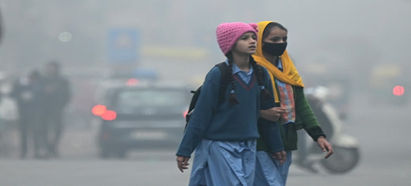
Colder-than-usual winter forecast for NCR; advisory issued for Delhi and adjoining cities
Get ready — this winter could feel different. Weather scientists warn that La Niña, a global climate phenomenon, may return later this year, potentially bringing a colder-than-normal season to India.
What is La Niña?
La Niña is the cooler counterpart of El Niño in the El Niño–Southern Oscillation (ENSO) cycle. It occurs when Pacific Ocean surface waters become cooler than average. Though it begins far away, its effects reach worldwide — from altering rainfall in the Americas to intensifying cold waves in Asia. For India, La Niña winters often mean harsher cold spells, heavier frost, and increased snowfall in northern regions.
The Latest Forecast
On September 11, the US Climate Prediction Center issued a La Niña Watch, estimating a 71% chance of its development between October and December 2025. The probability dips slightly to 54% for December 2025–February 2026, but the risk remains.
In India, the IMD has also flagged the possibility. Current conditions are neutral, but its climate models indicate that La Niña could set in after the monsoon.
“Our models show over a 50% chance of La Niña forming between October and December,” said a senior IMD official. “La Niña years are usually associated with colder winters in India, though climate change can sometimes soften the effect.”
Private Forecasts Still Watchful
Skymet Weather’s GP Sharma agrees that a weak or short-lived La Niña can’t be ruled out. He noted that the Pacific Ocean is already showing cooler trends, though not yet at La Niña levels.
“If temperatures dip below -0.5°C anomalies for three continuous overlapping quarters, we officially declare La Niña,” Sharma explained. “We saw a brief spell of it in late 2024 before conditions turned neutral again.”
Even without fully meeting the criteria, Sharma said the ongoing cooling could still influence global weather, triggering sharper cold waves and heavier snowfall across north and Himalayan India.
Science Confirms the Link
A 2024 study by IISER Mohali and Brazil’s National Institute for Space Research found a clear connection between La Niña and severe cold waves in north India. Researchers explained that during La Niña, unusual wind patterns pull icy air from higher latitudes into India, increasing the strength and frequency of cold wave events.
In short: La Niña winters hit harder — and this year, India may be in for one.
Related Posts