Bill Gates Lists the Only Three Jobs Safe From AI — And They’re Not Surgeons or Chefs
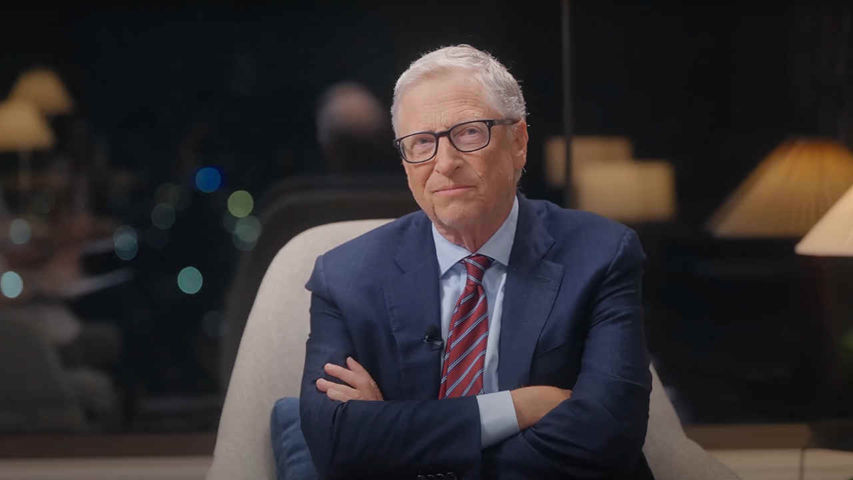
Bill Gates Reveals the Only Three Jobs AI Can’t Replace — For Now
New York, November 3 (Tech Desk):
Artificial intelligence has already begun rewriting the global job market — and even Bill Gates admits that no one truly knows how quickly things are changing. In a recent interview with CNN, the Microsoft cofounder cautioned that AI’s pace of improvement has outstripped most predictions, warning that entire job sectors could vanish before workers have time to adjust.
“It’s improving at a rate that surprises me,” Gates said, revealing that he personally tests AI systems several times each day and is often “shocked” by how detailed and accurate their answers have become.
The billionaire’s comments echo growing anxiety in Silicon Valley and beyond. Tech leaders, economists, and policymakers are all racing to understand how AI will reshape the economy — and who will be left behind.
AI’s Rapid Acceleration Alarms Even Its Creators
Gates’ remarks come amid what many experts are calling a turning point in the digital revolution. Artificial intelligence, once confined to academic labs and experimental projects, is now writing marketing copy, composing code, managing customer service desks, and even generating legal drafts — all with increasing precision.
The transformation is happening so quickly that even the people building AI systems are struggling to keep up. Anthropic CEO Dario Amodei, whose company develops the Claude AI model, recently warned that half of all entry-level white-collar roles could vanish within five years.
Across major corporations, automation is already taking a visible toll. IBM has eliminated around 8,000 HR positions, citing AI efficiencies. Meta’s CEO Mark Zuckerberg has openly discussed building an “AI engineer” capable of performing technical work at human level.
Amazon CEO Andy Jassy has also told employees to expect smaller corporate teams as artificial intelligence begins to replace routine programming and managerial tasks.
What concerns Gates most, however, is not what AI can already do — but how little time people may have to adapt to the next leap.
“The real question,” Gates said, “is whether it’s happening so fast that we don’t get a chance to adjust.”
Millions of Jobs Potentially on the Line
Studies appear to back that fear. Economists at Goldman Sachs estimate that AI technologies could automate the equivalent of 300 million full-time jobs worldwide. Roles involving repetitive or predictable work — from telemarketing and data entry to administrative support — are among the first to be replaced.
And yet, there’s little consensus about what comes next. Some researchers predict that AI could reach near-human reasoning abilities within a few years; others say that milestone might still be decades away.
What most agree on is that the shift is happening faster than any prior industrial transformation — and the social and economic consequences could be enormous.
Three Professions That Still Have an Edge
Despite the chaos, Gates believes a few jobs still have a defensive moat — at least for the foreseeable future. He points to three areas where human expertise remains indispensable: software development, energy systems, and biology.
1. Software Developers:
Ironically, the people building AI itself are among those best positioned to survive it. Although AI can now generate and debug code, it still lacks responsibility and context. Human engineers are required for system design, large-scale architecture, and verifying the reliability of machine-generated output. “AI can assist, but it still needs humans to supervise and repair what it creates,” Gates explained.
2. Energy Experts:
The second resilient field, according to Gates, lies within the global energy sector. From managing nuclear plants to maintaining renewable energy grids, the complexity and safety stakes are simply too high for total automation. “Would you really trust an AI to operate an entire power grid without any human checks?” Gates asked rhetorically. Most people, he added, would not.
3. Biologists:
Finally, Gates believes biologists are safe — though only temporarily. While AI can read genomes and detect diseases faster than any human, scientific discovery still depends on intuition and curiosity. “AI can process data,” he said, “but it can’t dream up hypotheses or interpret the unknown in the way scientists do.” Human creativity, for now, remains an irreplaceable ingredient in biological research.
A Shorter Workweek — or a Shrinking Workforce?
In the same interview, Gates floated one of his more optimistic predictions: that AI could eventually allow societies to transition to a three-day workweek. By dramatically boosting productivity, he suggested, economies could enable people to spend more time on leisure, education, or family.
“When productivity rises, you can choose to work less — smaller class sizes, longer vacations, more balance,” Gates said.
However, this optimistic vision comes with a darker mirror image. If AI eliminates millions of jobs before economies adapt, many workers could be left behind altogether. Entry-level positions — traditionally the training ground for future managers and executives — are disappearing fastest. Without these stepping stones, younger professionals face shrinking opportunities for advancement.
A 2025 McKinsey & Company survey found that 42% of Gen Z graduates already believe AI has reduced their career prospects. Many major companies are hiring AI specialists while simultaneously cutting back on traditional graduate programs, leaving fewer openings for newcomers to gain experience.
The Uncertainty Problem
Despite countless forecasts, no one knows exactly where the AI trajectory leads. Some experts believe “artificial general intelligence” — systems capable of reasoning like humans — could emerge before the end of this decade. Others argue such fears are exaggerated, claiming we’re still decades away from that level of autonomy.
Gates himself admits uncertainty. He has long supported AI development through Microsoft’s partnerships with OpenAI and other research ventures, but he acknowledges that the pace of change is unsettling even to him.
“I could be wrong about which jobs survive,” he said. “The concern is the speed of change — it might outpace how quickly societies can retrain people.”
As technology advances exponentially, skills that were valuable just a few years ago are becoming obsolete at record speed. The result, analysts warn, could be a growing mismatch between the skills employers need and the ones workers possess.
Preparing for the Next Phase
Economists say the best defense against AI disruption is adaptability — continuous learning, cross-disciplinary skills, and the ability to work alongside intelligent systems rather than compete with them.
Automation will likely erase many low- and mid-skill jobs, but it will also create new ones in data ethics, AI regulation, cybersecurity, and system design. However, the transition may be painful and uneven, with some regions and industries facing far greater upheaval than others.
Gates believes governments and educational institutions need to move faster. “The schools that are teaching traditional skills need to start integrating AI literacy,” he said in earlier remarks. “Understanding how these systems work — and where they fail — is going to be essential.”
The Bigger Picture
While the spotlight often falls on the potential dangers of AI, many economists still argue that the technology’s productivity benefits could outweigh its immediate disruptions. By taking over mundane and repetitive tasks, AI could allow humans to focus on creative, interpersonal, and high-value work.
Still, that future depends on how society manages the transition. Without effective retraining programs and social safety nets, large portions of the population could be left unemployed or underemployed — widening the gap between those who can adapt and those who cannot.
Gates, who has spent decades funding global education and technology initiatives, has repeatedly emphasized that innovation must serve human progress, not replace it. “AI should empower people, not make them obsolete,” he said. “If we plan carefully, it can improve quality of life everywhere.”
Conclusion
As artificial intelligence races ahead, uncertainty looms over the global workforce. Bill Gates’ warning serves as both a caution and a call to action: adapt quickly, or risk being overtaken by the technology you use.
For now, software developers, energy professionals, and biologists may hold some of the last strongholds where human judgment still prevails. But even those fields are evolving fast.
The billionaire’s message is clear — no one is immune to the coming transformation. Whether AI becomes humanity’s greatest ally or its toughest competitor will depend not on the machines, but on how we choose to respond.
Related Posts