Annular Solar Eclipse on February 17: When Will It Occur and Where Can It Be Viewed?
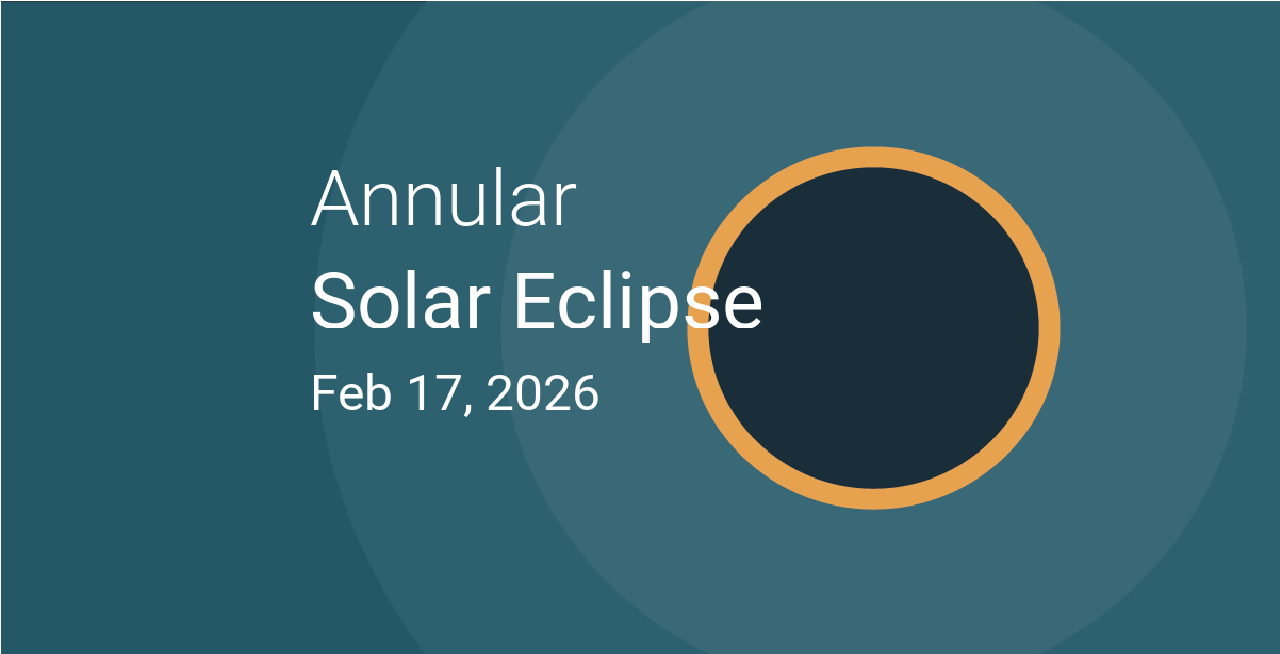
Annular Solar Eclipse on February 17, 2026: Date, Timings, Visibility and What Makes It Special
Skywatchers are in for a remarkable celestial treat on Tuesday, February 17, 2026, when the first eclipse of the year takes place. This event will not be just any ordinary eclipse—it will be an annular solar eclipse, often called the spectacular “Ring of Fire.” Astronomers and space enthusiasts across parts of the Southern Hemisphere will witness one of the most photogenic astronomical phenomena visible from Earth.
Unlike a total solar eclipse, where the Sun is completely covered, this event will produce a dramatic glowing ring in the sky. The sight of a bright halo surrounding a darkened Sun makes annular eclipses particularly mesmerizing and widely photographed.
An annular solar eclipse occurs when the Moon moves directly between the Earth and the Sun but does not completely block the Sun’s disk. This happens because the Moon is slightly farther away from Earth in its orbit at that time, making it appear smaller in the sky. As a result, it cannot fully cover the Sun.
Instead, when alignment is nearly perfect, the Moon obscures up to 96% of the Sun’s visible surface—leaving a brilliant ring of sunlight visible around the edges. This glowing circle is why the phenomenon is popularly known as the “Ring of Fire.”
From a scientific standpoint, a solar eclipse takes place when the Moon’s shadow falls on Earth. However, the shadow does not cover the entire planet uniformly. Only those located within a narrow path—known as the annular path—can see the full ring effect. Observers outside this path will see only a partial solar eclipse.
Why This Eclipse Is Special
The February 17, 2026 eclipse stands out for several reasons:
- It is the first eclipse of 2026.
- It will produce a near-complete solar covering (about 96%).
- It will primarily be visible from remote and dramatic landscapes in the Southern Hemisphere, including Antarctica and surrounding oceans.
- Its “Ring of Fire” effect makes it highly photogenic and scientifically significant.
Because annular eclipses require very precise alignment, they do not happen every year in the same regions. This makes the event particularly noteworthy for astronomers and eclipse chasers.
Date and Universal Timings of the Eclipse
The annular solar eclipse will occur on Tuesday, February 17, 2026. The exact viewing time depends on geographical location, as the Moon’s shadow travels across specific parts of Earth.
Below are the official timings in Universal Time (UT):
- Partial eclipse begins: 09:56 UT
- Annular phase begins: 11:42 UT
- Maximum eclipse: 12:12 UT
- Annular phase ends: 12:41 UT
- Partial eclipse ends: 14:27 UT
Local Timings by Region
To make it easier for observers, here are corresponding local times in selected locations:
When the Partial Eclipse Begins (09:56 UT)
- Argentina and Chile: 06:56
- Colombia and Miami: 04:56
- Mexico: 03:56
- Spain: 10:56
When the Annular Phase Begins (11:42 UT)
- Argentina and Chile: 08:42
- Colombia and Miami: 06:42
- Mexico: 05:42
- Spain: 12:42
Maximum Eclipse (12:12 UT)
- Argentina and Chile: 09:12
- Colombia and Miami: 07:12
- Mexico: 06:12
- Spain: 13:12
Annular Phase Ends (12:41 UT)
- Argentina and Chile: 09:41
- Colombia and Miami: 07:41
- Mexico: 06:41
- Spain: 13:41
Partial Eclipse Ends (14:27 UT)
- Argentina and Chile: 11:27
- Colombia and Miami: 09:27
- Mexico: 08:27
- Spain: 15:27
These time variations highlight how the Moon’s shadow moves across Earth rather than affecting all regions simultaneously.
Regions Where the Annular “Ring of Fire” Will Be Visible:
- Remote areas of Antarctica
- Southern regions of the Southern Ocean
Observers located directly within this narrow annular path will witness the full ring effect.
Regions Where It Will Appear as a Partial Eclipse:
- Southern tip of South America
- Parts of southern Africa
- Sections of the Pacific Ocean
- Portions of the Atlantic Ocean
- Areas of the Indian Ocean
- Most of Antarctica
In these areas, viewers will see the Moon partially covering the Sun but not forming a complete ring.
Why Visibility Is Limited
The Earth rotates while the Moon orbits it, and the Moon’s shadow is relatively small compared to Earth’s surface. Therefore, the annular path forms a thin corridor that sweeps across specific geographic regions.
This particular eclipse’s path largely crosses remote oceanic and polar regions. That means only a limited number of people will experience the full annular effect directly from land.
However, many global observatories and space agencies are expected to stream the event live, allowing viewers worldwide to watch the phenomenon virtually.
Scientific Importance of the Event
Solar eclipses provide valuable opportunities for scientific research. Even though annular eclipses do not completely block the Sun (unlike total eclipses), they still allow researchers to:
- Study the Sun’s outer atmosphere
- Analyze solar radiation changes
- Observe temperature and atmospheric shifts
- Test astronomical equipment and models
Additionally, eclipses inspire public interest in astronomy and science education.
Safety Measures for Viewing
It is extremely important to remember that looking directly at the Sun during an eclipse—even when most of it is covered—can cause permanent eye damage.
Safe viewing methods include:
- Certified solar eclipse glasses
- Solar filters for telescopes and cameras
- Indirect viewing methods such as pinhole projectors
Regular sunglasses are not safe for eclipse viewing.
Annular vs Total Solar Eclipse
Many people confuse annular and total solar eclipses. The key difference lies in the Moon’s distance from Earth:
- Total solar eclipse: Moon appears large enough to completely cover the Sun.
- Annular solar eclipse: Moon appears slightly smaller, leaving a bright ring visible.
Because the Moon’s orbit is elliptical, its distance from Earth changes. When it is farther away, annular eclipses occur.
A Rare Opportunity for Southern Hemisphere Observers
Eclipse paths vary greatly from one event to another. While North America experienced major eclipses in recent years, this February 2026 event largely favors remote southern regions.
For researchers stationed in Antarctica or explorers in southern oceanic territories, this will be a particularly rare opportunity to witness an annular eclipse from unique landscapes.
The Visual Impact: Why It’s Called the “Ring of Fire”
The phrase “Ring of Fire” perfectly describes the dramatic visual effect created during the peak of the annular phase. As the Moon aligns centrally with the Sun, a brilliant ring of light forms around the dark lunar silhouette.
The sky may dim slightly, though not as dramatically as during a total eclipse. Shadows can appear sharper, and the sunlight may take on an unusual quality. Photographers often describe annular eclipses as surreal and otherworldly.
Global Interest and Anticipation
Although the annular path crosses remote areas, the event is generating global interest among astronomers and sky enthusiasts. Modern technology allows real-time tracking, satellite imaging, and high-definition livestreaming of celestial events.
For many, this eclipse marks the beginning of an exciting year in astronomy.
Conclusion
The annular solar eclipse of February 17, 2026 promises to be one of the most striking astronomical events of the year. Occurring when the Moon covers approximately 96% of the Sun’s visible surface, the eclipse will create a stunning “Ring of Fire” effect for observers located within a narrow path across Antarctica and the Southern Ocean.
Beginning at 09:56 UT and reaching maximum at 12:12 UT, the event will unfold over several hours, offering both annular and partial viewing opportunities depending on location.
While visibility is limited mainly to parts of the Southern Hemisphere, global audiences will still be able to follow the phenomenon through scientific broadcasts and online platforms.
As always, safe viewing precautions are essential. With proper preparation, this celestial spectacle will provide both scientific insight and unforgettable visual beauty—reminding us once again of the dynamic relationship between the Earth, the Moon, and the Sun.
Related Posts